
Table of contents
TL;DR
- Manual SEO tasks drain time and limit growth.
- Automation tackles keyword research, content, and backlinks.
- Software like SEOLadders reduces human workload.
- Compare automation platforms before choosing your tool.
You’ve tried doing it all yourself: building SEO topic lists in spreadsheets, keeping up with constant algorithm updates, and juggling endless content drafts. Despite this, your search visibility can still stall. For founders and marketing teams without a dedicated SEO specialist, this workload quickly becomes hard to manage alongside other business demands.
This article explains why managing SEO tasks manually is overwhelming. It also shows how software like SEOLadders automates everything from keyword research to content creation and backlink management. Today’s automation platforms replace repetitive manual work with tools that deliver daily, optimized results. This lets you focus on growth instead of busywork.
What Is Managing SEO Tasks Manually?
Manual SEO management means handling every core task without automation, from keyword research to content optimization and backlink outreach. For many teams, this approach quickly becomes burdensome as site scale and search complexity increase.
Keyword research and rank tracking by hand
Manual keyword research and rank tracking require ongoing data collection and maintenance that quickly outstrip what one person (or a small team) can handle as a website grows. This process typically involves brainstorming potential search terms, using standalone keyword suggestion tools, and tracking rankings manually in spreadsheets.
- Tedious data collection — Teams must copy data from sources like Google Search Console and external keyword tools into local sheets.
- Constant update cycle — Every notable change in site content or rankings means another round of manual checks.
- Error-prone tracking — With hundreds of keywords and shifting SERP results, accuracy is hard to maintain.
According to SEOMind.biz, early SEO work meant building keyword lists and tracking positions manually, but today, the sheer volume of tasks makes this approach unsustainable for all but the smallest projects. For a better alternative, platforms like the Keyword Ideas Generator can automate discovery and tracking.
Content optimization and publishing workflows
Optimizing content and running publishing workflows by hand involves a sequence of disconnected, repetitive steps. Teams review competitor content, manually audit existing pages, compile optimization suggestions, and then implement every change step-by-step before updating the website.
- Siloed tasks — Writers and editors must coordinate changes through emails or shared documents, with limited visibility.
- Manual scheduling — Publishing content is often dependent on individual reminders or basic calendar tools.
- Editing bottlenecks — Without workflow automation, a single delay or missed step by one team member can stall the entire publication pipeline, causing content to pile up in review or miss important deadlines.
This disconnected process means even high-quality content can get stuck in review or miss critical on-page SEO steps. Automation, as discussed in how articles are written, reduces such delays and improves output consistency.
Backlink building and monitoring without automation
Running backlink outreach and monitoring link health without automation is labor-intensive and leads to slow progress. Teams research potential partners, draft outreach emails manually, log responses, and then track acquired links through ongoing checks or basic spreadsheets.
- Laborious prospecting — Every new potential backlink target must be researched, vetted, and added to a list, usually with no reuse across campaigns, which wastes time and duplicates effort.
- Reactive monitoring — Lost links and changes are often discovered only after drops in rankings, not proactively, leaving sites vulnerable to sudden SEO performance issues.
- Inefficient relationship management — The outreach process becomes repetitive, and tracking conversations over time is likely to break down, resulting in missed follow-ups, inconsistent communication, and lost opportunities for building lasting partnerships.
In practice, solo founders and lean teams often struggle to maintain momentum here, so many turn to automated backlink solutions for scale as site demands grow.
Expert Insight: Attempting to scale manual SEO workflows often leads to missed opportunities, delays, and bottlenecks that slow down results, highlighting why automation is no longer optional for growing sites.
How Does Automation Simplify Overwhelming SEO Work?
Automation transforms the most time-consuming manual SEO tasks into streamlined, repeatable processes. Here's an inside look at how software makes keyword research, content creation, and link building far less overwhelming for founders and lean marketing teams.
Step-by-step: Automated keyword research and tracking
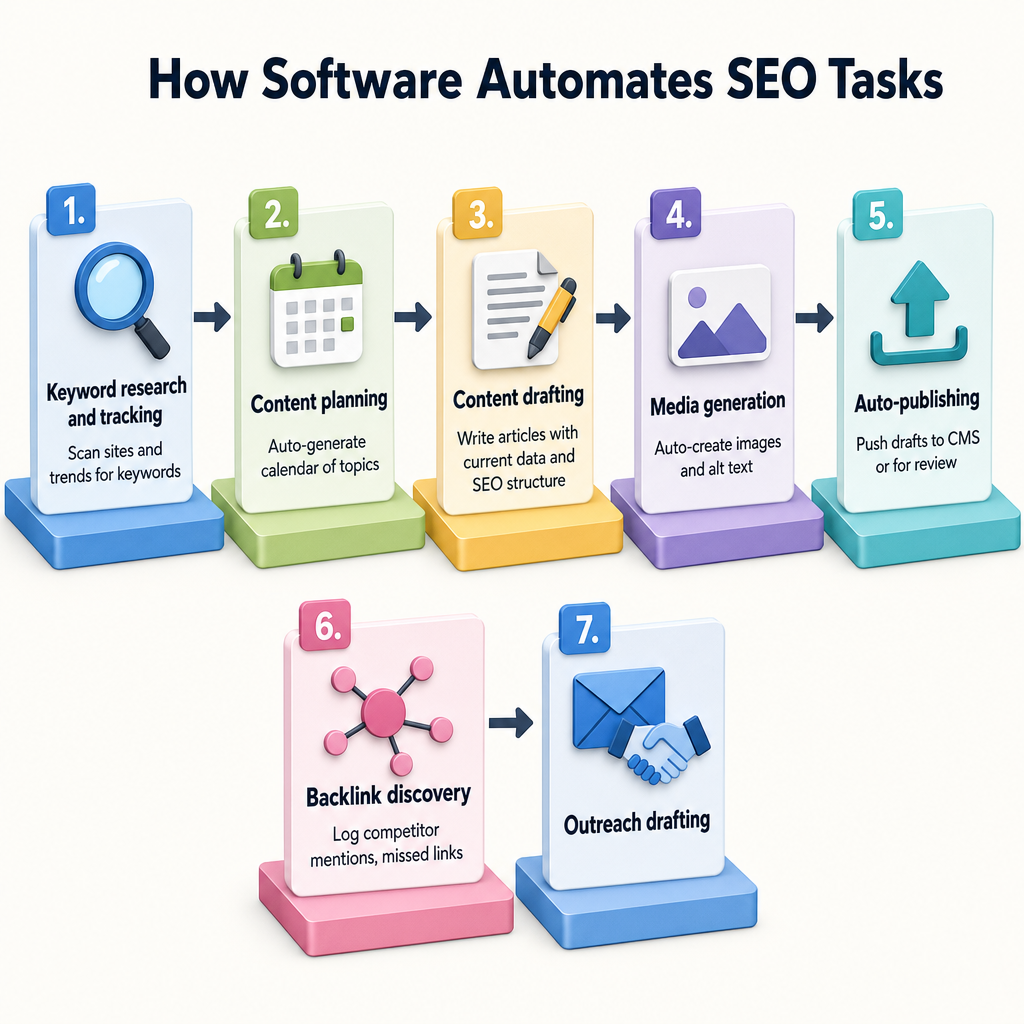
Automated keyword research and tracking replace endless spreadsheets with a data-driven engine that identifies opportunities and measures ranking changes on autopilot. Instead of manually pulling keywords from various tools or guessing what buyers are searching for, automation platforms scan your site, your competitors, and live search trends to surface high-impact keywords.
Step-by-step: Content creation and publishing automation
Automated content creation turns a planned topic list into publish-ready, optimized articles without waiting on outlines or freelancers. Modern software ingests your brand's factual source pages then drafts new content aligned to pre-set SEO and AI optimization rules.
- Article planning: The system fills a calendar with titles and topics based on market gaps and current site coverage.
- Content drafting: Each article is written with current data, competitive analysis, schema markup, internal linking, and AI-friendly structure—no manual research needed.
- Image and media generation: Cover images, infographics, and diagrams are auto-generated or selected, complete with optimized alt text and proper attribution for SEO and accessibility compliance.
- Auto-publishing: Finished drafts go straight to your CMS or webhook for instant publication, or can await your review.
Step-by-step: Backlink monitoring and outreach flow
Automated backlink workflows identify high-value link opportunities and reduce manual emailing to a minimum. Rather than trawling through backlink tools and crafting cold outlines, automation highlights sites that mention your market or competitors but skip your brand.
- Backlink opportunity discovery: The platform logs every page that cites a competitor or appears in AI model answers but omits you.
- Outreach drafting: Personalized pitch emails are composed by the system and readied for your inbox, so you only need to review and send.
- Link exchange: For brands preferring less outreach, automated exchanges match you with other relevant sites without direct swaps.
- Monitoring and tracking: Every placed link is checked regularly, with lost links flagged and anchor types recorded for analysis.
Expert Insight: Automating core SEO tasks doesn't eliminate the need for human judgment—reviewing drafts and prioritizing outreach targets ensures each action aligns with your brand goals.
Managing SEO Tasks Manually Is Overwhelming. How Can Software Help?
Manual SEO quickly becomes unmanageable as requirements and data points multiply. Software steps in to make the process scalable, targeted, and less prone to bottlenecks.
Why manual management doesn’t scale
Manual SEO task management becomes unmanageable as websites, keywords, and competitors multiply. Each new target keyword, backlink, or audit issue adds layers of complexity that demand constant attention. Teams often struggle when trying to coordinate topic research, content calendars, on-page changes, and link outreach from spreadsheets and scattered tools.
For example, a startup founder reported spending over 20 hours per week just tracking keyword rankings and content updates manually, which left little time for strategic growth. Missed deadlines and overlooked audit issues resulted in a 15% drop in organic traffic over six months.
Typical pain points include:
- Ever-growing checklists — More keywords and competitors mean more tracking and reporting work.
- Slow feedback loops — Waiting for rankings to change delays decisions and corrections.
- Error-prone handoffs — Multiple people reworking the same page increases the odds of mistakes or duplicate effort.
As a result, even simple SEO tasks bog down teams, making it hard to keep up with new search trends or algorithm shifts. For anyone who has experienced this, solutions like SEOLadders are designed specifically to address these scaling pain points.
How automation corrects common bottlenecks
SEO automation eliminates the repetitive and time-consuming steps that stall manual workflows. Tools like SEOLadders automate everything from keyword research to content publishing, freeing teams from day-to-day drudgery.
Automation can:
- Schedule and publish content automatically — No more manual posting or missed deadlines
- Run regular site audits and surface only priority issues — Automated reports show only what’s actionable, not a giant list of noise
- Draft outreach for backlinks and track outcomes — Email templates and partner link exchanges reduce outreach hours
- Feed live data from Google Search Console and AI search engines — Alerts flag gaps in ranking or AI visibility, as described in SEOLadders’ detailed process
The result is a consistent, data-driven workflow that prioritizes results while removing busywork.
Case: What to automate versus keep human
Not every SEO task benefits from full automation; some require human strategy and approval. A common approach is to automate high-volume, repeatable actions and surface the tasks that need creative or sensitive input for user review.
Examples:
- Automate:
- Keyword topic mapping and clustering
- Drafting and scheduling articles
- Detecting and flagging technical SEO issues
- Drafting outreach emails
- Keep human:
- Approving final content before it is published
- Deciding which competitor or buyer AI prompts matter most
- Handling high-stakes link negotiations or sensitive brand updates
SEOLadders uses this blended model: it publishes routine articles and audits, then assembles only critical fixes or outreach for manual review.
Expert Insight: The most efficient SEO workflows use software to handle 80-90% of production work but loop in humans for high-impact decisions, content review, and strategy shifts.
SEO Task Automation Tools Compared: What Stands Out?
Choosing the right automation platform means understanding which tools actually take work off your team's plate—and which still expect manual effort. Below is a direct comparison of the leading options for automating core SEO tasks.
SEOLadders: Full workflow automation
SEOLadders is designed to automate the entire SEO process—from topic research and planning to article writing, technical audits, publishing, and rank tracking—without the need for sustained manual input. Once connected, the platform maps all keyword opportunities across five pillar topics, generates 30 fully built articles per month (including AI-generated images and source citations), and publishes them directly to your CMS or holds drafts for approval.
All major SEO tasks are handled in one workflow:
Semrush, Ahrefs, Moz Pro, SE Ranking features
Semrush, Ahrefs, Moz Pro, and SE Ranking each offer distinct capabilities—none fully automate the process end-to-end. Semrush provides keyword and competitor research, rank tracking, content planning, backlink profiles, and digital PR. Ahrefs is known for its vast backlink index, site and keyword explorer, and SERP analytics. Moz Pro emphasizes research, domain and page authority metrics, and technical audits, while SE Ranking blends rank tracking, audit, and reporting across organic, AI, and social channels.
| Tool | Automation Depth | Entry Price | Key Workflows Supported |
|---|---|---|---|
| SEOLadders | High: AI-driven content creation & daily AI visibility tracking | $97/site/mo | Content briefs/articles, rank tracking, publishing via WordPress/Ghost/Webhooks (Webflow/Framer soon) |
| Semrush | Moderate: Keyword/competitor research, rank tracking, AI visibility varies by plan | $117.33/mo | Keyword research, rank tracking, content planning, backlink analysis, digital PR |
| Ahrefs | Moderate: Backlink and SERP analytics with optional Brand Radar AI add-on | $129/mo | Backlink profiles, site/keyword explorer, SERP analytics, rank tracking |
| Moz Pro | Moderate: Research and audits with GPT/Gemini AI by tier | $99/mo | Domain/page authority metrics, technical audits, content briefs (2–50 monthly), rank tracking |
| SE Ranking | Moderate: AI Search API for visibility + rank tracking and audit | $103.20/mo (annual) | Rank tracking, site audit, reporting across organic, AI, social channels |
Manual involvement is typically still required to produce and publish content on all platforms except SEOLadders.
Comparing costs, integrations, and automation depth
Pricing and workflow depth differ sharply across platforms. SEOLadders offers a single plan at $97 per site per month, including 30 articles, five team seats, all automated publishing and reporting features, and no upcharges for seats or feature unlocks. Full pricing details here.
In contrast, Semrush, Ahrefs, Moz Pro, and SE Ranking feature multi-tier pricing (see table above), often with usage caps and per-seat or per-feature add-ons. These platforms specialize in data and research, but the transition from insight to published content remains a manual job for your team or agency. Integrations differ: SEOLadders supports WordPress, Ghost, Webhook, and soon Webflow and Framer, automating the publishing flow. Most competitors do not list CMS integrations or workflows that eliminate manual copy-pasting or formatting.
Expert Insight: The biggest single time saver for most brands is not just research automation but eliminating manual content production—something only full-workflow tools like SEOLadders deliver.
Common Mistakes When Switching from Manual to Automated SEO
Automating SEO promises major time savings, but moving too quickly can introduce new problems if core principles get overlooked. Successful transitions require careful oversight and alignment at every step.
Neglecting strategy for the sake of speed
Skipping strategic planning during automation leaves gaps that tools can't fix on their own. Teams often rush to automate keyword research, content creation, and backlink outreach, but without a framework, the work can become disjointed and less effective. Strategic oversight is needed to set priorities, define target topics, and guide AI toward meaningful results.
- Content can drift off-topic if there's no topic map or clear pillar structure (see how topic clusters are mapped).
- Keyword selection may miss business intent when automation isn't guided by brand positioning.
- Backlink outreach becomes generic instead of targeted to real opportunities.
A successful switch to automation always starts with a concrete SEO roadmap that automation tools execute against—not the other way around.
Over-automation without reviewing AI output
Trusting automated content or technical changes without human review can create more problems than it solves. Even advanced platforms can generate articles, meta tags, or outreach emails that miss context, introduce factual errors, or repeat brand voice inconsistencies.
- AI-written articles may reference outdated info or misinterpret niche terminology unless checked before publishing.
- Automated technical SEO tweaks risk undoing custom setups or introducing new errors if applied blindly.
- Outreach drafts often need manual edits to fit the tone and expectations of specific industry contacts.
A robust workflow includes review stages. For example, SEOLadders allows drafts to be approved before going live, protecting brand quality (see how articles are written).
Failing to align tool output to business goals
Automating without clarifying business objectives results in SEO efforts that don’t move the metrics that matter. Automated tools perform their best work when fed clear guidance about target audiences, brand voice, and priority conversion goals. Without this alignment:
- Content calendars may prioritize the wrong topics, chasing search volume instead of growth or product adoption.
- SEO reporting can focus on vanity metrics rather than leads or sales impact.
- Link-building efforts may chase irrelevant domains instead of those serving the core audience.
Automation should reinforce business targets, not distract from them. During platform setup, connect core KPIs and review clusters regularly to verify everything is moving in the right direction. Using tools like SEOLadders, funnels and topic maps can be revisited as business needs evolve (Solutions).
Expert Insight: Build regular review checkpoints into your automated process—especially after the first few weeks—to catch content issues and recalibrate priorities before they snowball.
Frequently Asked Questions
Managing SEO tasks manually is overwhelming. How can software automate these workflows?
Software like SEOLadders automates SEO by handling keyword research, content planning, writing, publishing, backlink outreach drafting, and site audits. It performs tasks independently when possible and surfaces only urgent actions for user input, streamlining workflows and reducing manual effort while maintaining full editorial control.
What SEO tasks should not be automated?
SEO tasks requiring human judgment—like fixing high-impact issues, crafting nuanced outreach emails, addressing negative AI prompt framing, and adding your site to missed curated lists—should not be automated. These tasks need manual intervention to ensure strategic decisions and personalized communication. SEOLadders automates routine SEO tasks but surfaces such mandatory actions for users to handle directly, preserving necessary editorial control.
Which SEO tasks benefit the most from automation?
SEO tasks like keyword research, content creation, publishing, site auditing, and backlink outreach benefit most from automation. These are time-consuming and repetitive but can be streamlined by software like SEOLadders, which automates topic mapping, daily article writing, publishing to platforms (WordPress, Ghost, etc.), weekly audits, and drafting of outreach emails. This reduces manual workload while maintaining oversight on essential actions.
How do I choose the right SEO automation tool?
Choose an SEO automation tool that automates key tasks like keyword research, content creation, and backlink management while integrating with your CMS. Look for real-time audits, AI visibility tracking, prioritized task lists requiring minimal manual input, and seamless publishing options. SEOLadders, for example, offers all these features in one platform, plus personalized support and competitive pricing at $97/month per site.
Does automating SEO mean sacrificing content quality?
Automating SEO does not mean sacrificing content quality when the platform maintains thorough editorial control and context awareness. SEOLadders automates the creation and publishing of 30 optimized articles monthly, crafted with brand voice and supported by citations and images. Users review drafts before publication, ensuring quality while easing the burden of manual SEO tasks.
Conclusion
Manual SEO management ties up your time in admin and guesswork—while modern platforms like SEOLadders let you skip straight to the results you need. Among the solutions compared here, SEOLadders stands out for automating not just article planning and publishing, but also on-page optimization, AI visibility tracking, continuous page updates, and even drafting outreach for backlinks—all with a single subscription and direct founder support.
Here’s what to do next:
- Document which SEO tasks eat up most of your week
- Map out whether they can be automated today using a single software platform
- Start a free SEOLadders trial to see content, audit, and link tasks handled on autopilot
- Review the progress and decide if full automation matches your growth goals
There’s never been a better time to hand off your most tedious SEO work and reclaim time for strategy.
Ready to automate your most overwhelming SEO tasks? See how daily content, ongoing audit, and hands-off backlink management work with SEOLadders automation in action and start scaling your visibility today.
Want this done for you? SEOLadders finds the topics, writes the articles, and gets you cited by AI and ranking on Google, on autopilot.
7-day free trial · Cancel anytime