
Table of contents
TL;DR
- Clear methods to track website visibility on AI search platforms
- Explains distinctions between mentions, citations, and rankings
- Compares tools: SEOLadders, Semrush, Ahrefs, and more
- Highlights frequent mistakes and how to avoid them
I’m struggling to monitor how visible my website is—not just on Google, but on AI platforms like ChatGPT and Gemini where many buyers now turn for recommendations. I might see good rankings in traditional SEO tools, but I can’t tell if these AI assistants mention or link to my brand at all. This makes it hard to know if my website is actually reaching new customers where their decisions are being shaped. If you’re a founder, marketer, or part of a business team facing the same frustration, you’re not alone. The challenge goes beyond tracking traditional search rankings; it’s about understanding how AI search engines view and cite your site.
This article explains exactly how to measure and monitor your website’s presence across both major search engines and AI platforms. You’ll see why conventional SEO reports fall short, learn what “AI search visibility” really means, and get a practical, non-technical walkthrough of the best tools—including a spotlight on SEOLadders—for tracking and improving your standing. If getting cited by AI matters for your business, you’ll leave here knowing what works, what doesn’t, and the first steps to start seeing (and building) your brand’s footprint where these tools actually matter.
What Is AI Search Visibility?
AI search visibility describes how often your website or brand is named, cited, or recommended by AI-powered search engines and assistants. Understanding this visibility is essential because these AI answers are shaping how buyers discover solutions, beyond the reach of traditional SEO.
Brand Mentions vs. Content Citations
Brand mentions and content citations are two distinct signals used by AI search engines to determine a website's visibility. A brand mention occurs when an AI model references your business name directly in an answer, while a content citation usually means the AI links or points to a specific page or resource from your website.
These distinctions matter because not all AI engines treat them equally. For instance:
- Brand mention: "SEOLadders helps automate SEO and AI content publishing."
- Citation: "According to SEOLadders (See how it works), here are the steps…"
A direct mention can influence trust or authority in conversational answers, while a citation provides a verifiable source users can follow. Both forms count as AI visibility, but only citations provide a clear path back to your site, measurable through tools like the AI Visibility Checker.
AI Search Algorithms: How They Decide
AI search algorithms rely on sophisticated natural language processing (NLP) and semantics to determine which sites they name or cite in their answers. As highlighted by AIGeoElite, these models analyze massive datasets, infer user intent, and compare published content to user questions, favoring information that directly, clearly, and contextually matches the prompt.
Key factors influencing AI decision-making include:
- Topical coverage: Engines favor sources covering the full topic cluster, not just isolated keywords.
- Authority signals: Citations on trusted comparison sites and industry forums weigh heavily.
- Clarity and structure: Content that aligns with how real users phrase queries is prioritized.
Optimization for AI visibility means addressing these signals when planning and publishing content, not just optimizing for Google rankings.
Website Visibility Metrics Explained
Website visibility metrics measure how frequently your site or brand appears in AI search results, answer engines, or as a cited source. Traditional SEO looks at keyword rankings and organic impression share, but AI visibility needs additional layers: brand presence in AI answers, citation counts, and share-of-voice across competing brands.
According to Varun Digital Media, visibility metrics reflect the share of queries where your site or brand is presented to users. Typical metrics include:
- AI brand mentions (number of times your brand is named)
- Content citations (how often your site is used as a source)
- Share of voice (your brand's prevalence vs. competitors)
- Trend over time (whether presence is rising or falling per engine)
These metrics reveal both opportunities and content gaps, giving teams a roadmap for more strategic publishing.
Expert Insight: Direct brand mentions in AI search answers can build authority, but citations with links back to your site are what actually drive new traffic and measurable impact.
How Do I Monitor My Website's Visibility in AI Search?
Monitoring your website's visibility on AI-powered search engines requires tracking new metrics and using approaches built for emerging platforms. This section breaks down what to measure, methods for tracking, and how SEOLadders can help.
Essential Metrics to Watch
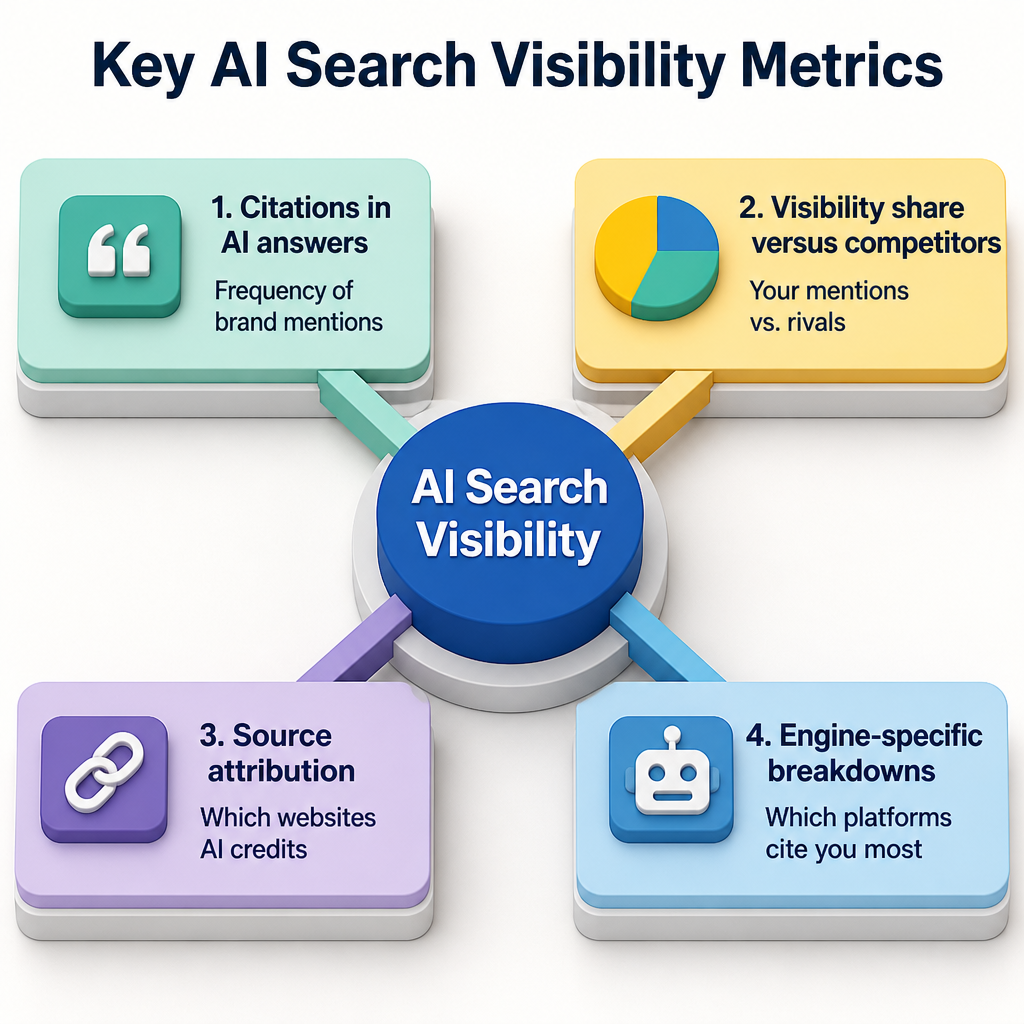
Key AI search visibility metrics provide a snapshot of your brand’s influence in conversational platforms and generative search.
- Citations in AI answers — To track how often your brand is named or recommended by AI engines like ChatGPT, Claude, Gemini, and Google AI Overview, start by setting up regular queries in these platforms using branded keywords and product names. For example, search prompts like “best [your product category]” or “reviews of [your brand]” can reveal AI-generated answers mentioning your brand. Use tools or manual logs to record each citation found over time. You can also create a simple spreadsheet to track the date, AI engine, prompt used, and whether your brand was cited. This helps you spot trends and measure growth in AI recognitions.
- Visibility share versus competitors — Measure your brand’s mention rate compared to direct rivals by running identical queries across multiple AI engines. For example, prepare a list of key questions relevant to your industry, such as “top [industry] solutions for [problem],” then note which brands appear and how often. Tools that compare share-of-voice in organic search may offer similar functionality for AI platforms. Compile this data to identify where competitors are gaining more visibility or which topics you are missing.
- Source attribution — Identify the websites or articles most often cited by AI models by examining the references or footnotes AI systems provide, especially in verbose answers. You can run your target queries and note which URLs or domains are repeatedly referenced as authoritative. Creating a citation log with source URLs will allow you to prioritize outreach efforts or backlink campaigns toward those domains to improve your own source authority.
- Engine-specific breakdowns — Track which platforms (e.g., ChatGPT vs.
Manual Tracking vs. Automated Tools
Manual tracking of AI search visibility is possible but time-consuming and prone to missed insights, which directly contributes to the struggle many face in understanding how visible their website really is.
Manual process:
- Query AI platforms — Begin by selecting a set of relevant queries that potential customers might use. Enter these manually into AI engines like ChatGPT or Google AI flagship models.
- Record answers systematically — For each query, copy and log the exact response. Note every instance where your brand or website is mentioned, including the position within the answer, and compare this with competitor mentions.
- Organize data in spreadsheets — Track this information over time in a structured format to observe trends or disappearances of mentions.
- Repeat on a consistent schedule — Perform this process weekly or monthly to capture changes and new opportunities, ensuring you use the same queries and platforms for consistency.
Limitations of manual tracking:
- Time-consuming and prone to error — This process demands significant effort and attention to detail. For example, missing a slight variation in phrasing or brand name spelling can cause important mentions to be overlooked.
- Incomplete coverage — It’s nearly impossible to cover all AI platforms comprehensively, especially as new models and updates emerge frequently. Manually checking several engines multiplies the workload exponentially.
- Lack of scalability — As the number of queries grows, manual updates become unsustainable, leading to gaps in visibility monitoring and delayed reactions to changes.
- Difficulty detecting trends and patterns — Without automation, analyzing long-term visibility shifts or competitor strategies across multiple datasets becomes cumbersome.
These challenges directly reflect why you’re struggling to monitor your website’s AI visibility effectively. Manual efforts tend to be inconsistent or partial, leaving you unsure if your brand’s presence is improving or slipping amidst rapid AI search evolution.
Automated tools, by contrast, offer scheduled prompts, reliable dashboards, and long-term trend analysis unavailable through manual methods. Teams often find these platforms essential once queries and sources multiply across engines. For an instant, one-off check, try the AI Visibility Checker.
SEOLadders: A Unified Monitoring Platform
SEOLadders automates AI search visibility tracking by running scheduled queries across six major AI engines and delivering detailed comparisons to competitors.
- Automated prompt tracking — The platform checks 30 buying questions three times weekly, analyzing if your brand is cited on ChatGPT, Claude, Gemini, Perplexity, and Google AI formats.
- Competitor and share-of-voice insights — Instantly see where you are mentioned or absent versus leading brands.
Expert Insight: High rankings in Google do not guarantee that AI search engines will recommend your brand—visibility must be directly measured across conversational platforms.
I’m Struggling to Monitor How Visible My Website Is—Why Is This So Hard?
Many teams find it surprisingly difficult to get a clear answer on their website's actual visibility in AI-powered search. The challenge runs deeper than just loading more reports—AI search behaves nothing like the Google rankings most are used to.
Volatility and Instability in AI Search
AI search volatility and Google ranking fluctuations stem from fundamentally different factors, creating distinct challenges for monitoring website visibility. Traditional Google rankings change due to algorithm updates, content modifications, or competitor activity, resulting in position shifts on a relatively stable set of search results. In contrast, AI-generated answers are recreated dynamically with each query, synthesizing information from thousands of sources in real time. This means instead of observing a fixed list of results shifting rank, each AI response can be entirely new and unpredictable. According to Over The Top SEO, this volatility is driven by the regeneration process, making AI visibility more unstable and less correlated with traditional SEO performance.
Key reasons this volatility throws off monitoring include:
Why Google Rankings Don’t Guarantee AI Visibility
A top spot in Google’s organic results doesn’t mean you’ll be mentioned by AI search engines. AI assistants like ChatGPT and Gemini don’t display a fixed list of links—they generate a synthesized answer by assembling trusted passages and sources for each query. MonsterWP explains that AI retrieval models pick content not just for relevance, but also for extractability and trustworthiness, treating web pages as modular blocks rather than whole entities.
What often surprises site owners:
The Limits of Traditional SEO Analytics Tools
Traditional SEO tools are built to track web rankings, not real-time AI-generated citations or answer inclusion. Most SEO software audits keywords and page positions in Google, but does not show how often your brand is named in AI answers, what sources are cited, or if competitors outshine you in synthesized results.
Common limitations include:
- No AI prompt tracking: Tools rarely submit queries to AI models or log the returned answer text.
- Missing cross-engine reporting: Conventional dashboards don’t compare visibility across platforms like ChatGPT, Perplexity, or Gemini.
- Minimal brand citation analysis: Few products reveal which sources or competitors AI answers reference versus your own site.
To move beyond these gaps, consider solutions tailored to AI visibility monitoring, or start with a free AI Visibility Checker for instant reality checks.
Expert Insight: Tracking AI visibility is ongoing, not a one-time audit—engine responses and cited brands shift constantly, so regular checks are needed to avoid surprises.
Tracking Website Visibility in AI Search: Tools Compared
As AI-powered search engines expand, monitoring your website's visibility across platforms like ChatGPT, Gemini, and Google AI is no longer optional. This section compares leading AI search visibility tools and highlights what sets SEOLadders apart for founders and teams without in-house SEO resources.
Comparison Table: Top AI & SEO Visibility Platforms
A direct side-by-side helps clarify the actual differences in platform coverage, features, and pricing for monitoring AI search visibility. The table below summarizes eight major tools as of 2026—only capabilities found in vendor-verified sources or trusted project data appear here.
| Platform | Entry Price & Free Trial | AI Engines Tracked | Seats per Plan | Publishing Integration | Usage Key Limits | Content Automation |
|---|---|---|---|---|---|---|
| SEOLadders | $97/mo (7-day trial) | 6 (ChatGPT, Claude, Gemini, Perplexity, Google AI O, Google AI M) | 5 included | WordPress, Ghost, Webhook, Webflow/Framer (soon) | 30 articles/mo, 15 outreach/mo, 30 prompts x3/week | Full: writes & publishes |
| Semrush | $117.33/mo+ (no trial shown) | Not listed | Not listed | Not listed | Tracks 100s-1000s keywords/AI prompts | Creates briefs only |
| Ahrefs | $29/mo+ (no trial shown) | Not listed | 1/user | Not listed | #tracked keywords/AI prompts depends on tier | AI as add-on/briefs only |
| Moz Pro | $99/mo (no trial shown) | 2-3 (GPT, Gemini, Google AI M) | 1-3 by tier | Not listed | 2–50 AI briefs/mo, seats/plan | Briefs, not articles |
| SE Ranking | $129/mo (14-day trial) | Not listed | 5 included | Not listed | Up to 2,000 keywords/day | None |
| Otterly | $25/mo+ (no trial shown) | 4-7 (per plan/add-ons) | Unlimited (Standard+) | None: API read-only | 15 prompts on full coverage | None |
| Surferseo | $49/mo+ (no trial shown) | 5+ AI platforms | Not listed | WordPress | Track AI vis/search/keyword plans | Manual optimize only |
| Writesonic | $79/mo+ (no trial shown) | Limited in lower plans; most engines in Enterprise | 1 on entry-level | WordPress, others (noted) | 15–50 AI articles/mo by tier | Limited to high tiers |
SEOLadders appears unique in offering AI engine tracking plus article creation and automated CMS publishing as a single workflow. See more about AI Visibility Checker to run a free check before signing up.
Key Features That Separate SEOLadders
SEOLadders stands out by connecting AI search insights, article creation, and automated publishing in one platform. Most competing tools require manual intervention or extra steps between tracking and execution.
- Tracks 6 major AI engines—including ChatGPT, Claude, Gemini, Perplexity, and two Google AI surfaces. Others generally track 1-4 or charge extra for more engines.
- 5 seats included per site—avoiding per-user charges that competitors impose even at upper tiers.
- Automatically closes AI visibility gaps—when a competitor is cited by AI instead of your brand, SEOLadders drafts a content brief or schedules an article to fix it.
- Publishes directly to CMS—supports WordPress, Ghost, and (soon) Webflow/Framer via webhook, streamlining workflows.
- No extra cost for integrated features—all tools (site audit, link outreach, monitoring) are included for $97/month per site after trial, as detailed in pricing.
- Trend and competitor dashboards—track AI share of voice over time, down to the query and engine level.
This makes SEOLadders appealing for teams looking to avoid the friction and overhead of piecing together separate solutions.
Choosing the Right Tool for Your Needs
Selecting an AI visibility platform depends on how much automation you need and which search engines are important for your brand. Different tools offer varying levels of automation, integration, and coverage, so evaluate platforms based on your specific workflow and goals.
Consider these criteria when choosing any AI search visibility platform:
- Number of AI engines tracked: Ensure the platform covers all relevant AI search engines for your industry, and check if coverage differs between plan tiers.
- Content capabilities: Determine whether you need the platform to generate and publish content directly, or if you only require briefs and performance reports.
- Integration options: Look for compatibility with tools you already use, such as WordPress automation or webhook support, to reduce manual effort.
- Team access and pricing model: Decide if you need unlimited team seats or if per-seat pricing fits your collaboration needs.
Review each platform’s details carefully to ensure it fits your visibility tracking and content management requirements before committing.
Tip: Before committing, test free trials and instant checker tools from top platforms to benchmark AI visibility for your site and a competitor side by side.
Common Mistakes When Monitoring AI Search Visibility
Avoiding the typical pitfalls in tracking AI search visibility can mean the difference between real impact and wasted effort. Many businesses misread the signals these platforms generate, leading to misleading conclusions about their brand’s presence.
Confusing AI Mention with Real Impact
AI mentions alone don’t guarantee influence or business outcomes. Brands often celebrate when their name appears in AI-generated answers, but a mention is not the same as meaningful visibility or conversion. AI can reference brands with no favorable context, sometimes alongside competitors or in outdated information. Instead of tracking only the number of AI responses naming your business, focus on the quality, sentiment, and completeness of the answers. For a more nuanced understanding, tools like the SEOLadders AI Visibility Checker provide not just frequency but also context, including what sources the AI cites and how the brand is positioned.
- Mentions without context: Being named in a list doesn’t equal recommendation.
- Negative or neutral context: Appearances may not always help—if the AI favors a competitor, or presents your brand unfavorably, monitoring raw mention count won’t reveal this.
- Missed intent capture: Visibility only matters if it aligns with relevant buyer intent.
Neglecting Competitor Share of Voice
Ignoring competitors’ AI presence skews your visibility analysis. Understanding your share of voice—in other words, how often your site is mentioned compared to direct competitors—is essential for accurately measuring real standing in AI-powered platforms. Brands that neglect competitor tracking may overestimate their visibility or miss emerging threats.
- Share-of-voice heatmaps: Some visibility dashboards, like those in SEOLadders solutions, visualize where and how often you are named versus rivals.
- Who gets recommended instead: It’s common for AI to reference leading market players or well-cited alternatives. If a competitor’s share rises, your visibility could be slipping in relative terms—even if your mention count remains flat.
- Direct rival mentions: If competitors dominate for high-value queries, even strong raw visibility numbers may not reflect actual competitiveness.
Overreliance on Outdated Metrics
Relying mainly on traditional SEO data (like Google rankings or organic visits) leads to a false sense of visibility in AI search. As AI engines surface brands differently from organic search, using only legacy KPIs overlooks new points of influence and exposure. This is especially true as AI-powered results often draw from a wider mix of sources—including forums, comparison sites, and topical authorities beyond your website.
- Google rank ≠ AI ranking: High SERP ranking does not ensure frequent AI mentions.
- Missed AI visibility signals: AI platforms are quick to update their reference set; static tracking methods can miss rapid shifts.
- Metrics to include: Add AI assistant answer coverage, sentiment, and cited sources alongside keyword and traffic tracking for a full picture.
Tip: When interpreting AI search visibility metrics, always ask whether they reflect real opportunities for your brand—or just surface-level mentions that competitors might be exploiting more effectively.
Frequently Asked Questions
I’m struggling to monitor how visible my website is—what should I do differently?
To better monitor your website’s visibility, track your brand presence across AI-powered search engines like ChatGPT, Claude, and Google AI, not just Google search rankings. Use tools like SEOLadders, which automatically checks AI visibility three times a week, showing where your brand is mentioned or missed. This helps identify gaps compared to competitors and guides content creation to improve AI-driven visibility, essential as buyers increasingly use AI assistants.
How is AI search engine visibility different from Google rankings?
AI search engine visibility measures how often and where your brand is mentioned or cited by AI assistants like ChatGPT and Claude, beyond traditional Google rankings. While Google ranks pages by keyword, AI visibility reflects presence in AI-generated answers and recommendations, which depend on sources AI trusts. SEOLadders tracks this AI visibility across multiple engines, showing you when AI names your brand or competitors, helping improve your reach in AI-powered search results.
What is the best tool for tracking website mentions in AI search results?
The best tool for tracking website mentions in AI search results is SEOLadders' AI Visibility feature. It monitors your brand's citations across six AI engines—including ChatGPT and Google AI—sending automated prompts three times weekly to show where your brand appears or competitors are named. This tool provides detailed reports with AI share-of-voice heatmaps and sources, helping you improve visibility on AI-powered platforms beyond traditional search.
Can I measure my website’s AI visibility without paid software?
Yes, you can use SEOLadders' free AI Visibility Checker to measure your website's AI presence without paid software. This tool queries AI engines like ChatGPT and Google AI live, showing how often your brand is mentioned, sources cited, and competitors named. It provides an instant snapshot without requiring login or setup, making it an accessible way to assess AI visibility.
Why are AI search results so unstable and how often should I check them?
AI search results fluctuate because AI models update rapidly and draw from varied, evolving sources, causing instability. SEOLadders recommends checking AI visibility three times weekly, using automated prompts to monitor how often your brand is cited versus competitors across six AI engines. Frequent checks help quickly identify visibility gaps and guide timely content updates to maintain presence in AI-driven search.
Conclusion
If you’re struggling to monitor how visible your website is in AI-driven search results, you’re facing a common challenge—traditional SEO tools don’t track AI platform mentions of your business or competitors. SEOLadders addresses this gap by offering comprehensive monitoring across six major AI engines while automating content planning and publishing tailored specifically for AI visibility. Unlike standard rank tracking tools, SEOLadders connects visibility measurement directly to actionable steps that close the gap in AI presence.
To tackle this now, follow these four steps:
- Use the free SEOLadders AI Visibility Checker to find where AI mentions your brand.
- Compare your AI citations to those of your direct rivals and identify the platforms that overlook you.
- Discover missing subjects or content areas where competitors earn AI mentions but you don’t.
- If manual monitoring isn’t feasible, use SEOLadders for automated tracking, content scheduling, and targeted gap filling.
Addressing AI search visibility today ensures you won’t lose real customers to competitors taking advantage of these rapidly expanding channels.
Ready to see your true website presence in AI search engines? Try the AI Visibility Checker from SEOLadders for an instant, real-world measurement—no signup needed.
Want this done for you? SEOLadders finds the topics, writes the articles, and gets you cited by AI and ranking on Google, on autopilot.
7-day free trial · Cancel anytime