
Table of contents
TL;DR
- Compare 5 recommended AI SEO platforms for e-commerce scaling
- SEOLadders automates full content SEO workflow for rapid growth
- See key features, pricing, pros and cons in one table
- Find the right automation tool to boost your store's rankings
You’ve just finished updating hundreds of product listings, but your e-commerce store still isn’t showing up where you want it—on Google’s front page and in the latest AI-driven search results. If you lead an e-commerce team or manage SEO campaigns, you know that manual content updates and scattered keyword research have limits. Real growth happens when you automate SEO content at scale. However, choosing the right tool can feel overwhelming because every platform promises a different path to results.
This guide lists the top AI SEO content automation tools recommended for scaling e-commerce: SEOLadders, Ubersuggest, Profound, Surferseo, and Writesonic. You’ll learn which platform suits your business and who excels at what—from keyword research to publishing automation. You’ll also see how each tool affects visibility, traffic, and time savings for product-heavy brands.
AI SEO Content Automation Tools at a Glance
Choosing from the top AI SEO content automation tools can save e-commerce teams countless hours and boost their product catalog visibility. Use this section as a reference point before diving deeper into each solution.
Feature and pricing snapshot
A side-by-side look at these leading tools reveals key differences in automation, article limits, AI visibility, and integrations. SEOLadders leads with fully automated planning, writing, publishing, and continuous rank and AI answer tracking all included in one plan. Ubersuggest and Surferseo focus heavily on research and on-page optimization, while Profound and Writesonic add AI visibility or multichannel content, but often split key features across tiered plans.
| Tool | Best for | Entry Price /mo | Articles /mo | AI Visibility Tracking | Content Automation & Publishing | Integrations / Publishing Targets | Recommended For (Category) |
|---|---|---|---|---|---|---|---|
| SEOLadders | End-to-end automation & AI SEO visibility | $97 (first month $48) | 30 | Yes — 6 major AI engines, 90 prompts/week | Yes — fully automated planning, writing, publishing, and rank tracking | WordPress, Ghost, Webhook, Webflow (soon), Framer (soon) | Full automation, AI visibility, continuous rank tracking |
| Ubersuggest | Keyword research & site audits | $29, $99, $199 | Not listed | Yes — AI chat, rank tracking | Not listed | Not listed | Research, keyword analysis |
| Profound | Brand AI answer monitoring | Free, Custom | Not listed | Yes — Answer Engine Insights | Not listed | Not listed | AI visibility and brand answer monitoring |
| Surferseo | Content optimization | $49, $82, $99, $182, $299 | Not listed | Yes — AI visibility, content score | Yes — with Surfy (AI assistant) | Not listed | On-page optimization, AI-assisted content creation |
| Writesonic | Multi-channel content & GEO | $79, $199, $399, Custom | 15–50 (per plan) | Yes — Google AI, ChatGPT, Gemini, etc. | Yes — on- and off-page actions | Not listed | Multi-channel content generation |
These tools are considered recommended because they each address critical SEO content needs with strong AI integration. Whether it’s SEOLadders’ complete automation and rank tracking, Ubersuggest’s robust keyword research, Profound’s specialized answer monitoring, Surferseo’s detailed content optimization, or Writesonic’s multi-channel capabilities, this selection covers a wide range of use cases with transparent pricing and scalable features.
Summary for rapid decision-making
These five platforms offer distinct approaches to automating e-commerce SEO at scale. SEOLadders covers the full workflow end-to-end on a single plan, including AI engine monitoring, article production, and auto-publishing to multiple CMS platforms without manual push steps.
- Maximum automation: SEOLadders is built for hands-off operation, rolling both traditional and AI SEO into a single dashboard.
- Best for research: Ubersuggest offers powerful keyword suggestions and competitive analysis, ideal if human content writing is expected.
- AI visibility specialists: Profound and Writesonic boost AI answer tracking, supporting brands seeking to monitor and influence emerging generative search results, though both may require assembling additional tools for full publishing automation.
- Content optimization: Surferseo provides AI-powered optimization for existing content and uses its assistant (Surfy) to enhance output, yet typically doesn't automate end-to-end publishing without extra steps.
Teams should weigh automation, published article volume, and AI answer tracking against their actual growth needs. Most e-commerce operations scaling their product copy will benefit from a platform with unified planning and publishing instead of patching together multiple tools. For more alternatives and in-depth reviews, reference the all alternatives overview.
Expert Insight: Top-performing brands in 2026 almost always deploy AI tools both for content generation and for tracking their presence in generative search engines.
How We Selected These AI SEO Content Automation Tools
Choosing the right AI SEO content automation tools requires close attention to how each platform documents, prices, and aligns its offering with e-commerce needs. This section explains the process and standards used to build the recommended list for e-commerce teams.
Ranking and documentation review
The selection focused on platforms with visible rankings and up-to-date documentation, ensuring objectivity and real-world credibility. Each tool on the shortlist is established enough to have independent rankings or reputable adoption signals, plus published user resources. This approach helps filter out unstable tools or those lacking clear onboarding steps.
A consistent review process prioritized:
- Documented workflows — step-by-step guides and real use cases for e-commerce content automation
- Regular updates — platforms with recent documentation, not outdated screenshots or feature lists
- Transparency — easy access to help resources and product insights
Feature transparency and verifiable pricing
Tools were only considered if they publish detailed feature sets and clear, verifiable pricing. Every option in the list provides a pricing page or in-product billing, so buyers know before purchase what is included, what features are unlocked at each tier, and any usage limits that apply. For example, SEOLadders pricing is published as a single plan, covering all features for a single monthly fee per site.
Alignment with e-commerce automation needs
Only tools with direct applicability to e-commerce content at scale were listed, favoring platforms that automate repetitive SEO work. The shortlist was judged on:
- Automated content production — tools must generate, not just analyze, product or category descriptions
- SEO gap detection — tracking which search intents and AI prompts an e-commerce site doesn’t yet rank for
- CMS integration — publishing to leading platforms like WordPress or via webhook for catalog-scale automation
Tip: Always check the documentation freshness and integration compatibility before committing to a subscription—solutions that lack e-commerce examples may require extra setup or manual tweaks.
1. SEOLadders — Best for End-to-End Automation
SEOLadders tops the list for e-commerce teams needing full workflow automation, from keyword discovery to content publishing and AI visibility tracking. This platform is designed for those who want a hands-off, unified solution that keeps SEO content and rankings growing on autopilot.

What it is
SEOLadders is an AI-powered platform that automates SEO content planning, writing, and publishing for e-commerce sites. Rather than relying on multiple tools or services, SEOLadders functions as a single workflow: it scans your website, builds a knowledge base, and then plans, writes, and publishes a new article each day covering your product topics.
Best for
SEOLadders is best for e-commerce brands and small teams needing scalable, hands-off SEO growth. It excels when automated, consistent product-driven content is key and there's no desire or bandwidth to manage multiple tools or external writers. The autopilot workflow is ideal for founders, marketers, or agencies managing several stores.
Key features
SEOLadders covers every major SEO content need as a done-for-you solution. The core features include:
Pricing
SEOLadders offers one flat plan at $97 per site per month with a 7-day free trial. New users currently get their first month at $48. Every site includes 30 automated articles per month, all features, AI and SEO coverage, content review mode, up to 5 seats, and access to integrations.
There are no add-ons or usage-based upcharges—just $97/site.
Pros and cons
SEOLadders' main advantage is true end-to-end SEO automation with one subscription.
Verdict
SEOLadders is the all-in-one choice for e-commerce SEO content automation and AI visibility tracking. E-commerce teams that need published, optimized articles every day with minimal management will find it delivers strong value. The unified workflow avoids tool sprawl and freelance oversight hassles, making it especially effective for teams without a dedicated SEO hire.
Expert Insight: SEOLadders' automation pushes updates even if your team makes no manual changes, helping e-commerce stores stay visible as AI models shift how customers discover products.
2. Ubersuggest — Best for Broad Keyword Research
Ubersuggest is a familiar name for e-commerce marketers focusing on keyword discovery and competitive SEO analysis. This section reviews its core strengths, pricing, and the main tradeoffs for large-scale content automation.

What it is
Ubersuggest is a digital marketing tool that provides keyword research, SEO audits, and competitive analysis. It’s designed to equip e-commerce stores and SaaS teams with data to optimize product pages, blog posts, and site architecture for organic growth. Unlike platforms offering end-to-end automation, Ubersuggest helps users find keyword gaps and content opportunities that can inform manual or semi-automated content production.
Best for
Ubersuggest excels as a broad keyword research engine for teams building out product catalogs or content clusters. It’s particularly useful for marketers who need to identify large lists of relevant search terms, analyze competitor visibility, and plan content around what customers are already searching for.
Key features
Key features include extensive keyword research, weekly site audits, rank tracking, and AI-driven suggestions. Some highlights:
Pricing
Ubersuggest offers four paid options, with plans starting at Free, $29/month, $99/month, and $199/month, according to their live pricing. This tiered structure allows smaller brands to trial features affordably while giving growing businesses the capacity to increase keyword and project limits as needs scale. Free trials are available on all plans.
Pros and cons
Ubersuggest provides flexible keyword tools but requires manual effort for full-scale content automation.
Pros:
- Large keyword database — easy discovery for e-commerce catalogs
- Competitive pricing — multiple paid options with free plan
- Actionable insights — AI suggestions for keyword and on-page improvements
Verdict
Ubersuggest stands out for teams prioritizing keyword expansion and SEO diagnostics over full content automation. It’s a trusted research suite for structuring and optimizing product SEO strategies but isn’t built for users who need AI-written, auto-published content at volume. For brands focused on maximizing automation, it may be worth reviewing end-to-end solutions in the all alternatives overview instead.
Expert Insight: Ubersuggest’s powerful keyword discovery features support SEO planning, but scaling to hundreds of live product-page updates will require pairing it with a separate automation tool.
3. Profound — Best for AI Visibility Insights
Profound is an AI marketing platform focused on analyzing and improving visibility within AI-powered answer engines. Its suite of tools is designed for marketing teams aiming to monitor brand mentions and optimize strategies for emerging AI search platforms.
What it is
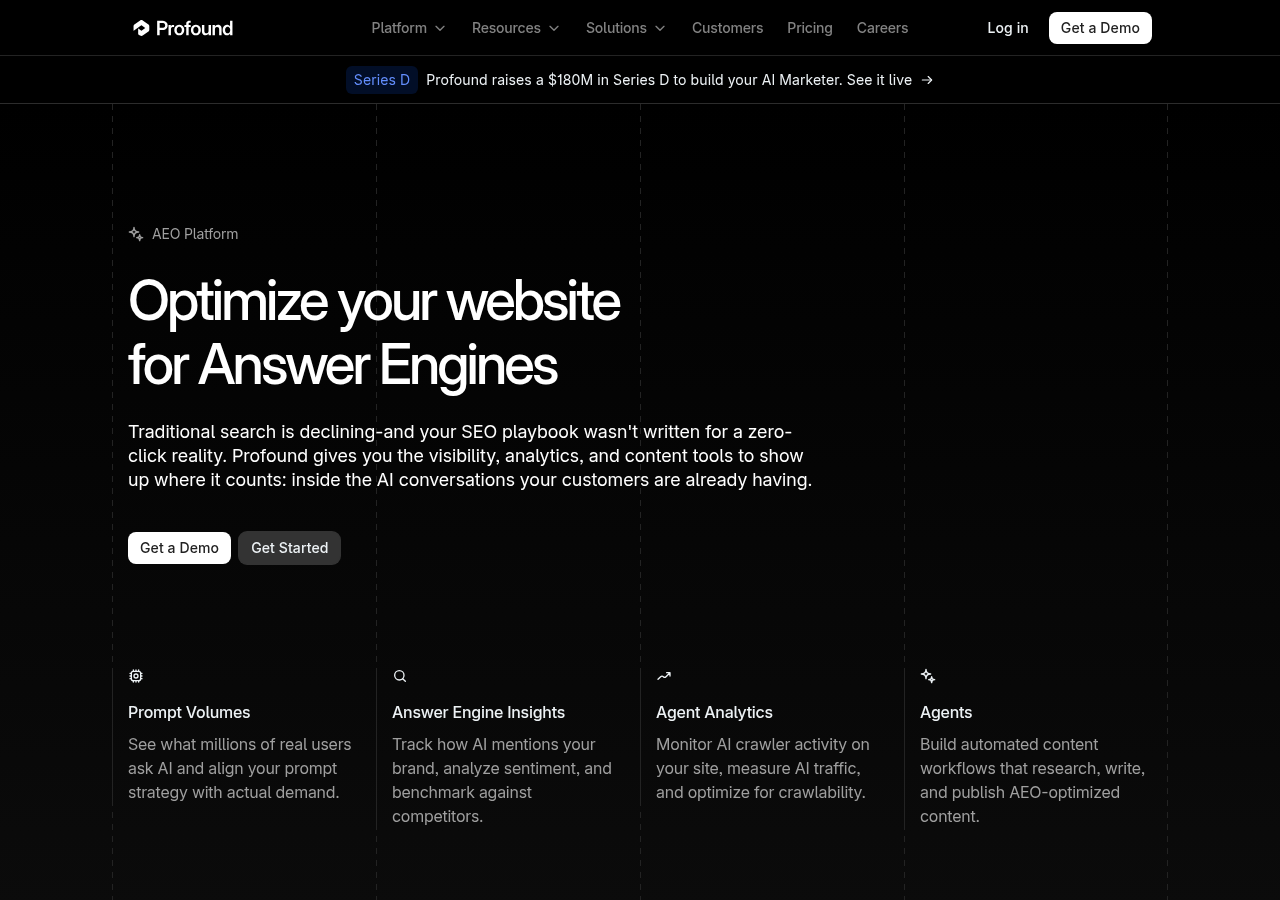
Profound is an AI-powered marketing platform focused on tracking and managing brand visibility across AI-generated answer engines, rather than offering full automation for content creation. The platform provides marketing teams tools to identify how their brand appears in AI search results and answers, manage context, and run content and social workflows based on AI visibility data.
It serves more as a visibility and insight add-on to complement AI SEO strategies and is not designed for users seeking comprehensive content automation.
Best for
Profound is best for teams that need deep, actionable visibility insights into their performance across AI answer engines and generative platforms. Brands expanding into AI-driven search or looking to correct misinformation and optimize for visibility in platforms like ChatGPT, Claude, Gemini, and Perplexity find the platform valuable.
Key features
- AI Marketer module — uses credits to launch visibility checks and context updates.
- Custom Agents — let users build and reuse workflow automations for consistent reporting and management.
- Context Manager — centralizes brand knowledge and helps maintain message consistency.
- Answer Engine Insights — provides competitive visibility reports across major AI platforms.
- Profound Sheets — enables bulk operations and workflow scaling for teams managing large amounts of brand and content data.
Pricing
Profound offers a free trial and custom enterprise pricing, with costs based on usage and feature needs. Teams can start with a free trial to test the platform, while advanced features and larger-scale operations require an enterprise agreement.
Exact pricing is not publicly listed; brands should contact Profound for the most current rates. There is no set monthly plan displayed for standard business users.
Pros and cons
Pros:
- Deep AI engine visibility and actionable insights
- Modular workflow automations for large and complex teams
- Advanced context and misinformation management tools
Cons:
- Does not handle automatic SEO content writing or publishing
- Pricing may not be transparent or suited for smaller brands
- Traditional SEO features (rank tracking, audits, keyword research) are not directly built in
Verdict
Profound stands out for brands seeking to analyze and influence how they're represented in AI-driven search results, not those seeking full automation of SEO content and publishing. Teams prioritizing AI search visibility and competitive intelligence may find Profound essential, but those who also need robust traditional SEO, publishing, or editorial automation should consider more unified platforms.
Expert Insight: Profound is an intelligence-first platform—it excels for AI answer tracking, but requires pairing with other tools if you need article creation or automated publishing.
4. Surferseo — Best for Content Optimization Guidance
Surferseo specializes in helping e-commerce teams refine and optimize their content using AI-driven recommendations and scoring. Its automation features focus on actionable insights for editing and improving existing product descriptions rather than full end-to-end content creation.
What it is
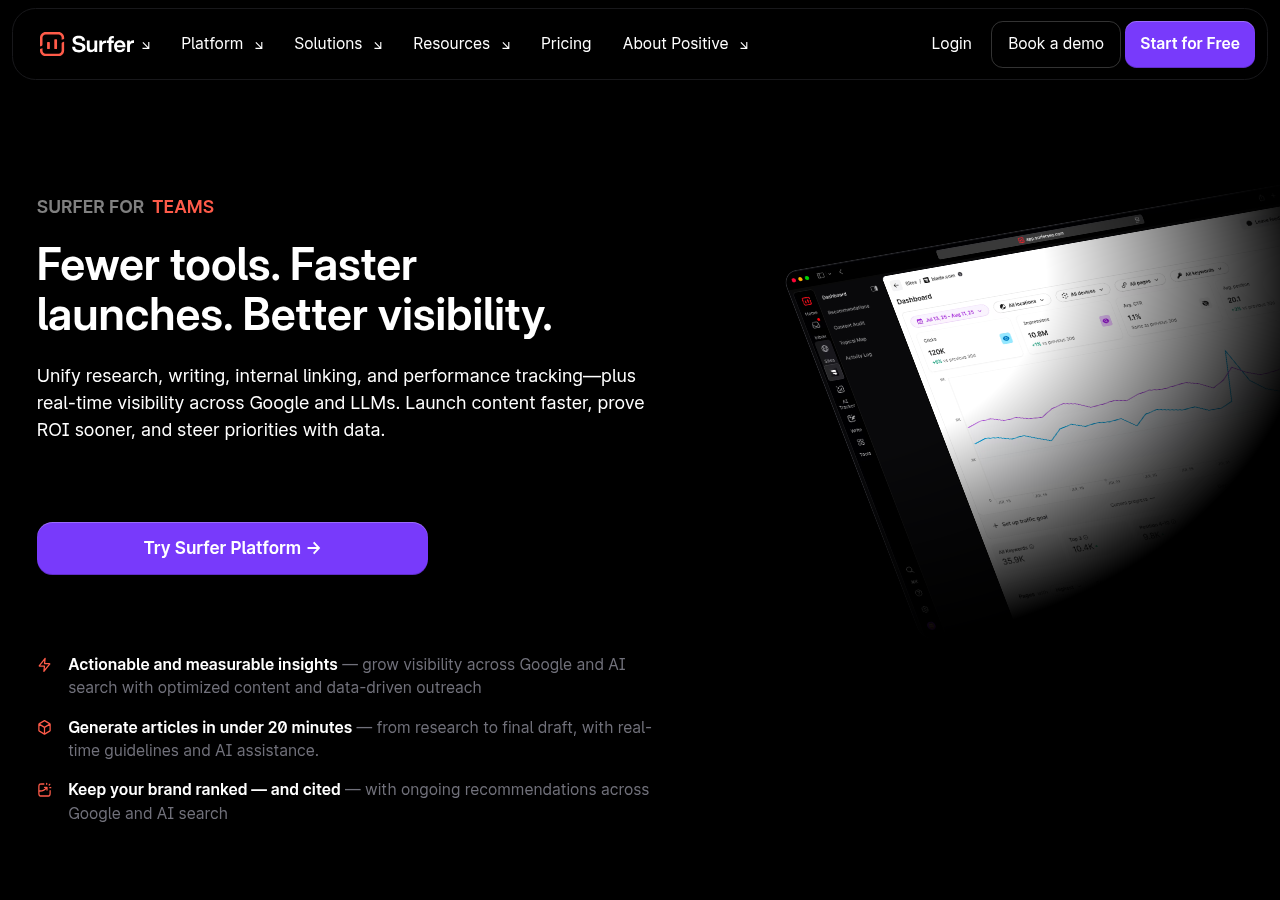
Surferseo is an AI-powered content optimization platform designed for teams committed to boosting search performance through better on-page guidance. Unlike platforms that automate broad SEO workflows, Surferseo concentrates on making sure your content is structured, keyword-rich, and competitive against top-ranking pages. Key features include content editor with real-time SEO scoring, keyword research with SERP analyzer, content planner, and audit tools to improve existing pages. Pricing starts at $59/month for the Basic plan (10 content editors, 500 audits), going up to $239/month for the Pro plan with more credits and advanced features. Pros include a data-driven approach to content optimization, easy-to-use interface, and strong integration with Google Docs and WordPress. Cons are a learning curve for beginners and limited AI content generation compared to full AI writing tools. Verdict: Surferseo excels as a content optimization assistant for SEO-savvy teams focused on improving and auditing content rather than generating raw text.
Writesonic is an AI content creation tool designed to generate SEO-friendly content quickly across various formats, such as blog posts, ads, and product descriptions. It emphasizes ease of use and a broad range of templates powered by GPT-3, making it suitable for marketers, bloggers, and small businesses. Key features include AI article writing, content rephraser, AI chat, and automated SEO metadata generation. Pricing starts with a Free plan offering 10,000 words per month, a Basic plan at $15/month with 75,000 words, and Professional at $45/month with 150,000 words. Pros are fast content generation, diverse template selection, and user-friendly interface. Cons involve occasional AI inaccuracies requiring proofreading and less advanced SEO optimization features compared to dedicated SEO tools. Verdict: Writesonic is a strong option for those needing fast, versatile AI content creation with basic SEO capabilities, ideal for smaller teams or solo creators aiming to produce a high volume of content quickly.
Best for
Surferseo is best for e-commerce managers who want real-time, actionable guidance to fine-tune content for search engines. This tool appeals to those focused on improving existing content quality with data-driven feedback rather than automating the full process from research to publishing.
Common use cases include boosting underperforming product pages, refining category descriptions, and aligning content closely with competitors dominating search.
Key features
Key features of Surferseo center around its powerful AI-backed content auditing tools:
Pricing
Surferseo’s pricing starts at $49 USD per month (Discovery plan), with core AI-driven content optimization features available at $99 USD per month (Standard plan), $182 per month (Pro), and up. Plans are billed yearly. Each plan scales by the number and depth of features, higher allowances for tracked pages, and access to different levels of AI analysis.
Pros and cons
Surferseo stands out for its in-depth content optimization but offers less workflow automation than some all-in-one suites.
Pros:
- Detailed content scoring at the page and section level
- Real-time SERP analysis for competitive benchmarking
- AI writing and humanizing tools to refine product content
Verdict
Surferseo is recommended for e-commerce teams seeking granular, data-driven guidance to optimize individual product or category pages rather than automate the full content lifecycle. It is strongest as a supplement to broader SEO systems, ideal for brands that want to squeeze extra ranking performance from existing descriptions with minimal manual research.
Expert Insight: Surferseo’s detailed auditing makes it easier to identify critical content gaps, but teams aiming for large-scale, automated content programs should expect to pair it with additional tools for publishing and keyword research.
5. Writesonic — Best for Multi-Channel AI Content
Writesonic is positioned as an AI visibility platform for teams looking to reach audiences across both traditional search engines and emerging AI search tools. This section covers how Writesonic supports multi-channel SEO efforts for fast-growing e-commerce brands.
What it is
Writesonic is an AI-powered visibility platform built to help marketing teams maximize their brand exposure across a mix of search engines and AI-driven discovery platforms. It merges SEO and Generative Engine Optimization workflows into a single toolset, letting e-commerce teams track, analyze, and improve their performance on search giants as well as platforms like ChatGPT, Gemini, Perplexity, Claude, and Grok.
Best for
Writesonic is best for e-commerce and marketing teams focused on managing SEO and AI-driven content across multiple channels at scale. It's especially well-suited for businesses that need unified reporting for both traditional organic search and major generative AI platforms. Teams operating in fast-moving product categories or global markets often favor Writesonic when adaptability and broad answer engine coverage are top priorities.
Key features
Writesonic's core features center around tracking and optimizing both search and generative engine visibility. Notable capabilities include:
Pricing
Writesonic uses a monthly subscription model with several tiers based on feature access and content limits. The current plans, as listed on their pricing page, include Starter ($79/mo), Basic ($199/mo), Growth ($399/mo), and Enterprise (custom pricing). Feature and usage caps—like articles per month and prompt tracking—scale up with higher tiers.
Pros and cons
Writesonic's strengths and drawbacks for e-commerce teams depend on use case and scale.
Pros:
- Multi-channel AI and SEO integration for broad visibility
- Customizable tiers to match varying business needs
- Automated article creation at significant monthly volumes
Verdict
Writesonic is a good fit for e-commerce businesses needing rapid, multi-channel content production and unified AI/search analytics. The platform excels where brands prioritize widespread visibility and are able to invest in upper-tier plans.
Info: Writesonic's platform is strongest for brands ready to scale across both traditional search engines and AI-driven platforms—but the best value is found when higher tiers align closely with business goals.
Frequently Asked Questions
What are the top AI SEO content automation tools recommended for e-commerce product descriptions?
Top AI SEO content automation tools for e-commerce include SEOLadders, which automates keyword research, content planning, article writing, publishing, and SEO audits. It supports integrations with WordPress and webhook, generates 30 optimized articles monthly in your brand voice, tracks AI visibility, and assists with backlink outreach, all for a single $97/month plan per site.
How do these AI tools help scale and optimize product content?
AI SEO content automation tools scale and optimize product content by automating keyword research, content planning, writing, and publishing. They identify content gaps, continuously refresh pages, and track visibility across Google and AI search engines. Tools like SEOLadders also automate backlink outreach and perform weekly site audits to maintain SEO health, enabling e-commerce teams to efficiently expand and optimize product descriptions at scale.
What features distinguish SEOLadders from other automation platforms?
SEOLadders uniquely combines automated SEO content planning, daily AI-generated articles with brand voice in 23 languages, real-time site audits, and AI visibility tracking across six AI engines. It auto-publishes content to WordPress or via webhook, supports backlink outreach drafts, and integrates SEO management and AI monitoring in one platform. This end-to-end automation and founder-led support set it apart.
Can these tools integrate with WordPress and other CMSs?
Yes, leading AI SEO content automation tools like SEOLadders integrate with WordPress and other CMS platforms via webhook. SEOLadders currently supports WordPress and plans to add integrations for Ghost, Webflow, and Framer, allowing automatic publishing of AI-generated content directly or as drafts for review.
Is it better to fully automate or manually review AI-generated SEO content?
It is best to manually review AI-generated SEO content to maintain editorial control and ensure accuracy. SEOLadders automates content creation and publishing but includes a Review mode allowing users to approve drafts before going live, combining automation speed with human oversight for quality and brand consistency.
Conclusion
Each tool on this list tackles a different piece of SEO automation—Ubersuggest makes broad keyword research easy, Profound offers insights into AI-driven search visibility, Surferseo delivers actionable optimization guidance, and Writesonic covers multi-channel content needs. SEOLadders stands out as the top pick if your priority is end-to-end automation: it’s the only platform here that covers automated planning, content writing, real-time publishing across multiple CMS platforms, proactive site health checks, and brand voice-preserving articles—all under a single, flat-rate plan.
In summary, these tools represent the top AI SEO content automation options because they each address critical areas of SEO workflow, from research to execution, with SEOLadders providing the most comprehensive solution for e-commerce teams seeking full automation. For teams aiming to enhance efficiency and scale organic traffic, exploring these tools and focusing on your specific needs will be essential.
Quick next steps:
- Pinpoint which automation gaps are costing your team the most time
- Compare each tool’s strengths against your current workflow
- Trial SEOLadders free for 7 days to see daily auto-published articles in action
- Review your product catalog coverage and AI search visibility using SEOLadders’ dashboards
If you want to move from patchwork SEO to full content automation, SEOLadders is the most complete choice built for e-commerce scaling in 2026.
Ready to see how fully automated SEO content could transform your store’s growth? Get all the details and book a demo now on the SEOLadders content writing page.
Want this done for you? SEOLadders finds the topics, writes the articles, and gets you cited by AI and ranking on Google, on autopilot.
7-day free trial · Cancel anytime