
Table of contents
TL;DR
- GEO optimizes for AI-driven answer engines.
- Prioritizes structure, factuality, and semantic signals.
- Crucial for ranking in ChatGPT and Gemini.
- Differs from traditional SEO strategies.
Generative engine optimization (GEO) is the process of improving your website and content to ensure they are visible and cited by AI-powered search and answer engines. This approach has become crucial because even if you rank well on Google, your brand or site often doesn't appear in the responses AI assistants like ChatGPT or Gemini provide to your customers. For founders, marketers, and business teams, this creates a new kind of visibility challenge that traditional SEO alone can’t solve. Ensuring your brand is referenced in AI-generated answers is now as important as ranking for keywords.
In this article, you’ll learn exactly what generative engine optimization is, how it works in practice, how it compares to conventional SEO, where it’s most effective, and what common mistakes to avoid. If you want your site to be found not just on search engines but inside AI-driven answers, you’ll get what you need to get started—and see real examples of GEO in action.
What Is Generative Engine Optimization?
Generative engine optimization (GEO) is reshaping how brands become visible online as AI-driven search engines like ChatGPT and Gemini generate their own answers rather than just showing ranked web links. Understanding the basics and underlying technology is crucial for founders and marketers who want to be referenced by these systems.
Generative engine: AI models and answer engines
Generative engine refers to AI systems—such as ChatGPT, Gemini, Claude, and Perplexity—that create original answers to user questions instead of just listing or ranking existing web pages. These models study a large amount of indexed online content. They pull out facts and patterns, then generate human-like text to reply. Unlike traditional search engines, generative engines rely on their own training data and ongoing crawling.
Because of this, websites and brands need to make sure their content is clear, easy for machines to read, and very relevant. This increases the chances their content will be cited in direct answers. For example, in classic search, if you ask "What is the best guide to learning guitar?" the engine might return a list of top-ranking web pages. In contrast, a generative engine might read several guides, pick key points, and provide a concise summary tailored to your question. According to rankauthority.com, generative engine optimization means making a brand's information easy to understand and present to these models so they choose it in AI-generated summaries.
Optimization in a machine learning context
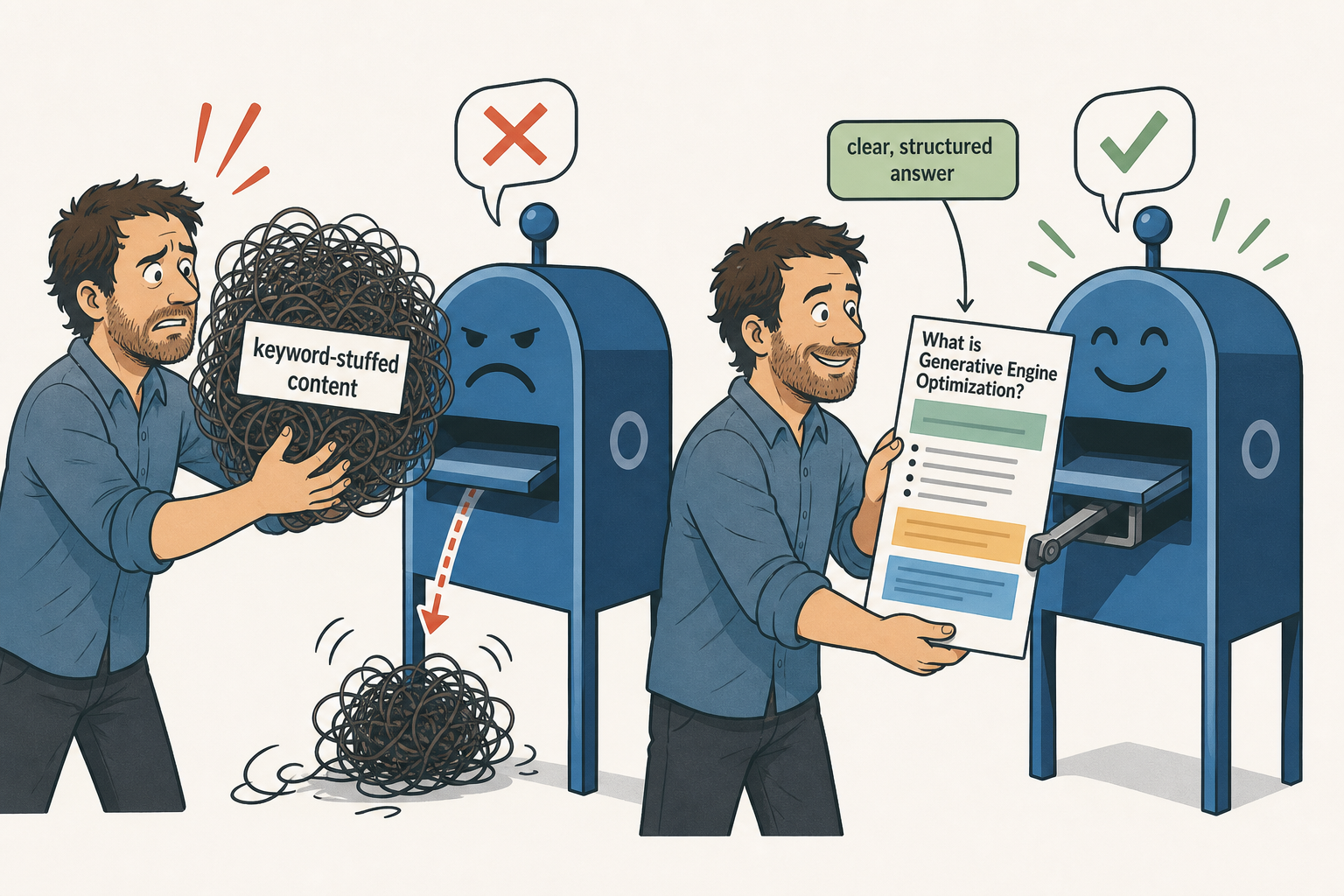
Optimization in a machine learning context is the process of improving how data is presented so that AI models are more likely to select and cite it in their generated responses. Generative engines evaluate sources for quality, clarity, and structure—often preferring content that is direct, answers questions explicitly, and follows machine-friendly formatting. GEO requires more than keywords: it involves clear headings, concise summaries, schema markup, and authoritative signals.
Teams aiming to track and improve their AI visibility often turn to automated solutions such as SEOLadders’ AI visibility features, which monitor citation rates across multiple engines. This focus on visibility stems from how LLMs, or large language models, are trained: they reward clarity and explicit answers, not just keyword matches.
Semantic search and prompt engineering basics
Semantic search is a technique in which AI models interpret user questions based on meaning, not just keywords, matching them with the most relevant, clearly structured answers in their index. This prioritizes content that directly solves user intent through plain language explanations and contextual clues. Prompt engineering is the practice of crafting both content and search prompts so that generative models retrieve and present the intended information. For example, a brand that organizes its content around clear, specific questions—such as “What are the benefits of [Brand]’s eco-friendly packaging?”—and provides concise, authoritative answers is more likely to be cited by ChatGPT or Gemini in response to related queries, rather than just appearing as a generic search result. Effective prompt engineering means anticipating the way AI engines parse queries and ensuring that on-page content is contextually robust, well-structured, and answers common questions. To check how ready your site is for this new landscape, tools like the AI Readiness Test can help identify content gaps and prompt optimization needs.
Tip: Clarity and question-focused structure often outweigh keyword stuffing when optimizing for generative engines, so prioritize direct, answer-first content.
How Generative Engine Optimization Works
Generative Engine Optimization (GEO) relies on making digital content clear, reliable, and discoverable to AI platforms built on large language models. Understanding the working process means breaking down how AI finds, interprets, and chooses what to recommend.
Step 1: Structuring content for AI models
GEO begins by making content machine-readable and semantically organized so AI platforms can interpret and extract key information. According to matjarx.com, generative engines like ChatGPT, Gemini, and Perplexity move beyond keyword matching, evaluating content through structures like semantic proximity and relevance in vector space. To align with these ranking factors:
- Use clear, unambiguous language in answers and definitions
- Organize topics into clusters that connect pillar topics to subtopics, reflecting natural question patterns
- Format with lists, tables, and questions to improve chunking and answer extraction
- Add schema markup or structured data where appropriate (but adapting for how LLMs understand context, not just Google bots)
- Ensure headings and metadata clearly signal content hierarchy and topic focus
These steps help AI engines determine which page or source gives a direct, authoritative response that matches user questions. See what it can do for real examples of structuring content for AI models.
Example: Optimizing a FAQ Paragraph for Generative Engines
Before Optimization:
<h2>FAQ</h2>
<p>Generative engine optimization is important. It helps improve rankings and user experience.</p>
<p>AI models read content and decide what to show users.</p>
After Optimization:
<h2>What Is Generative Engine Optimization?</h2>
<p><strong>Generative Engine Optimization (GEO)</strong> is the process of structuring content so AI models can easily interpret and provide accurate answers.</p>
<ul>
  <li>Improves search rankings by focusing on topic relevance and clarity</li>
  <li>Organizes content into clear clusters and sections</li>
  <li>Uses schema markup for enhanced machine understanding</li>
</ul>
<p>By aligning content with AI model expectations, GEO ensures responses are authoritative and directly answer user questions.</p>
This markup clarifies the topic, uses clear headings, bullet points for easy parsing, and semantically rich language so AI engines can extract and present information effectively.
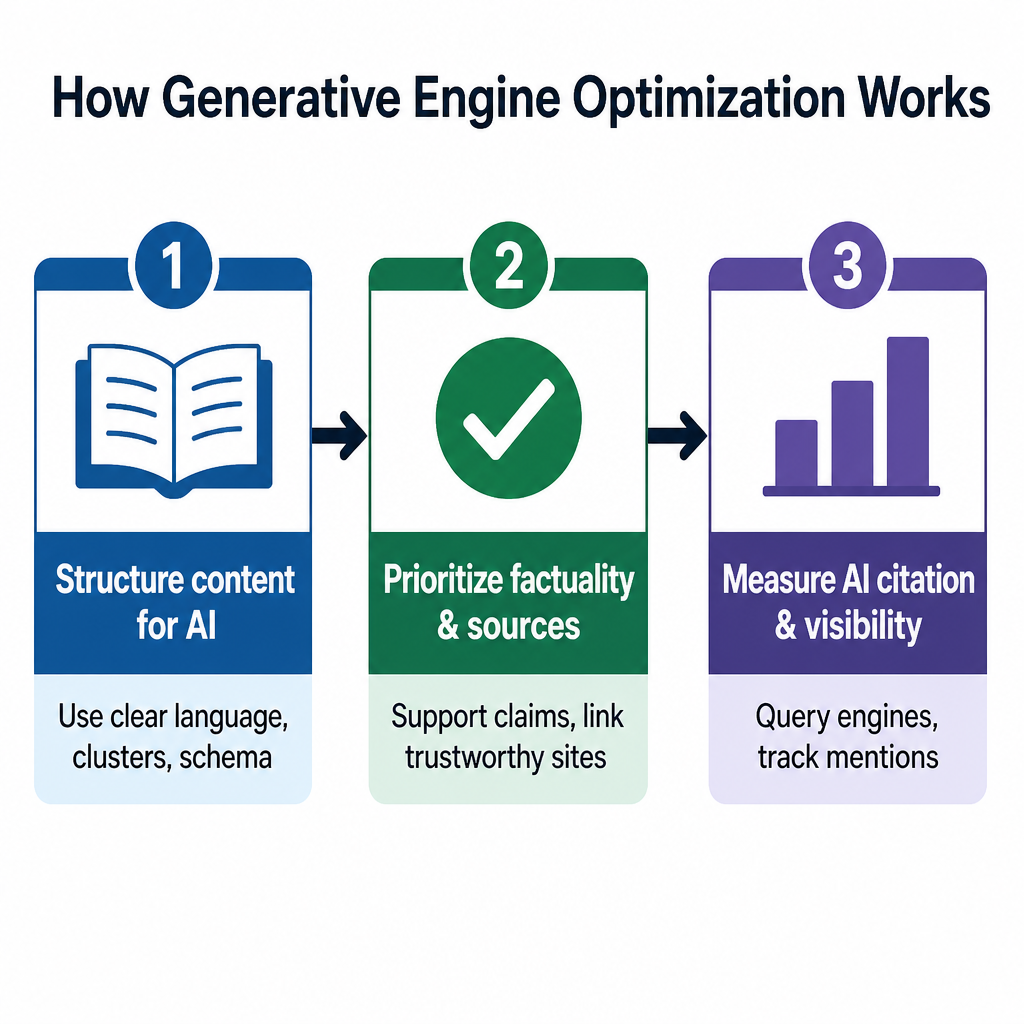
Step 2: Factuality, sources, and linking
AI engines prioritize sources that demonstrate high factual accuracy, cite verifiable references, and link to trustworthy domains. ClickRank found that E-E-A-T signals (Experience, Expertise, Authoritativeness, Trustworthiness) heavily influence relevance and rankings in 2026.
- Support claims with named sources and explicit citations (AI will check for primary and secondary evidence)
- Link to well-established, high-authority websites to boost contextual trust
- Ensure internal links connect related content so AI can map your site’s topical authority
AI models extract not only text but the relationships between claims, authors, and references. Failing to cite sources or relying on ambiguous claims can mean your site is skipped in favor of one with stronger evidence.
Step 3: Measuring AI citation and visibility
Measuring success in GEO requires tracking if, where, and how frequently AI assistants cite or mention your brand in responses. Because traditional rankings don’t reflect whether ChatGPT, Gemini, or Perplexity answers with your name or content, specialized tools now query AI models directly.
A typical workflow includes:
- Generate key buying and informational prompts from your target topics
- Query major AI engines multiple times each week with these prompts
- Track if your brand or competitors are mentioned, and where you’re recommended or overlooked
Platforms like SEOLadders automate this process and show detailed dashboards across engines. For a hands-on snapshot, the AI Readiness Test gives instant feedback on brand presence in AI answers.
Expert Insight: GEO is not just about keywords or technical SEO—semantic clarity and transparent sourcing are now essential for visibility in AI answers.
When Does Generative Engine Optimization Apply — And When Doesn’t It?
Generative engine optimization is not a universal fit for every digital channel or query. Understanding where it excels—and where classic SEO remains essential—helps teams prioritize their resources for maximum impact.
Best use cases: AI search and conversational engines
Generative engine optimization is most impactful where AI-driven search and conversational engines generate answers that reference brands or content. This includes emerging platforms like ChatGPT, Gemini, Claude, Perplexity, and new Google AI features that synthesize search results rather than ranking blue links alone. Businesses gain the most by targeting queries where users expect AI to summarize, cite, or recommend—from informational questions to product or service comparisons.
Key use cases include:
Scenarios where classic SEO still leads
Classic SEO remains a leading choice for intent types and queries dominated by traditional search engines or structured ranking formats. For transactional, navigational, and highly competitive head terms, Google's blue-link rankings are still critical to organic visibility. Generative AI often summarizes answers but links back to top-ranked sites, making high organic positions in classic SERPs a prerequisite for being cited.
Where classic SEO is most essential:
- Local search results (map packs and business cards)
- Product pages and e-commerce — Where intent is clear and purchase-driven
- Branded searches — Users seeking a specific company or domain
- Featured snippets and FAQ rich snippets
AI-specific opportunities and limitations
AI-centric optimization opens new opportunities but also introduces unique constraints not found in traditional SEO. Brands targeting generative engines can benefit from increased share-of-voice and being first-movers in answering niche or emerging questions. However, AI models often change answer sets rapidly and may rely on incomplete or outdated data, making consistent citations less predictable.
Key factors to recognize:
- Citation volatility — AI outputs shift as models update and retrain
- Opaque ranking factors — Many conversational engines don’t explain why specific sources are cited
- Limited control — Publishers have less influence over how content is presented or summarized
- Regulatory and bias risks — AI-generated content may amplify errors or overlook newer sites
Expert Insight: Generative engine optimization works best when paired with—and not replaced by—traditional SEO for maximum reach across both search and AI-generated answers.
Generative Engine Optimization vs Traditional SEO
Generative engine optimization (GEO) and traditional SEO approach ranking, content creation, and audience acquisition in fundamentally different ways. Understanding these contrasts is key to building a strategy that doesn't miss out on AI search visibility.
Ranking factors: AI visibility vs. link authority
Generative engine optimization prioritizes being cited by AI models over accumulating backlinks and traditional authority signals. While classic SEO relies on keyword presence, backlinks, and site authority to climb Google’s rankings, GEO is about appearing as a trusted, factual source in AI-generated answers. According to Reinvent Digital, ranking first on Google doesn’t guarantee your brand is visible in ChatGPT, Gemini, or Perplexity, since these large language models select content based on its extractability, clarity, and factual reliability, rather than pure ranking signals.
Key differences:
- Traditional SEO: Optimizes for search intent, links, and content quality as judged by Google’s algorithms.
- GEO: Optimizes for “answer readiness”—clear statements, cited facts, structured data, and easy-to-parse content AI engines can attribute.
For more details on modern GEO strategies, see 10 Top Generative Engine Optimization Platforms.
Content style and structure: factual vs. persuasive
Generative engine optimization prioritizes clear, factual, and machine-readable content, while traditional SEO emphasizes persuasive writing tailored to human intent. GEO favors concise, accurate information presented in definitive statements and well-structured formats like Q&A blocks, lists, and schema markup. This approach helps AI models quickly extract and summarize key facts without promotional language or keyword stuffing, as highlighted by MadMade Designs.
For example, a GEO-optimized paragraph about a smartphone might read:
"The XYZ Phone features a 6.5-inch OLED display, 128GB storage, and a 48MP camera. Battery life lasts up to 24 hours."
In contrast, a classic SEO version focuses on persuasion and narrative flow:
"Experience stunning visuals with the XYZ Phone’s vibrant 6.5-inch OLED display, capture every moment in crystal-clear detail using its 48MP camera, and enjoy all-day battery life that keeps you connected."
This contrast illustrates how GEO content supports AI extraction through factual precision, whereas traditional SEO aims to engage and convert human readers.
Traffic patterns: AI answers vs. clicks
Generative engine optimization targets brand mentions and citations inside AI-generated answers, while SEO seeks click-throughs from search results to your site. The biggest operational shift for GEO is that your brand can reach users even when they never visit your website directly—AI models summarize, attribute, or mention your content in answers. Brands track AI visibility, not just page impressions or organic clicks.
Key differences:
- SEO — Click-driven: Measures organic sessions, CTR, and conversions from search engines
- GEO — Mention-driven: Measures citations, brand presence, and share-of-voice within AI answers
To test your site’s AI readiness, try the AI Readiness Test from SEOLadders.
Expert Insight: Optimizing for AI visibility doesn’t replace traditional SEO—it adds a new goal: being the cited source in AI answers, which requires a change in both how you structure your content and how you judge its success.
Common Generative Engine Optimization Mistakes
Many businesses miss out on higher AI visibility because they treat generative engine optimization just like traditional SEO. Here are the most frequent missteps that can undermine your site's success with AI-driven answer engines.
Ignoring answer engine ranking factors
Ignoring answer engine ranking factors prevents your content from surfacing in AI-generated answers, even if it ranks well in traditional search. According to Webelty, AI search algorithms constantly evolve, so strategies must adapt to changes in answer ranking and SERP features.
The most overlooked ranking elements are not always about keyword frequency or backlinks. ProvenROI notes that brands can have strong SEO traffic but get almost no citations in ChatGPT, Gemini, or Perplexity because they neglect:
Underestimating the value of citation
Citation is the backbone of answer engine recommendations, but many organizations overlook its role when optimizing for generative search. Without recognized sources, AI models may ignore your content or give credit to competitors with stronger citation footprints.
For example, a mid-sized software company invested heavily in creating detailed technical guides but struggled to appear in AI-generated answers. After actively securing mentions on well-known developer forums and industry review sites, their visibility in AI recommendations increased significantly within three months, directly boosting organic traffic. This contrasted with a competitor who had similar content but lacked external citations and saw no comparable growth.
A site may generate authoritative blog posts, but if they're not referenced by external sources or structured to be easily quotable, AI assistants won't pull them into answer summaries. Key steps to avoid this mistake include:
- Earning third-party mentions on independent sites relevant to your sector
- Getting existing resources indexed and cited in authoritative databases or directories
- Structuring content for clear sourcing, with name and brand mentions attached to statements
Skipping technical SEO for AI structure
Skipping technical SEO for AI structure limits how well AI engines interpret and cite your content. Many businesses focus solely on traditional SEO best practices—like metadata and sitemaps—while ignoring the markup and formatting that LLMs use to extract information.
Common technical missteps include:
- Not using structured data (like FAQ, HowTo, and Article markup) to describe page meaning
- Missing explicit question-and-answer formatting for voice and chat compatibility
- Neglecting internal linking to clarify topic relevance and entity relationships
Without these, even well-written sites can be invisible to AI answer engines. Teams often find that once they address these gaps, answer coverage spikes—increasing both direct citations and brand impressions.
Expert Insight: Generative engine optimization is only effective when content is both discoverable and easily referenced by AI models. Focusing solely on Google rankings often misses the different requirements of answer engines.
Frequently Asked Questions
How is generative engine optimization different from answer engine optimization?
Generative engine optimization (GEO) focuses on optimizing websites and brand content to be cited and visible within AI-driven search engines like ChatGPT and Gemini, emphasizing content generation and AI visibility. Answer engine optimization (AEO), by contrast, targets optimizing content to directly answer user queries in classic search results. SEOLadders supports GEO by automating content creation, AI visibility tracking, and publishing to improve AI citation.
Does GEO replace traditional SEO, or should both be used?
Generative Engine Optimization (GEO) does not replace traditional SEO; both should be used together for best results. GEO focuses on optimizing content for AI-driven search engines, while traditional SEO targets standard search engines like Google. SEOLadders automates both processes, integrating SEO and GEO to enhance visibility and citation across search and AI platforms.
What content formats work best for AI-driven search engines?
AI-driven search engines favor well-structured, fully built articles that include clear keyword clusters, relevant images, citations, and consistent brand voice. SEOLadders produces such articles daily, optimized for both traditional SEO and AI visibility, ensuring compatibility with models like ChatGPT and Gemini. This format supports AI citation and better organic ranking compared to generic or unstructured content.
How do you measure results in generative engine optimization?
Results in generative engine optimization are measured by tracking your brand's visibility and citation across AI-driven search engines like ChatGPT, Gemini, Claude, and Perplexity. This includes monitoring rankings, competitor mentions, and backlink profiles regularly to see if your business is recommended by AI. SEOLadders automates this process, providing AI visibility metrics, weekly audits, and ranking updates to ensure your content gains optimal recognition in generative search.
Why do many GEO strategies fail to increase AI citations?
Many GEO strategies fail because they lack comprehensive automation that covers research, content creation, publishing, and ongoing SEO audits tailored for AI engines. Without systematic monitoring and optimizing for AI visibility across major models, brands miss citations. SEOLadders addresses this by automating every step, including AI visibility tracking and link outreach, ensuring content is consistently optimized and cited by AI search engines.
Conclusion
Getting mentioned by AI search engines is now a distinct challenge from traditional SEO, and generative engine optimization offers a focused strategy to meet it. Through this article, you’ve learned what generative engine optimization is, how it works, when to use it (and when not to), how it differs from conventional SEO, and which traps to watch out for.
SEOLadders is built specifically for businesses and teams that want to be visible both on Google and in AI-generated search results. Its unique advantage is automated AI visibility tracking across leading engines like ChatGPT and Gemini, alongside automated content delivery, real-time audits, and backlink outreach—all designed to maximize both search and AI engine mentions.
To move your brand closer to being cited by the next wave of AI assistants:
- Identify which generative engines matter most for your industry
- Review your current mentions in AI answers using SEOLadders' tracking
- Map out your content clusters for topics most likely to earn citations
- Monitor and refine your approach to avoid common GEO mistakes
Investing in generative engine optimization now means you won’t get left behind as AI search becomes the norm.
Ready to future-proof your brand for AI search and answer engines? Explore SEOLadders' AI visibility feature to see where you rank—and how to improve your odds of being featured in next-generation AI answers.
Want this done for you? SEOLadders finds the topics, writes the articles, and gets you cited by AI and ranking on Google, on autopilot.
7-day free trial · Cancel anytime