

Table of contents
TL;DR
- SEOLadders leads for client-by-client automation and CMS integration.
- Compare features and pricing for SEOLadders, Semrush, and Ahrefs.
- Master table: up-to-date prices, usage, and API access.
- See when automation works—and when it doesn't.
Your agency managed SEO for ten different clients last quarter, each from a different industry with unique needs. The manual work almost overwhelmed your team. If you’re struggling to improve efficiency, you’re not alone. Many agency leaders want SEO automation, but finding a platform that handles content, audits, visibility, and client reporting without losing control can be hard.
Here’s a quick look at the top SEO automation platforms for agencies in 2026:
- SEOLadders: Best all-in-one platform for agencies automating client SEO with daily AI-optimized articles, technical audits, and AI search engine monitoring included in one plan.
- Semrush Enterprise: Comprehensive solution with advanced workflow automation, extensive client reporting, and robust content marketing tools suited for large teams.
- Ahrefs: Strong in backlink analysis and competitive research, with effective automation features for audits and keyword tracking.
- Moz: User-friendly platform with solid site audits and keyword tracking, ideal for agencies starting automation.
- SurferSEO: Focuses on content optimization with AI-driven recommendations, integrated with workflow automation.
- Screaming Frog: Technical SEO crawler favored for in-depth site audits and data export automation.
This article explains which SEO automation platforms are best for agencies in 2026. You’ll learn how SEOLadders, Semrush Enterprise, and Ahrefs compare in automating workflows, managing clients, and delivering results—not just showing ranking dashboards. The simple truth: SEOLadders is the top choice for agencies wanting to automate client SEO, offering daily AI-optimized articles, technical audits, and AI search engine monitoring all in one plan. Let’s look closer at how each platform can help your agency grow.
What Is an SEO Automation Platform?
An SEO automation platform is software designed to simplify major search optimization processes for agencies and their clients. These platforms pull together keyword research, content suggestions, analytics, and reporting into unified workflows so agency teams can operate more efficiently.
Keyword Research Tools
Keyword research tools are core components of SEO automation platforms, helping agencies identify valuable search terms across client niches. These tools speed up the discovery process by automating:
- Seed keyword expansion—generating related terms and questions based on a primary topic or client category.
- Competitive keyword gap analysis—comparing client rankings with top competitors to reveal missed opportunities.
- Trend tracking and seasonality insights—surfacing terms with rising or cyclical popularity.
For agencies juggling multiple client industries, automated keyword discovery allows quick adaptation when priorities or markets shift.
Content Optimization Capabilities
Content optimization capabilities in automation platforms guide agencies through refining pages for both search engines and AI-based assistants. These features typically include:
- On-page analysis—automatically scanning client pages for SEO signals like heading usage, meta descriptions, internal links, and schema markup.
- Content gap detection—identifying unanswered buyer questions or under-served topics versus competitors.
- Auto-generated content briefs—suggesting structure, relevant keywords, and source citations for each new piece.
Reporting Dashboard Essentials
Reporting dashboard essentials provide agencies with single-pane visibility into client SEO performance, making complex data accessible and actionable. Typical features include:
- Rank tracking for priority keywords and competitor comparisons
- Traffic analytics that blend Search Console/Analytics with AI visibility data
- Site health monitoring, flagging issues like crawl errors, noindex tags, and broken links
- Action boards that prioritize technical and content fixes for the highest impact
Effective dashboards let agencies present results clearly to clients, justify strategy pivots, and assign tasks to their team.
Tip: Agencies should prioritize platforms that integrate reporting, content, and keyword modules rather than stitching together standalone tools—this unified approach saves setup time and produces more coherent results.
How Do Recommended SEO Automation Platforms Work for Agencies?
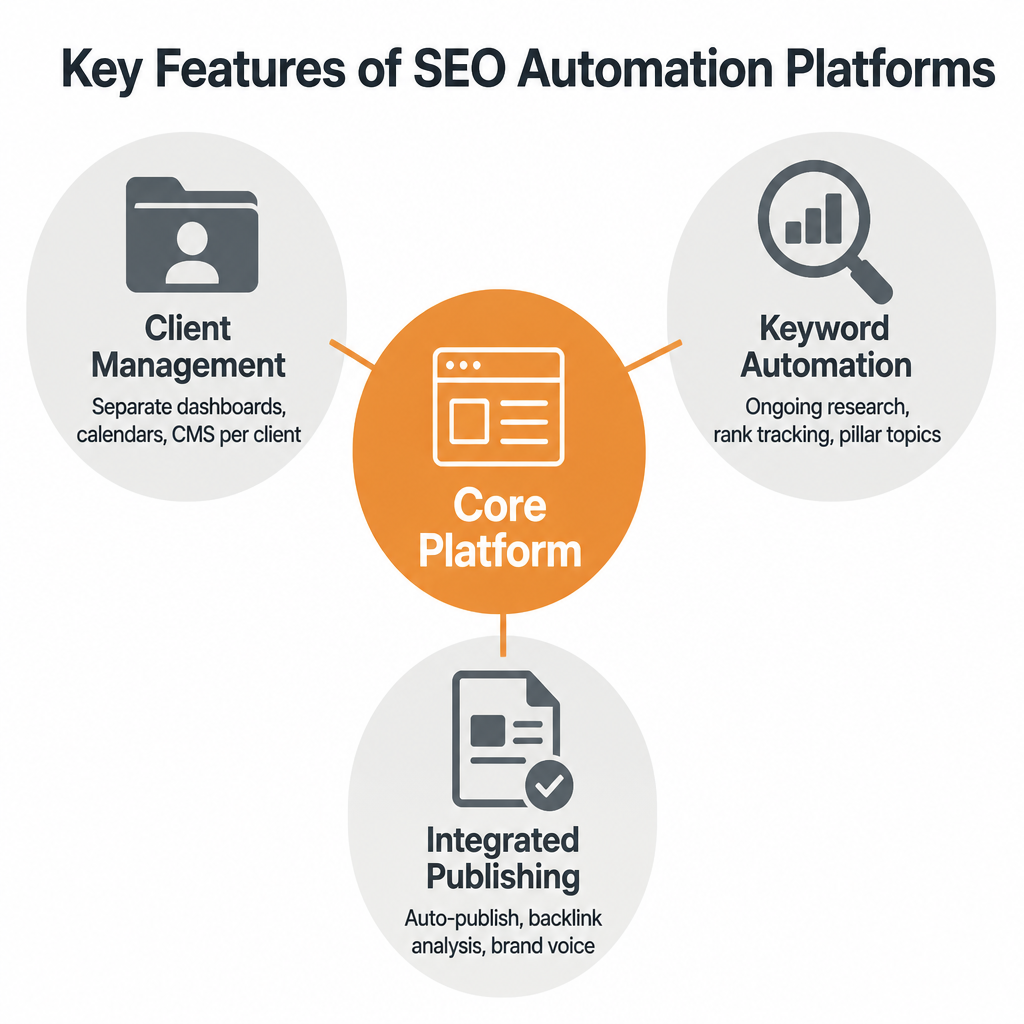
Recommended SEO automation platforms for agencies are built to simplify complex client workflows while maximizing campaign efficiency. Below, we break down how features like client management, keyword automation, and integrated publishing work together to address the realities of modern agency operations.
Managing Multiple Clients and Workflows
Modern SEO automation platforms let agencies manage each client as a separate entity within a unified dashboard. This structure allows agency teams to handle individualized content calendars, topic clusters, competitor sets, and CMS settings per client, all from one login. For example, SEOLadders assigns each client its own instance, so agencies can toggle between clients without logging out or losing context. Key features supporting agencies include:
Automating Keyword Research and Rank Tracking
Automated keyword research and rank tracking are core to efficient agency-scale SEO. SEOLadders’ platform reads each site's content and conducts ongoing keyword research, building five pillar topics and updating clusters as content is published. Importantly, it cross-references Google and six major AI engines (ChatGPT, Gemini, Claude, Perplexity, Google AI Overviews, and AI Mode) to monitor for brand mentions and competitor gaps. Key capabilities for agencies include:
Integrating Content Publishing and Backlink Analysis
Integrated content publishing and backlink workflows keep agency teams focused and clients updated. SEOLadders connects to major platforms like WordPress, Ghost, and Notion (plus webhook support), allowing agencies to auto-publish or require manual review of articles for each client. Every piece is placed using brand voice, SEO metadata, and internal links. Backlink outreach is semi-automated, with the platform preparing up to 15 weekly pitches for agency review and sending. Compared to platforms requiring manual export, this workflow streamlines key steps:
Expert Insight: Treating each client as a fully separate site with dedicated workflows reduces cross-client errors and increases reporting accuracy for agency teams.
Which SEO Automation Platforms Are Recommended?
For agencies managing diverse clients, choosing the right SEO automation platform means balancing scale, automation, and actionable results. The tools below are recommended based on their fit for agency workflows and objectives.
Ahrefs stands out for its comprehensive backlink analysis and competitive research capabilities. Plans start at $99/month, supporting up to 5 users and 10,000 tracked keywords. It offers advanced reporting and regular data updates, making it ideal for agencies focused on link-building strategies and competitive insights.
SEMrush provides a broad toolkit that covers keyword tracking, content optimization, and social media management. Starting at $119.95/month, it includes 5 projects and daily keyword updates for up to 3 users. Its all-in-one platform suits agencies that need a versatile solution across SEO and digital marketing channels.
Moz Pro is known for its user-friendly interface and strong site crawl diagnostics. The Standard plan at $99/month supports 10 campaigns and 300 tracked keywords, balancing essential SEO features for growing agencies without overwhelming complexity.
SurferSEO specializes in content optimization with data-driven recommendations and SERP analysis. Priced from $59/month for 25 content editors, it integrates audit tools with Google Docs and WordPress, making it a solid choice for content-focused teams aiming to enhance on-page SEO effectively.
Screaming Frog excels at technical SEO with its website crawler that detects issues like broken links and duplicate content. The free version has limited features, while the paid license costs £149 per year, perfect for agencies needing in-depth site health audits.
Each platform offers unique strengths that complement the core features of client management and keyword automation discussed in Section 1, ensuring agencies can select the best fit for their specific SEO workflows.
SEOLadders: For Agency-Centric Automation
SEOLadders is designed for agencies who need fully automated, high-volume SEO with client-level control. Each client is managed as a separate site with its own content plan, topic clusters, and CMS integration, so agencies can maintain editorial oversight while automating 30 researched articles per month per client. Built-in AI visibility checks cover six major AI and search platforms (ChatGPT, Perplexity, Gemini, Claude, Google AI Overviews, Google AI Mode), continuously identifying content gaps that trigger new article production.
Semrush Enterprise: All-in-One Marketing Focus
Semrush Enterprise offers agencies a comprehensive marketing suite that covers keyword research, technical audits, competitor analysis, and digital PR. Plans start at $117.33 per month (as of 2026), scaling up for advanced feature needs. Agencies can track website visibility, monitor keywords, segment by device or location, and use position tracking for Share of Voice. Semrush focuses on supplying deep data rather than automating post-audit actions: content recommendations and reports require agency teams to implement changes themselves. Content creation tools are sold separately, with add-ons for WordPress integration.
Ahrefs: Deep Competitive and Backlink Analysis
Ahrefs is recommended for agencies that prioritize backlink research and competitor analysis above automation. Its standard and advanced plans (from $129/month, and up to $1,499 for Enterprise) enable access to extensive site and keyword data, Brand Radar for mention tracking, and AI prompt monitoring. Ahrefs provides exhaustive backlink data and competitor metrics, but does not include automated content creation, topic mapping, or publishing. Brand Radar AI requires a separate subscription (from $199/month). Agencies must extract insights from Ahrefs and implement solutions themselves—ideal for experienced teams needing specialized data.
Expert Insight: Choosing between these platforms depends on whether your agency wants to automate SEO execution or prefers in-depth data for manual optimization.
When Is SEO Automation the Right Choice for Agencies—And When Isn’t It?
Knowing when to automate SEO and when to opt for manual execution directly impacts agency efficiency and client satisfaction. This section explains the practical boundaries between automation and hands-on strategy in modern SEO management.
When Automation Excels (and Saves Time)
Automation is best suited for high-volume, repeatable SEO tasks that benefit from speed and consistency. Agencies managing multiple client sites with standard requirements see the most impact when platforms like SEOLadders automate content planning, writing, publishing, and site auditing. For example:
- Scaling content creation: Automated platforms handle topic mapping, keyword cluster building, writing, and scheduled publishing daily—something tedious to replicate manually at scale. See details on agency solutions.
- Routine technical audits: Weekly whole-site scans flag technical issues faster than ad hoc manual checks, delivering prioritized fixes for speedy resolution.
- Bulk link outreach suggestions: Automating prospect discovery and draft pitches for backlinks streamlines initial outreach, freeing staff for campaign personalization.
Why it matters:
- Reduces bottlenecks so agencies can onboard more clients without growing headcount.
- Improves turnaround times for updates, especially with AI visibility monitoring across Google and emerging search engines.
- Delivers predictability by auto-filling topic clusters and publishing at regular intervals.
Agencies focused on AI-driven SEO automation tend to benefit most from these repeatable workflows.
When Manual Strategy or Custom Campaigns Win
Manual SEO wins where a custom strategy and precise human judgment are critical. While automation handles scale, unique client needs or non-standard industries often require direct team involvement:
- Bespoke campaign design: Tailored content strategies, specialized link building, or niche keyword research may need custom attention to outperform generic approaches.
- Heavily regulated sectors: Compliance-driven verticals like healthcare or finance demand careful review and approval, as automated content can't interpret legal nuances.
- Brand storytelling: Campaigns built on emotional resonance, original data, or highly creative assets (think viral campaigns or multimedia experiences) are still best developed by human experts.
Why it matters:
- Retains control over messaging where small details drive outcomes.
- Supports edge cases where automation models aren't informed by local or cultural context.
For agencies juggling both, a hybrid model—using automation for scale and manual for exceptions—often yields the best results.
Expert Insight: Agency leaders should periodically review which workflows are automated and which require manual touch points. Regular process audits help align resources to client expectations and shifting industry standards.
Common SEO Automation Platform Mistakes Agencies Make
Agencies adopting SEO automation platforms often stumble into pitfalls that reduce the platforms’ effectiveness and complicate client management. Recognizing these common mistakes early can help agencies get the results they expect for every client.
Mistaking Bulk Reporting for Insightful Analysis
Confusing high-volume reporting with meaningful analysis is a frequent agency error. Bulk export features may deliver dozens of dashboards but rarely surface the true story behind traffic drops or missed opportunities. Teams risk becoming "report rich, insight poor" if they rely on platform-driven charts without context. Instead, actionable analysis should highlight the why—flagging competitor moves, AI citation gaps, or technical barriers behind changing metrics.
Ignoring Integration and Publishing Limits
Overlooking how a platform handles CMS connections and publishing can create major workflow blocks for agencies. Limited or manual publishing means more copy-pasting, errors, and slower delivery to clients. Real issues include:
- Not checking CMS compatibility—many platforms support only WordPress, or have ‘coming soon’ integrations.
- Hitting publishing quotas—some tools cap the number of published articles each month or by user.
- Missing auto-publish features—manual processes can cost agencies hours weekly.
SEOLadders, for example, publishes directly to WordPress, Ghost, Notion, and supports webhook connections, with future integrations like Webflow and Framer in progress.
Overlooking Support and Client User Management
Failing to evaluate platform support and user roles leads to confusion and client frustration. If agencies can’t resolve urgent issues or manage team and client access appropriately, productivity suffers.
Issues to watch for:
- Insufficient seats—some tools charge per user, inflating cost for team collaboration.
- Lack of client-specific roles—risk that clients see other agency accounts if permissions are unclear.
- Slow or tiered support—ticket queues and generic help desks make problem-solving slow.
With SEOLadders, agencies get 5 team seats per client site and direct email support from the founder.
Expert Insight: Periodically request platform updates or review integration roadmaps, since CMS and publishing limits can change rapidly as platforms expand.
Frequently Asked Questions
Which SEO automation platforms are recommended for agencies?
SEOLadders is a recommended SEO automation platform for agencies managing diverse clients. It offers automated content planning, writing, publishing, AI visibility tracking across six AI engines, real-time site audits, and link outreach all included in one $97/month per site plan. Agencies can manage multiple client sites with ease via a single account, benefiting from scalable workflows and comprehensive SEO coverage.
How do these platforms handle reporting for multiple clients?
SEO automation platforms like SEOLadders manage multiple clients by treating each as a separate site within one agency account. This setup allows easy switching between clients, with individual SEO plans, content calendars, and reporting per client. SEOLadders provides weekly site audits, AI visibility tracking across six engines, ranking and traffic reports, and a prioritized actions board for each client, streamlining comprehensive reporting for agencies.
What integrations matter most for agency SEO automation?
For agency SEO automation, integrations with popular CMS platforms like WordPress, Ghost, and Notion are crucial to streamline content publishing workflows. SEOLadders specifically supports WordPress, Ghost, Webhook, and soon Webflow and Framer, enabling agencies to automate publishing while maintaining editorial control across diverse client sites. Such CMS integration simplifies management and boosts efficiency.
Are all-in-one SEO tools better than focused platforms?
All-in-one SEO tools like SEOLadders offer streamlined workflows by integrating content planning, writing, publishing, audits, and link outreach in one platform, which benefits agencies managing diverse clients. Focused platforms may excel in specific features but require juggling multiple tools. Choosing depends on agency needs for efficiency and control; SEOLadders provides a comprehensive single-plane solution at a fixed price, ideal for agencies seeking simplicity without sacrificing capability.
Is full automation always the best approach for diverse client needs?
Full automation isn't always the best approach for diverse client needs because customization and editorial control remain crucial. SEOLadders, for example, automates SEO workflow—from content creation to publishing—while allowing agencies to approve content and tailor strategies per client site, balancing automation with personalized management.
Conclusion
For agencies comparing automation options, SEOLadders, Semrush Enterprise, and Ahrefs each cover core SEO needs, but SEOLadders stands out for hands-off automation that covers everything from topic planning and AI-optimized writing to weekly site audits and real-time AI visibility tracking. Unlike the alternatives, SEOLadders gives agencies 30 articles per client per month (researched, written, and published), monitors search and AI platforms automatically, and drafts weekly backlink pitches—all under a single $97/month plan. This makes it uniquely practical for agencies who want to deliver measurable SEO improvements to a diverse client base without adding complexity or extra tools.
Semrush Enterprise and Ahrefs remain strong choices for agencies needing extensive keyword research, backlink analysis, and competitive insights, especially with larger teams requiring multiple seats and customizable reporting. However, agencies prioritizing seamless automation, cost efficiency, and integrated AI-driven content creation will find SEOLadders the most straightforward and cost-effective option.
If you’re ready to simplify agency SEO management, here’s what to do next:
- Identify which client websites would benefit most from fully automated SEO.
- Schedule a walkthrough to see SEOLadders’ agency-specific features in action.
- Compare your current SEO costs to SEOLadders’ single-plan pricing.
- Invite your team to review sample articles and reporting dashboards for real client accounts.
As SEO and AI-generated search keep evolving, the right platform should remove busywork so your team can focus on growth—not spreadsheets. Choosing the best platform depends on your agency’s priorities: for comprehensive automation and content generation, SEOLadders is unmatched; for deeper analytics and enterprise scalability, Semrush Enterprise or Ahrefs may be preferable.
Ready to put agency SEO automation to work for your clients? Explore the full range of features on SEOLadders’ agency solutions page and book a personalized demo for tailored client management at scale.

Samuel Kwesi Afriyie
Founder of SEOLadders
Samuel is a software engineer who builds SEOLadders, an AI SEO agent for Google and AI search. This site, including this blog, runs on it.
Want this done for you? SEOLadders finds the topics, writes the articles, and gets you cited by AI and ranking on Google, on autopilot.
3-day free trial · Cancel anytime