
Table of contents
TL;DR
- Clear example of link building, step by step
- Explains common tactics like outreach and exchanges
- Covers what works and what usually fails
- Shows how automation tools simplify the process
You’ve probably sent out dozens of cold emails for backlinks—or maybe you’ve hesitated, unsure exactly what effective link building looks like in practice. If you’re a founder, marketer, or business team aiming for higher organic rankings and visibility, understanding a real-world link building example can save you wasted hours and missed opportunities.
In this article, you’ll see exactly how modern link building works, from pinpointing the right target sites to crafting and sending your outreach, plus a breakdown of alternatives and common pitfalls. The answer up front: a link building example is a detailed, step-by-step walkthrough of the strategies and real actions teams use to secure authentic backlinks, not just theory.
What Is a Link Building Example?
Understanding a link building example means seeing how every element—from a simple backlink to the authority of the site linking to you—shapes search results. The next sections break down these parts for a clear, actionable view.
Backlink
A backlink is a hyperlink from one website to another, serving as a core signal for SEO rankings. These links tell search engines that another site considers your content valuable enough to reference. Lumsx-bbb.lums.edu.pk notes that building a strong backlink profile can significantly improve your rankings. You can track the links you earn using a backlink checker tool, which shows not just how many links you have, but also where they come from and how strong they are. Key questions to ask:
- Is the link editorial or user-generated?
- Does it pass ranking value (dofollow), or is it marked nofollow?
- What page does it point to?
Anchor text
Anchor text is the visible, clickable text of a backlink and influences both relevance and search engine interpretation. The specific wording of anchor text tells search engines what the linked page is about. Good anchor text is descriptive and relevant to the target page, while over-optimized or spammy text can cause penalties. You can audit anchor text types—exact match, phrase match, branded—within your backlink strategy analysis:
- Exact-match: Matches your target keyword directly
- Branded: Uses your business name
- Generic: Phrases like “click here” or “learn more”
Domain authority
Domain authority measures the likelihood of a website ranking well based on the strength and quality of its backlink profile. Higher authority domains pass more trust and influence. When you earn a backlink from a high-authority source, it carries more weight in search algorithms than one from a lower-authority site. Tools like the SEOLadders Backlink Checker display domain authority next to every referring domain. Consider:
- High authority: .edu, .gov, established publications
- Medium: Industry blogs, trade associations
- Low: New, untrusted, or spammy sites
Tip: When reviewing link opportunities, prioritize high-authority domains with natural, relevant anchor text pointing to your key pages.
How Does Link Building Work Step-by-Step?
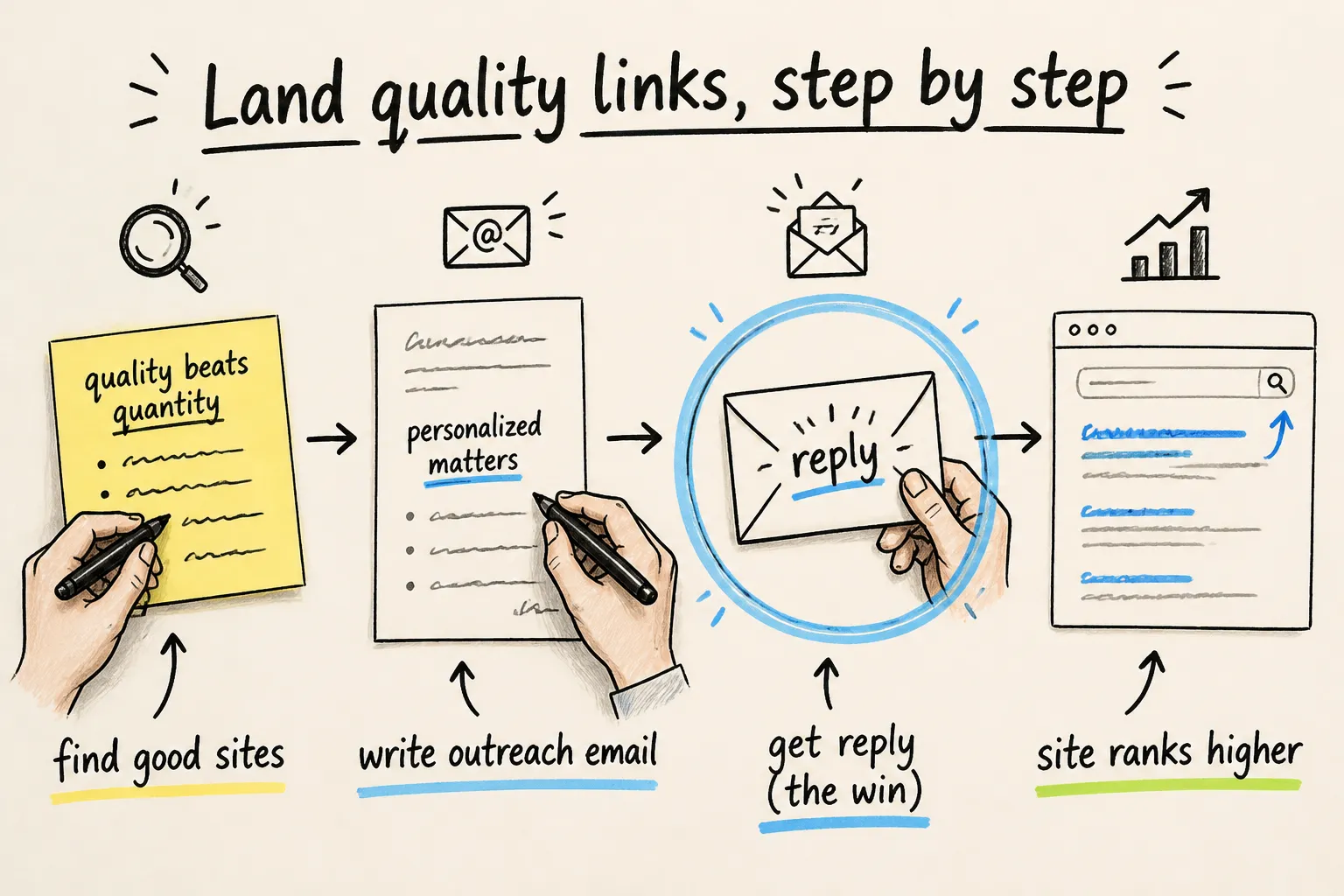
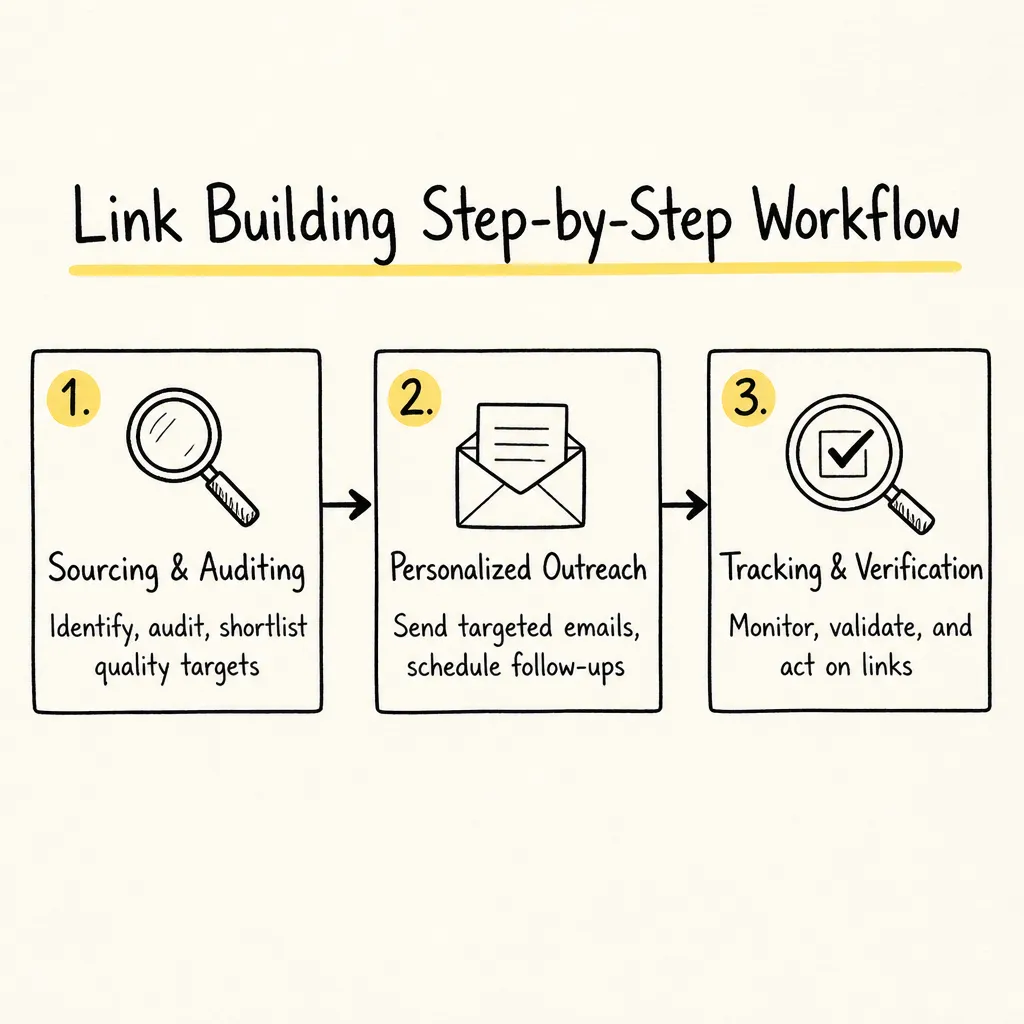
Understanding the specific stages of a modern link building example is key to planning campaigns that actually earn results. The workflow below breaks down the practical process from identifying targets to tracking outcomes.
Sourcing and auditing target links
Effective link building starts with identifying and evaluating possible sites for outreach or partnership. SEOLadders, for instance, sources prospects from AI-cited sources, competitor backlink gaps, and curated best-of lists. Each domain’s profile is audited with a focus on quality indicators like the ratio of dofollow to nofollow links, anchor text used, Domain Rating, and spam score. Tools such as the Backlink Checker can help filter out irrelevant or risky domains, allowing teams to create targeted and actionable prospect lists.
- AI-cited or competitor-backed targets often yield higher trust
- Important markers: high spam scores, irrelevant anchors, or reciprocal links usually exclude a prospect
- Audit results drive the shortlisting of only high-value opportunities
Personalized outreach and follow-ups
Personalized, relevant outreach drastically improves response rates in link building campaigns. SEOLadders drafts individual emails tailored to each contact (editor, author, or LinkedIn profile), focusing messaging on missing brand mentions or relevant value-adds to the recipient’s content. According to Resourcera, only 8.5% of outreach emails receive a reply, so targeted personalization and timely follow-ups are vital.
- Drafted follow-ups are scheduled after periods of no response
- Never send bulk or generic requests—that’s a spam flag
- Limit follow-up attempts (e.g., two per target) to maintain reputation
Tracking, link exchanges, and verification
Link acquisition is only half the battle—ongoing link tracking and verification ensure lasting results. Once outreach or exchange links are placed, SEOLadders monitors their status, checks for any drops, and enables verification so nothing is missed. Their exchange program matches brands with relevant member sites for ethical in-content placements (never direct swaps or competitors), with automated link checks following an established schedule.
- Track live and lost links with backlink management dashboards
- Validate exchange links for contextual relevance and non-reciprocity
- Act on lost links by using a grace period for replacements
Expert Insight: Relying on quality signals—like dofollow rate, topical fit, and low spam score—beats chasing a high backlink count every time.
When Is Link Building the Right Move—and When Is It Not?
Knowing when to invest in link building can shape your SEO results and resource allocation. Let’s break down where link building excels, its limits, and its pitfalls.
Situations where link building delivers results
Link building is effective when your website needs greater visibility or authority in specific niches. Teams often see results by targeting sites that buyers already read, or by earning mentions from industry-recognized publications. Link building works best when:
- Launching new content or services: Quality backlinks help Google discover and rank new pages faster.
- Competing for high-value keywords: Links from expert sources can tip the balance in competitive topics.
- Building authority: Being cited by established sites signals trust to search engines.
- Wanting AI citation across platforms: More backlinks from reputable sites help services like ChatGPT or Perplexity notice your brand (how link building works).
Where other strategies are better
Link building is not always the priority, especially when foundational issues need solving first. Sometimes, teams get better results by focusing on site structure, page speed, on-page SEO, or creating high-value content. For early-stage or local businesses, a strong Google Business Profile and locally targeted pages can outpace any link campaign.
- Technical SEO gaps: Fixing site errors or slow load times is often more urgent.
- Missing content: A site with few pages will see bigger gains by filling knowledge gaps or building topic clusters (topical authority).
- Authority mismatch: Competing for links in an unrelated industry rarely pays off.
Risks of link building in the wrong context
Badly timed or low-quality link building can cause more harm than good. According to UMATechnology, mass emailing, paid links, and prioritizing quantity over quality now risk Google penalties. Modern algorithms crack down on spammy outreach, and even well-meaning campaigns can trigger suspicion if they target irrelevant or low-authority sites.
- Ranking drops: Spammy links impact visibility.
- Wasted budget: Time spent chasing non-contextual or reciprocal links rarely produces results.
- Reputation damage: Poor links may erode trust with both users and search engines (track the links you earn).
Expert Insight: Don’t treat link building as a cure-all—solving technical SEO, content, or local visibility first can deliver faster, safer results.
Link Building Example vs Common Alternative Approaches
There’s no one-size-fits-all method for link building, so it’s important to understand how a practical link building example stacks up against other standard approaches. Here’s a breakdown of key workflow differences and common trade-offs.
Direct outreach vs link exchange
Direct outreach and link exchange are two distinct paths for earning backlinks, each suiting different goals and risk profiles. Direct outreach involves personally contacting website editors or authors to request a contextual link placement, typically after identifying relevant pages your audience reads. Done right, this method tends to result in higher-quality, editorially-placed links that feel natural to readers. SEOLadders’ outreach, for example, drafts short, personalized pitches to authors sourced from bylines or LinkedIn—but leaves the actual sending to you, so all outreach is transparent and sender-controlled.
Link exchange, by contrast, lets you join a network of related sites that agree to place links for each other within relevant articles. This provides consistent opportunities for acquiring links at scale, as long as the exchange is managed to avoid direct swaps and spammy patterns. With SEOLadders, links are placed contextually within articles, competitors are excluded, and no reciprocal linking occurs.
| Approach | Outreach personal value | Control | Risk of penalties | Typical scale |
|---|---|---|---|---|
| Direct outreach | High | High | Low, if done well | Moderate |
| Link exchange | Moderate | Medium | Higher if unchecked | High |
Manual vs automated workflows
Manual and automated workflows each present unique challenges and benefits for link building. Manual workflows mean you research prospects, write every pitch, and log link wins yourself. This offers full oversight, allowing you to tailor every email and decision, but it’s labor-intensive and tough to scale. Automated solutions, like those in modern backlink outreach tools, streamline repetitive research and draft outreach without sacrificing personalization.
- Manual workflows:
- Full customization — Every step is tailored, but requires significant time.
- Risk of human error — Missed follow-ups are common.
- Automated workflows:
- Consistent output — Tools like SEOLadders generate draft emails, track link status, and suggest new prospects weekly.
- Faster scaling — Lets small teams run sustained outreach and exchange campaigns without added staff.
Automation doesn’t send emails for you (as with SEOLadders), but it does shift campaign management from spreadsheets to centralized dashboards.
Tip: Combining both outreach and exchange—ideally supported by automation—lets you diversify link sources while avoiding overreliance on a single method.
Common Link Building Mistakes
Many teams apply link building tactics without realizing certain pitfalls can undermine their SEO. Here are the most frequent mistakes to watch for when evaluating any link building example.
Ignoring link quality over quantity
Focusing on link quantity instead of quality often leads to weak SEO outcomes. Search engines look for genuine, relevant backlinks, not just a high count. Low-quality or spammy sites, off-topic domains, and links with high spam scores provide little value and may even harm rankings. Use a tool like the Backlink Checker to assess referring domains’ authority, the dofollow ratio, and the presence of risky links. Teams should prioritize links from authoritative sources that are contextually relevant to their industry or target audience, rather than chasing raw numbers.
Over-automating outreach
Automated outreach at scale can quickly cross into spam if not managed carefully. Relying on untargeted blasts, generic templates, or failing to personalize emails can lower response rates and damage your reputation. Modern strategies emphasize relevance and relationship-building—tools that generate tailored pitches or identify contextual fit, as seen in this guide to backlink outreach tools, lead to more sustainable results. Smart automation supports manual review before sending, keeping campaigns targeted and credible.
Improper anchor text usage
Anchor text that’s overly optimized or repetitive can signal manipulation to search engines and trigger penalties. The best examples distribute anchor text types, including branded, generic, and long-tail phrases. Avoiding keyword stuffing and mixing anchors helps maintain a natural profile. Teams often use tables to track anchor distribution, such as:
| Anchor Type | Recommended Usage |
|---|---|
| Branded | 40-60% |
| Exact Match | <10% |
| Long-Tail | 10-20% |
This approach keeps link profiles balanced and defensible.
Expert Insight: Unnatural link patterns, like a sudden spike from low-quality sources or excessive use of exact-match anchors, are among the quickest ways links lose value or attract penalties.
Frequently Asked Questions
What is the difference between a backlink and internal link?
A backlink is an external link from another website pointing to your site, while an internal link connects pages within your own website. Backlinks improve external authority, and internal links enhance site navigation and SEO structure. SEOLadders supports backlink outreach and exchanges to build external links.
How do I know if a link is high quality?
A high-quality link comes from a reputable, relevant site with a strong domain rating and low spam score, ideally within your industry niche. SEOLadders helps identify such sites by filtering out spam and low-quality backlinks during outreach and link exchange processes.
Is link building risky for my website?
Link building can carry some risk if done with low-quality or spammy links, but SEOLadders mitigates this by filtering out spammy sites and ensuring links come from relevant, reputable sources. Their link exchange and outreach processes prioritize quality and natural placement to protect your website.
Can I automate the entire link building process?
You cannot fully automate link building because outreach emails must be sent personally from your inbox, not by SEOLadders. However, SEOLadders automates identifying targets, drafting personalized outreach pitches, and manages a link exchange network for placing backlinks.
Conclusion
This article broke down real link building examples, showed how the process works step-by-step, and highlighted when it makes sense for your goals. If you’re looking for practical strategies, SEOLadders stands out by generating tailored outreach pitches and managing a safe member link exchange—two approaches other tools covered here don’t combine.
- Review your current backlinks with a trusted checker
- Pick one proven strategy from these examples and put it into action today
- Explore automation tools to draft and organize your outreach with less manual effort
Ready to automate your link building with easy, real-world steps? See practical outreach tools and strategies in action on our link building features page and start building high-value links with confidence.

Samuel Kwesi Afriyie
Founder of SEOLadders
Samuel is a software engineer who builds SEOLadders, an AI SEO agent for Google and AI search. This site, including this blog, runs on it.
Want this done for you? SEOLadders finds the topics, writes the articles, and gets you cited by AI and ranking on Google, on autopilot.
3-day free trial · Cancel anytime