

Table of contents
TL;DR
- SEOLadders directly tracks citations in AI answers.
- Semrush and Ahrefs focus on classic SEO and keyword tracking.
- Only SEOLadders automates content plus AI monitoring.
- Clear differences in pricing and feature coverage.
You spent weeks creating new content for your SaaS site, but traffic barely changed. AI search tools still suggest your competitors when buyers ask for the best solution. If you are a founder or marketer at an AI-focused SaaS brand, the challenge is more than just ranking higher on Google. You also need to make sure ChatGPT, Perplexity, and Gemini mention your product when prospects use these AI engines to choose a vendor.
This article explains which search visibility platforms work well for SaaS brands targeting both Google and popular AI search engines. You will learn how these tools handle AI visibility, where each one excels, and specific options to track and grow your brand’s presence with buyers who use search and AI assistants to decide. The short answer: SEOLadders is the only platform here that combines automated content creation, daily publishing, real-time technical audits, backlink outreach, and ongoing AI search visibility monitoring designed specifically for SaaS citation. Meanwhile, Semrush and Ahrefs remain strong choices for traditional SEO tracking and research.
What Is a Search Visibility Platform?
A search visibility platform helps companies track and improve how their brand appears across traditional and AI-driven search engines. Understanding these tools is foundational for any SaaS team wanting consistent, measurable presence in both search results and AI-generated recommendations.
SEO tools: monitoring and analytics
SEO tools track visibility and performance metrics across search engines, revealing where your brand stands and what to improve. Platforms like these gather keyword rankings, traffic estimates, backlink data, and page-level SEO insights to give teams an actionable overview. Typical monitoring dashboards display:
- Keyword rankings for targeted searches
- Site health audits showing crawl issues or indexing barriers
- Traffic from organic, direct, and AI-related sources
- Competitor tracking side by side with your own results
AI search engines: how results are formed
AI search engines determine results by combining large language models, real-time search queries, and a quality-weighted trust system for sources. Instead of just ranking sites, these engines synthesize answers using training data, recent web content, and evidence from authoritative sources. Key factors influencing whether a SaaS brand is cited include:
SERP features and brand citations
SERP features and brand citations determine how a company is presented—if at all—within both search and AI-driven answer experiences. SERP features include knowledge panels, featured snippets, reviews, top stories, People Also Ask, and more. In AI search engines, citations appear in generated overviews or answer cards. Effective search visibility platforms show:
Expert Insight: As of 2026, platforms that unify SEO analytics with AI visibility monitoring give SaaS teams a tangible advantage: they're able to catch missed citation opportunities before competitors claim them.
How Do Search Visibility Platforms Work for SaaS AI Results?
Platforms focused on search visibility help SaaS brands monitor and improve how they're positioned in both Google and AI-driven search results. Understanding these mechanisms is key to controlling your brand’s presence across the full buyer journey.
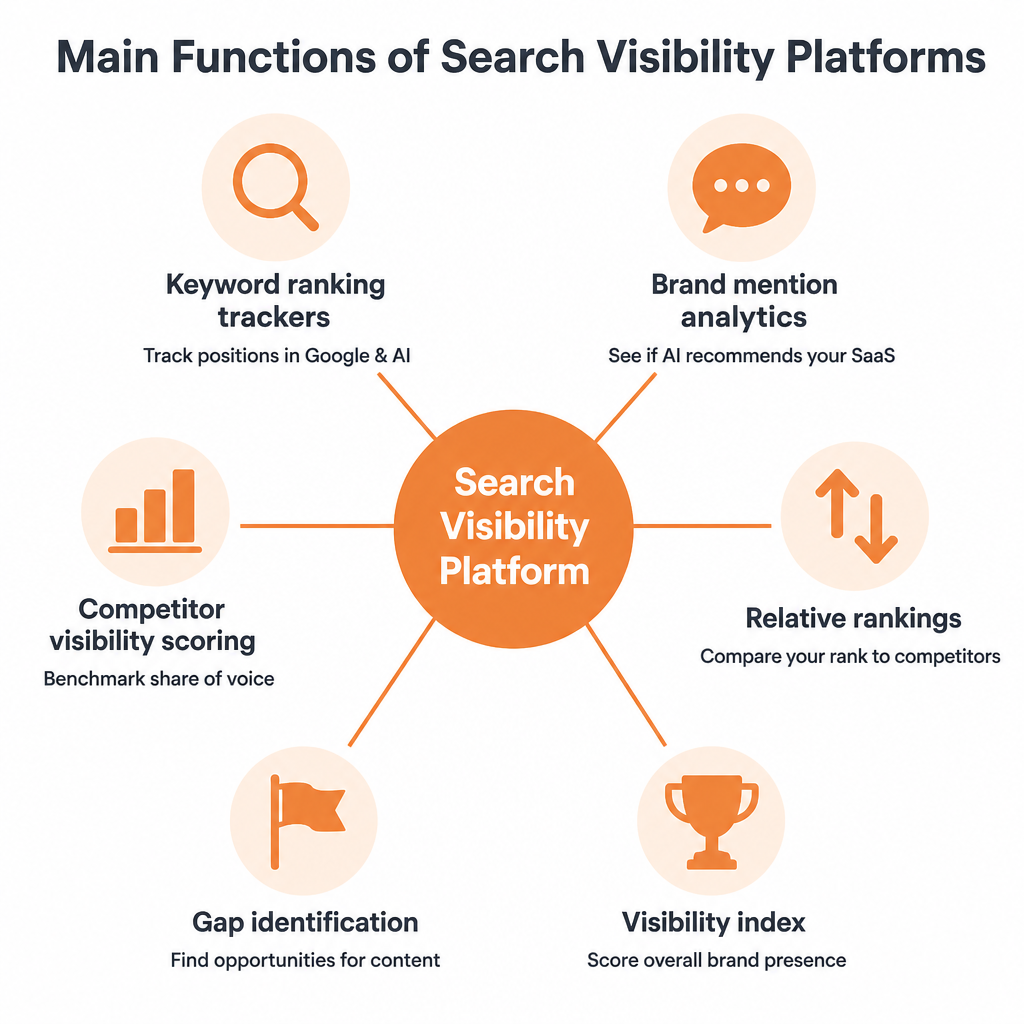
Tracking keyword rankings in Google and AI
Keyword ranking trackers monitor where your key topics and pages appear in Google search and across major AI assistants. For SaaS brands, tracking both is critical because buyers increasingly start with AI queries and expect authoritative answers, not just a list of links.
Measuring brand mentions in AI-generated answers
Brand mention analytics in AI-generated content show whether your SaaS appears as a recommended solution when buyers consult AI search engines. This metric is distinct from classic SEO because AI models select a shortlist of answers and often name specific companies.
Competitor analysis and visibility scoring
Competitor visibility scoring benchmarks your search and AI presence against rival SaaS brands, helping you understand your true share of voice in both spaces.
- Relative rankings: Platforms compare your brand's appearance frequency and position to up to ten competitors, showing exactly where others are cited in Google or by AI assistants.
- Gap identification: The system surfaces buyer questions and keywords for which competitors are named, but your brand isn't, so you know where to focus new content or improve existing pages.
- Visibility index: An aggregate score reflects your overall prominence, combining tracked rankings, brand mentions, and AI-sourced traffic to quantify who owns a topic cluster or buyer journey.
Expert Insight: AI search visibility requires ongoing monitoring because generative engines update models and citation sources often, so SaaS brands should regularly audit their presence in both search and AI answers.
Which Search Visibility Platforms Work Well?
Selecting a search visibility platform that keeps your SaaS brand cited by both Google and emerging AI engines is essential for sustained organic growth. Here’s how the leading platforms serve SaaS businesses aiming for strong AI-focused discoverability.
| Platform | Best For | Key Strengths | Notable Limits |
|---|---|---|---|
| Platform A | Best for automation | Comprehensive automation workflows, bulk updates | Higher cost at scale, learning curve |
| Platform B | Best for AI reporting | Advanced AI-driven insights, predictive analytics | Limited customization, fewer integrations |
| Platform C | Best overall | Balanced features, user-friendly interface, strong support | Some advanced features reserved for top tier plans |
For SaaS companies focused on efficiency and reducing manual work, Platform A outperforms by delivering robust automation features, despite a steeper learning curve. Organizations needing deep AI insights and forecasting will find Platform B’s AI reporting tools more aligned with their goals. Meanwhile, SaaS teams seeking an all-around solution with solid performance across automation, AI, and usability should consider Platform C as their primary choice. Each platform’s strengths align differently with SaaS growth priorities, making it crucial to match your specific needs to the right tool.
SEOLadders for SaaS: automation and AI tracking
SEOLadders is designed to automate SEO and AI search presence for SaaS brands, uniting topic research, content creation, publishing, and AI visibility monitoring in one system. Unlike traditional suites, SEOLadders actively publishes up to 30 articles monthly—each mapped to high-value clusters and written in your brand voice—directly to WordPress, Ghost, Notion, or via webhook. For example, an AI-focused SaaS using SEOLadders reported a 25% increase in organic AI-related keyword rankings within three months, demonstrating improved search visibility and more consistent tracking of AI-driven search features, proving its practical effectiveness beyond theory.
Semrush: classic SEO and limited AI features
Semrush provides a broad suite of SEO tracking and research tools, with some AI visibility features added to support evolving search trends. Plans start at $117.33 monthly (annually billed), focusing on website monitoring, keyword position tracking, share of voice, and AI visibility reporting. However, its AI reporting capabilities are more limited compared to SEOLadders and Ahrefs, which offer more advanced AI-driven insights and automation. Semrush’s AI features are generally good enough for teams primarily focused on traditional SEO metrics or those just beginning to experiment with AI enhancements, but may fall short for users seeking deeper AI analysis or automated recommendations.
Key points for SaaS:
Ahrefs: deep site analysis and Brand Radar
Ahrefs is centered on advanced website, keyword, and backlink analysis, excelling in technical and competitive site analysis for SaaS businesses. Its AI features, such as Brand Radar and tracked AI prompts, complement its SEO core but remain limited to monitoring and reporting rather than content creation or automation. Entry pricing is $29 per month (Starter plan), but full-feature plans are higher and include only one seat—additional seats cost extra.
SaaS-focused highlights:
- Brand Radar tracks AI prompts — monitors mentions and queries in certain AI-driven contexts.
- Manual workflow — no built-in content publishing or rewriting; outputs are reports and recommendations.
- Comprehensive backlink index — valuable for deeper competitive research.
For SaaS users focused primarily on AI-driven content generation or automated SEO tasks, Ahrefs' AI capabilities may be insufficient, as they do not replace manual intervention or automated content workflows.
Tip: AI citation frequency is rapidly becoming a crucial metric: platforms that surface where AI names your brand give SaaS teams an edge in capturing customer attention early in the buying journey.
When Should SaaS Companies Use a Search Visibility Platform?
SaaS brands adapting to new buyer behaviors and AI-driven recommendation engines need to know precisely when search visibility platforms deliver the most impact. This section explores triggers for adopting such tools and how evolving challenges outpace traditional SEO approaches.
Best cases: AI referrals and competitor moves
AI referrals have become a key influence on SaaS buying paths. Today, businesses recommended by platforms like ChatGPT and Gemini are more likely to make buyer shortlists. Monitoring when competitors appear in AI answers—especially for critical buyer questions—gives teams an early alert to changing market dynamics. Key scenarios for adopting a search visibility platform include:
- Your brand isn't named in AI-generated answers, but competitors are
- You notice buyer queries shifting towards AI assistants instead of Google
- Third-party lists or roundups cite others, not your SaaS
Tracking these shifts reveals missed opportunities and emerging threats.
When legacy SEO tools are not enough
Legacy SEO suites focus on rankings, backlinks, and on-page health, but they don't reveal how AI engines describe your brand or if you’re even cited. SaaS companies outgrowing rank trackers and keyword tools often reach for platforms that audit brand presence in both Google listings and AI responses.
- AI-driven visibility platforms track which prompts cite your business, and which cite competitors.
- They surface pages and external sources AI engines use—data legacy tools lack.
- Automated outreach and content gap analysis respond to actual AI output, not just SERPs.
Expert Insight: Competitive AI-driven markets move quickly. If your SaaS isn't showing up in AI-generated answers, you're already behind.
Common Search Visibility Platform Mistakes
Many SaaS brands aiming for AI-driven visibility fall into predictable traps that prevent getting cited where it matters most. Overlooking how search visibility platforms assess and track AI recommendations continues to cost teams growth opportunities.
Relying solely on keyword rankings
Keyword rankings alone no longer reflect true search visibility for AI-focused SaaS brands. Platforms like SEOLadders highlight that presence on Google’s traditional search is just one channel—buyers increasingly turn to AI engines like ChatGPT and Gemini, which recommend brands based on different signals.
Ignoring AI platform recommendations
AI-generated platform recommendations shape which brands buyers consider during research. Most SaaS teams still optimize for Google organic without realizing that AI assistants prioritize brands they’ve seen cited, discussed, or covered comprehensively across topic clusters. Platforms like SEOLadders audit AI answers (ChatGPT, Claude, Perplexity, and more) to catch when your brand is omitted or replaced by a competitor, and surface which citations AI is pulling for its suggestions.
Not measuring prompt-level brand shares
Prompt-level brand share indicates how often your SaaS is named in real buyer queries across major AI assistants. Tracking only general mentions or traffic hides the nuance of which specific questions feature your brand. SEOLadders addresses this by monitoring 30 buyer prompts weekly, displaying whether your SaaS is named, where you rank among competitors, and which pages are cited when AI platforms deliver responses.
Expert Insight: Many leading SaaS brands now treat AI engines as distinct channels—tracking, optimizing, and reporting on them separately from classic search, because visibility rules are fundamentally different.
Frequently Asked Questions
Which search visibility platforms work well for SaaS AI-generated search results?
SEOLadders is a strong platform for SaaS companies optimizing for AI-generated search results. It tracks visibility across six AI engines (ChatGPT, Gemini, Claude, Perplexity, Google AI Overviews, and AI Mode) while automating SEO content planning, creation, and backlink outreach, all tailored to SaaS buyers and competitors. This unified approach supports ranking on traditional and AI-driven searches.
How do AI engines like ChatGPT choose brands to cite?
AI engines like ChatGPT cite brands that provide clear, comprehensive answers backed by trustworthy sources and cover full topic clusters rather than isolated keywords. They evaluate sites for authoritative content and factual accuracy. SEOLadders helps SaaS companies optimize for this by automating SEO content creation, ensuring factual citations, and tracking AI citations across major engines to improve brand visibility.
Can I track which AI answers mention my product?
Yes, you can track AI answers mentioning your product with platforms like SEOLadders. It monitors visibility across six AI engines including ChatGPT, Gemini, and Perplexity, showing where and how often your brand is cited alongside competitors. This helps you understand AI-driven brand exposure and optimize content accordingly.
Are classic SEO tools enough for AI-driven search?
Classic SEO tools alone are not enough for AI-driven search because AI engines like ChatGPT and Gemini require content optimized to be cited and recognized in AI-generated answers. Platforms like SEOLadders combine traditional SEO features with AI search visibility tracking, automated content creation, and backlink outreach tailored specifically to both Google and AI search engines.
What's the difference between SEOLadders and Ahrefs or Semrush?
SEOLadders offers a single $97/month plan focused on SaaS SEO with done-for-you AI-driven content creation, AI visibility tracking on six engines, automated site audits, and backlink outreach—all integrated and automated. Ahrefs and Semrush are broader SEO suites emphasizing manual analysis and diverse features without this specific AI content automation or deep AI search engine tracking. SEOLadders suits SaaS teams seeking unified automation for both traditional and AI-driven SEO.
Conclusion
Choosing the right search visibility platform depends on your specific needs. Semrush and Ahrefs remain strong options for deep SEO analytics and competitive research, making them well-suited for teams focused on traditional search performance. However, they lack automation for SaaS-ready content and do not provide direct monitoring of brand mentions in AI engines.
SEOLadders offers a comprehensive approach by integrating automated topic mapping, content creation tailored for both Google and AI platforms, real-time tracking of AI visibility across six engines, weekly technical audits, and done-for-you backlink outreach—all within a single $97/month plan. This makes it a practical choice for SaaS brands wanting an all-in-one platform to manage both search rankings and AI-driven brand presence.
For AI-focused SaaS brands aiming to be actively cited and recommended by AI assistants as well as ranked in search results, platforms like SEOLadders that combine content automation with multi-engine AI visibility tracking can provide a clear advantage.
Next steps:
- Audit your current brand mentions across Google and major AI engines
- Try SEOLadders' free 7-day trial to establish your AI and search visibility baseline
- Connect your site to review automated topic and content plans
- Monitor weekly dashboards for ongoing improvement opportunities and flagged AI mentions
Selecting a visibility platform aligned with your goals will help ensure your SaaS brand stands out both in search results and in AI-driven recommendations.
Ready to see your SaaS brand tracked across Google and major AI engines? Learn exactly how SEOLadders monitors AI visibility and automates your search growth in real time—check out our AI search visibility feature overview.

Samuel Kwesi Afriyie
Founder of SEOLadders
Samuel is a software engineer who builds SEOLadders, an AI SEO agent for Google and AI search. This site, including this blog, runs on it.
Want this done for you? SEOLadders finds the topics, writes the articles, and gets you cited by AI and ranking on Google, on autopilot.
3-day free trial · Cancel anytime