

Table of contents
TL;DR
- Automate outreach for up to 15 targets a week
- Personalized drafts but manual sends avoid spam traps
- Tools like SEOLadders prep, you review and send
- Know when automation works—and when to go manual
You want to grow your backlink outreach quickly, but you’re tired of mass emails that feel spammy and get no replies. The fastest way to run automated backlink outreach mixes speed with a personal touch. This makes sure your emails reach the right people and get real responses. Whether you are a founder, marketer, or on a small team, your time is too valuable to waste on cold emails that get ignored.
This article shows how SEOLadders helps you automate the hard work without losing personalization. You will learn how SEOLadders finds the best targets, writes custom outreach emails (up to 15 per week), and gives accurate contact information. We will also explain when to use automation, when to do outreach manually, and common mistakes that hurt your results even with automation.
What Is the Fastest Way to Run Automated Backlink Outreach?
What’s the fastest way to run automated backlink outreach? Building backlinks at scale is crucial for growth, but doing it quickly without sacrificing quality or personalization requires a specific set of strategies and tools. This section explains how businesses can maximize speed and efficiency in their outreach while keeping every pitch relevant and authentic.
What’s the Fastest Way to Run Automated Backlink Outreach at Scale?
Automated Backlink Outreach
Automated backlink outreach is the process of using software to identify relevant websites and generate tailored outreach emails quickly. This eliminates repetitive manual tasks, so teams can focus on higher-level strategy. Platforms like SEOLadders combine site scanning, keyword analysis, and market research to curate a weekly list of top link opportunities directly related to your target audience.
A typical automated workflow includes:
Personalization in Outreach
Personalization in outreach means tailoring each pitch to establish a genuine connection with the target site’s content and audience. Even in automated campaigns, messages should incorporate insights from your product knowledge and recent competitor analysis to explain why your brand fits the specific page.
Key methods include:
- Custom Email Drafts — Emails specifically mention the recipient’s page and how your offering provides relevant value.
- Editor Contact Sourcing — Pitches go directly to verified contacts, such as visible bylines or LinkedIn profiles, eliminating random guesses.
- Market Context — Messaging aligns with current industry trends to resonate with the audience’s interests.
These tactics maintain speed without sacrificing the thoughtful, targeted nature of outreach, resulting in more effective campaigns at scale.
Prospecting and Link Building Tools
Prospecting and link building tools accelerate outreach by automating research and reducing repetitive work while offering controls for review. In practice, these tools often include:
- Automated Discovery — Suggests outreach targets based on content relevance and citation patterns
- Central Dashboards — Tracks every opportunity, draft, and backlink that goes live in one place
- Export and Review — Allows you to send emails manually, keeping control over final messaging
| Approach | How it works | Personalization | Main risk |
|---|---|---|---|
| Fully automated sequences | Software writes and sends every email and follow-up | Low: one template with name and site swapped in | Spam complaints, and editors learn to ignore it |
| Template mail merge | You write one template and send it to a list | Low to medium: depends on how many fields you fill in | Reads like a mass email, so few replies |
| Drafted per prospect, you send | Each email is drafted for that one site; you read it and send it from your own inbox | High: each email is about that one site | Slower than full automation, because you send each one yourself |
SEOLadders works the third way: it drafts each pitch for one site, and you read it and send it from your own inbox.
For additional comparisons, see 4 Automated Backlink Outreach Platforms For Solo Founders [2026].
Expert Insight: The fastest and most scalable backlink outreach relies on automation for the repetitive parts and human oversight for final approvals—this keeps outreach both efficient and relevant.
How Automated Backlink Outreach Works: Step by Step
Automated backlink outreach uses a blend of data-driven automation and manual steps to help businesses scale link acquisition without losing the personal feel needed for real results. Here’s how each critical phase unfolds within a streamlined workflow.
Target Discovery and Prospecting
Target discovery in automated backlink outreach focuses on identifying high-impact websites that your target audience actually engages with. This section covers how platforms like SEOLadders use buyer intent signals and AI-cited references to uncover new, relevant backlink opportunities that haven't yet mentioned your brand.
Typical prospecting includes:
- Finding AI-cited sources — Surfaces web pages where competitors are named but your brand isn’t. These pages present an opportunity to introduce your brand where it is currently lacking.
- Competitor link analysis — Locates pages that link out to competitors but miss your site. This helps you find opportunities to secure links from sites already linking to similar businesses.
- Curated lists and directories — Spots roundups, resource pages, and lists relevant to your market or location, providing ready-made contexts for your backlink outreach.
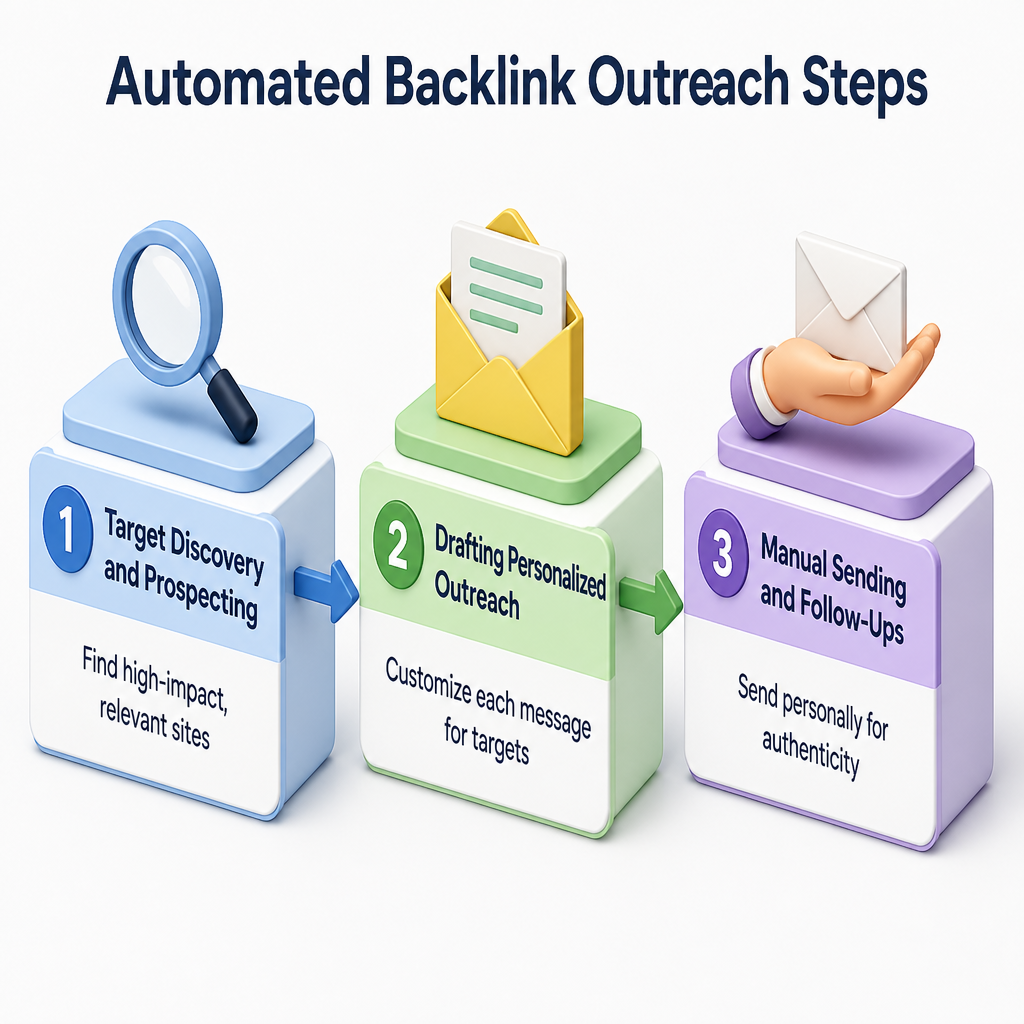
Drafting Personalized Outreach
Personalized outreach is generated automatically, but customization is built in at every step to keep messages from feeling generic. SEOLadders drafts a unique email for each target, referencing why your business belongs on their page and addressing the specific editor or contact.
Key personalization steps include:
- Referencing content gaps — Explains exactly what’s missing from their page and how your brand fills it.
- Contextual intros — Openers tailored from bylines or LinkedIn info when available.
- Concise value propositions — Brief, relevant pitches showing mutual value.
Manual Sending and Follow-Ups
Manual sending is critical for maintaining authenticity and inbox deliverability in automated outreach campaigns. With SEOLadders, users copy each drafted email and send it from their own account, ensuring the message comes from a real person and not a bulk sender.
This approach means:
Warning: Fully automated sending often risks deliverability issues and can trigger spam filters—manual review and send remains best practice for maintaining trust.
When Should You Use Automated Backlink Outreach—And When Should You Avoid It?
Deciding when to automate backlink outreach depends on your goals, resources, and the need for personalized engagement. This section breaks down when automation drives results and when manual effort is better.
Ideal Scenarios for Automation
Automated backlink outreach is most effective when scale and consistency matter more than tailored one-to-one connection. Businesses with large content portfolios, limited outreach hours, or a need to monitor many competitors can benefit from automation, as platforms like SEOLadders identify high-opportunity targets and draft up to 15 outreach emails weekly. This speeds up link prospecting, prioritizes relevant contacts, and maintains a steady pipeline without sacrificing basic personalization. Automation is typically best for:
When Manual Outreach Wins
Manual outreach excels when building high-value, personal relationships or pitching unique collaborations. Certain partnership requests, custom content deals, or delicate publisher negotiations require personal back-and-forth and in-depth research that automation can’t match. It’s more effective to write every word yourself when:
- Approaching industry leaders for top-tier editorial links
- Negotiating content partnerships with influential brands or blogs
- Managing complicated brand collaborations or sensitive link placements
Manual work often results in higher response rates for opportunities that demand a personal touch.
Avoiding Spam and Over-Automation
Over-relying on automation risks outreach being labeled as spam and undermining your reputation. Large-scale template blasts, generic requests, or skipped research can lead to blacklisting, ignored emails, or even damaged domain trust. Sustainable outreach means:
- Limiting outreach volume to targeted, relevant contacts
- Personalizing merge fields and referencing specifics about the recipient
- Rotating templates and subject lines to avoid spam triggers
- Monitoring responses and adapting messaging as needed
Smart automation always includes human review before sending, as in SEOLadders, where users approve and dispatch every drafted email.
Tip: Pairing automated tools with manual review ensures every outreach email stays relevant and avoids spam filters.
Automated Backlink Outreach vs. Fully Manual Campaigns
Choosing between automated backlink outreach and fully manual campaigns comes down to balancing speed, personalization, and scalability for your link building goals. This section breaks down the key differences that influence which approach will help your business grow faster without sacrificing authenticity.
Effort and Time Comparison
Automated backlink outreach dramatically reduces the repetitive workload compared to manual campaigns. With automation platforms, most research—finding link prospects, sourcing contact info, and drafting pitches—is handled in bulk, saving teams hours each week. Manual outreach requires building lists, researching contacts, and crafting every email one by one, which quickly becomes time-consuming at scale.
Typical automation workflows include:
- Automated prospect discovery: Software curates lists of relevant sites.
- Contact identification: Emails or LinkedIn profiles are collected automatically.
- Drafted emails: Personalized templates are generated, ready for review.
Manual processes, by contrast, mean:
Cost and Scale Differences
Automated outreach delivers lower per-link costs and higher scalability than manual campaigns. Manual link building often means either dedicating expensive in-house labor or hiring agencies, both of which can become costly as you expand your outreach targets. Automation tools typically charge a flat monthly fee for unlimited or high-volume prospecting, which supports growth without proportional cost increases.
Below is a simple comparison:
| Approach | Startup Cost | Ongoing Cost | Scale Potential |
|---|---|---|---|
| Manual | Low (time) | High (labor/agency) | Limited by staff size |
| Automated | Moderate | Fixed subscription | High |
Scaling a fully manual campaign commonly hits resource constraints, while automation keeps incremental costs in check as outreach volume grows.
Which Approach to Choose?
Automated backlink outreach suits brands prioritizing speed, reach, and efficiency, while manual campaigns offer maximum personalization for select targets. Teams often use automation to handle the bulk of prospecting and outreach, then switch to manual methods for high-value or complex relationships.
Consider automation if:
- You have a lean team, tight timelines, or aggressive growth targets.
- Personalization standards can be met with drafted templates.
- You need to regularly hit large outreach numbers.
Expert Insight: Many businesses combine automated outreach for scale with manual touches on a shortlist of high-priority websites to maximize both efficiency and personalization.
Common Automated Backlink Outreach Mistakes
Mistakes in automated backlink outreach can slow your results, damage your reputation, or keep your team chained to tactics that just don’t work. Here’s where automation efforts most often go off track.
Neglecting True Personalization
Personalization is what separates effective outreach from mass spam. Relying entirely on software to craft and send pitches often strips out details unique to the recipient or their site, making messages feel generic. Personalization in 2026 means more than mail merging a name; it means referencing relevant content, acknowledging the editor’s expertise, or pointing to where your solution intersects with the target’s audience. For example, a campaign targeting tech bloggers initially used generic emails about a new SEO tool and got few replies. Replies went up after each email mentioned a specific article on the blogger's site and how the tool could help that article. Teams using automated drafting tools like SEOLadders can skip this pitfall by editing draft emails before sending, tailoring each pitch’s opening and value statement. A generic approach may reach inboxes, but it rarely wins quality backlinks because editors recognize mass outreach at a glance.
Low-Quality Prospecting Targets
Targeting irrelevant or low-authority sites wastes effort and risks your reputation. Many outreach platforms generate wide prospect lists, but if you don’t vet those prospects, your campaign will underperform. Low-caliber targets might include unrelated directories, abandoned blogs, or sites flagged for spam. A better workflow is to start with curated lists—such as sites already cited by AI or by your top competitors—and review site quality before outreach begins.
Tools that prioritize reputable, contextually relevant targets put your site in front of actual decision-makers. To see how this targeting works in practice, review the workflows in 7 Best Backlink Outreach Tools for Earning Quality Links [2026].
Overusing Template Emails
Template emails sent en masse are easy for editors to spot and ignore. Rigid templates result in repetitive messaging, leading to low open and response rates over time. The fastest campaigns calibrate templates only as a starting point: users adapt messaging based on the target’s content, linking history, or editorial guidelines. Smart workflow: save reusable blocks for introductions or value props, but personalize the context and ask.
Many brands now flag generic or recycled pitches as spam, blacklisting entire domains. Quality outreach relies on balancing efficient drafting with thoughtful, bespoke edits.
Warning: Automated tools can speed up outreach, but over-automation without oversight can put your domain on editor blacklists or earn spam complaints that are hard to reverse.
Frequently Asked Questions
What’s the fastest way to run automated backlink outreach?
The fastest way to run automated backlink outreach is by using a tool like SEOLadders that identifies up to 15 relevant link opportunities weekly, finds contact info, and drafts personalized outreach emails for you to send. This maintains personalization while accelerating the process. SEOLadders also supports link exchanges among members, further boosting backlinks efficiently without losing authenticity.
How do you keep backlink outreach personalized at scale?
To maintain personalized backlink outreach at scale, automate contact discovery and draft customized emails based on relevant content your audience reads. SEOLadders, for example, drafts up to 15 personalized outreach emails weekly tailored to each target, but lets you send them personally, preserving authenticity while saving time.
Do automated outreach tools risk violating Google spam policies?
Automated outreach tools can risk violating Google spam policies if they send impersonal, mass emails or low-quality link requests. SEOLadders mitigates this by drafting personalized, relevant outreach emails for users to send themselves, maintaining authenticity and compliance. Users control sending, ensuring each pitch stays tailored and respects Google's guidelines.
Can SEOLadders fully automate email sending?
No, SEOLadders does not fully automate email sending. It drafts personalized outreach emails for backlink campaigns, but users must copy and send these emails themselves, as the platform contains no send button or direct email dispatch capability.
What’s commonly misunderstood about scalable outreach?
A common misunderstanding about scalable outreach is that increasing volume means losing personalization. However, effective scalable outreach uses automation to draft personalized, relevant pitches without sending generic batches. For instance, SEOLadders drafts up to 15 tailored backlink outreach emails weekly based on buyer audience data, but users send them manually to maintain authenticity and control.
Conclusion
If you’re eager to speed up your link building without sounding like a robot, here’s what matters: SEOLadders delivers the fastest approach by automating research and personalized draft pitches, keeping your outreach efficient while you stay hands-on with the actual send. You’ll save the most time on prospect discovery, avoid dead ends with actionable drafts, and never lose the personal credibility that gets replies. Manual-only campaigns simply can’t compete on scale or speed, and less-focused automation means more rejections in your inbox.
Here’s how to put what you’ve learned to work right away:
- Connect your site to SEOLadders and review the actionable link targets it provides
- Personalize or approve the drafted pitches and send them from your inbox
- Track which links go live and follow up on any that disappear with SEOLadders’s monitoring alerts
- Use the Monday recap and prioritized task list to see results and adjust your outreach weekly
Automated outreach doesn’t mean generic—and SEOLadders proves that you can scale faster without giving up on what works.
Ready to scale your outreach while preserving personalization? See how SEOLadders streamlines backlink campaigns with actionable drafts and smart prospecting in our detailed link building workflow.

Samuel Kwesi Afriyie
Founder of SEOLadders
Samuel is a software engineer who builds SEOLadders, an AI SEO agent for Google and AI search. This site, including this blog, runs on it.
Want this done for you? SEOLadders finds the topics, writes the articles, and gets you cited by AI and ranking on Google, on autopilot.
3-day free trial · Cancel anytime