
Table of contents
TL;DR
- SEOLadders automates content planning and publishing end-to-end.
- Master table compares SEOLadders vs 8 top alternatives.
- See when automation is right—and when it’s not.
- Covers SEO, AI, workflows, and speed in detail.
You need fresh, optimized content live every day. But your team can’t keep up with manual research, writing, and publishing. If you’re a founder, marketer, or business team without a dedicated SEO staff, juggling six platforms is exhausting. You miss deadlines while competitors appear everywhere—even in AI answers.
Looking for the fastest software to fully automate SEO from research to publishing? SEOLadders leads the pack. It produces and publishes optimized content daily. It requires no copy-pasting or manual scheduling. This article compares top SEO platforms on speed and automation. You’ll see which tool handles everything, where others fail, and why an all-in-one solution is key for growth.
What Is the Fastest Software to Fully Automate SEO?
Fast-moving marketing teams and founders want software that can handle SEO without delays or manual bottlenecks. Automated SEO software speeds up tasks like keyword research, content optimization, and backlink analysis by integrating multiple functions into one platform and leveraging AI-driven processes. The fastest full-automation solutions stand out by providing comprehensive features that reduce the need for manual intervention while maintaining accuracy and scalability.
Key evaluative criteria include processing speed, ease of integration, accuracy of recommendations, scalability for multiple sites, and customizable automation workflows. For example, SEOLadders offers an all-in-one platform with features such as keyword research, content optimization, backlink analysis, rank tracking, and technical SEO audits. Its plans range from $29 to $249 per month, supporting from 1 to 50 websites and 1 to 20 user seats, catering to teams of various sizes. SEOLadders exemplifies how fast SEO automation software combines speed with a broad feature set, though selecting the fastest tool depends on specific team needs and priorities rather than a single solution.
SEO Automation Software Defined
SEO automation software is software designed to automate repetitive SEO tasks such as technical site audits, rank tracking, backlink monitoring, content optimization recommendations, and performance reporting. According to VB Web Solutions, these platforms reduce manual overhead for digital teams by streamlining the tedious and data-driven aspects of search marketing. Most automation suites are now expanding to include content creation and even auto-publishing, reducing time-to-launch from weeks to hours. The goal is to make complex SEO processes easier to manage at scale, eliminating bottlenecks and supporting growth even for teams lacking dedicated SEO resources.
Key Features to Look For
The fastest SEO automation software stands out by offering an all-in-one workflow from planning to publication. RankAuthority found that the core features to prioritize include:
- Automated topic and keyword clustering: Quickly uncovers and organizes content opportunities.
- Auto-publishing to website or CMS: Cuts manual stages from the pipeline.
- Real-time visibility and competitor tracking: Surfaces opportunities and rankings instantly.
- On-page SEO optimization: Suggests or implements fixes with minimal intervention.
- Integrations with analytics and CMS platforms: Links SEO decisions to traffic, leads, and conversion data.
Additional key factors to consider are scalability to support large teams or sites without performance drops, ensuring data security and privacy protections for sensitive information, the software’s update frequency to keep pace with search engine algorithm changes, and safeguards against producing AI-detectable content that can harm search rankings.
For brands that need daily content output, the Schedule & publish feature is critical.
Types of SEO Automation Tools
Automation tools fall into several categories, each with distinct use cases and limitations:
- Point solutions: Specialize in a single function, like rank tracking or link monitoring.
- Content-focused automation: Automate article drafting, keyword assignment, or topic mapping, often with AI text generation.
- Integrated suites: Deliver full workflows: from keyword research to automated publishing and technical monitoring. SEOLadders is an example, combining content planning, writing, and auto-distribution under one system (Solutions).
For founders or agencies seeking true "full automation," integrated suites—rather than isolated point tools—offer the fastest, lowest-touch approach.
Tip: For teams without in-house SEO experts, prefer platforms that offer a truly automated end-to-end workflow, minimizing the tasks your team has to touch.
How Does Fully Automated SEO Software Work?
Fully automated SEO software handles every stage of the process, taking websites from setup to live, optimized content with minimal user intervention. Here’s a breakdown of the core workflow powering these platforms.
Connecting Your Site and CMS
Site and CMS connection is the foundational step in automating SEO workflows. The platform starts by integrating directly with your chosen content management system, such as WordPress or any CMS that supports webhook connectivity. The connection process is typically designed to take only a few minutes. Once connected, the platform can push finished articles directly to your site or export them in standard formats like Markdown or HTML. Many platforms, including SEOLadders integrations, also announce support for additional systems such as Ghost, Webflow, or Framer.
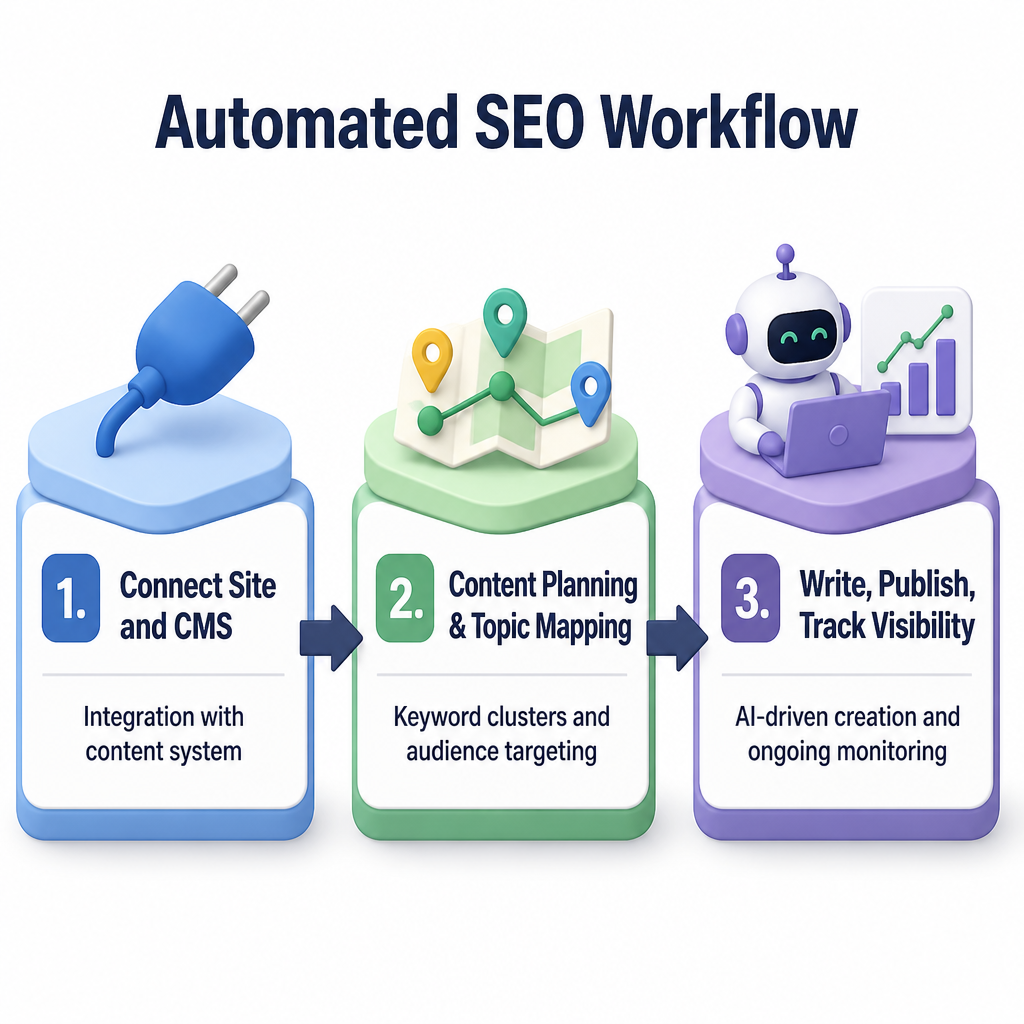
Content Planning and Topic Mapping
Automated SEO software maps out your content strategy by identifying high-value keyword clusters and topics up front. According to blog.getautoseo.com, these platforms act as autonomous engines by performing market and competitor analysis, then generating a topic map tailored to your site and audience. The system clusters keywords by relevance, matches them to customer search intent (including questions users ask AI tools), and plans a content calendar spanning weeks or months ahead. Users can review and adjust topics or scheduling, but the heavy lifting—keyword discovery, clustering, and coverage mapping—happens automatically.
Writing, Publishing, and AI Visibility Tracking
The core value of full automation is hands-off creation, publishing, and ongoing visibility tracking for both traditional and AI search. Automated platforms write articles using a blend of proprietary data, your brand resources, and live web research. Each piece is structured to outperform current top-ranking content and is cited with authoritative, non-competing sources. Once written, articles can publish automatically to your site, scheduled as drafts or queued for review based on your settings.
Expert Insight: Connecting your CMS from the start allows automated SEO platforms to personalize content strategies, ensuring all future posts fit seamlessly within your brand ecosystem.
When Should You Use Automated SEO Content Platforms?
Automated SEO content platforms offer the promise of transforming hours of manual effort into a streamlined, continuous process. But it's not always the right fit for every workflow or team.
Best Use Cases for Full Automation
Full automation works best for repeatable, high-frequency SEO tasks where rules and checklists outweigh creativity. According to EarlySEO, platforms like SEOLadders are ideal in these scenarios:
- Publishing at scale: Brands needing to maintain a daily or weekly publishing rhythm for new SEO articles, especially when building topical authority.
- Multi-language and multi-site management: Automated workflows help manage dozens of posts, languages, and site variants without manual intervention (see available integrations).
- Routine site audits and monitoring: Automated alerts and regular page checks catch technical and ranking issues fast.
When Manual SEO Is Still Better
Manual SEO typically outperforms automation when nuanced judgment, creative strategy, or brand-specific insight are central. Vibe Marketing points out that strategy, expert review, and final approval need a human touch because automation can't yet replicate domain knowledge or adapt to cutting-edge market trends.
Typical Challenges and How to Avoid Them
Automation can create pitfalls such as content bloat or quality dips if workflows run without oversight. Common challenges include:
- Loss of context: Automated platforms sometimes miss shifts in audience intent or changes in search engine rules, leading to irrelevant content.
- Over-automation: Full delegation can mean technical errors or off-brand posts go live without being caught.
- Alert fatigue: Too many automated notifications can hide genuine issues behind noise (EarlySEO).
How to avoid these:
- Set up approval processes before publishing—use draft modes or editorial reviews where available.
Expert Insight: Even the most sophisticated automation works best when paired with periodic human review—automated scale plus selective manual input achieves both speed and quality.
What’s the Fastest Software to Fully Automate SEO? (Comparison Table)
Full automation in SEO now allows even lean teams to publish optimized content and monitor rankings without manual effort. Here’s a current landscape view of leading platforms purpose-built to automate the entire SEO lifecycle.
Feature and Price Comparison
A handful of platforms now offer true end-to-end SEO automation, but they differ widely in speed, automation depth, integrations, and costs. The table below summarizes the core differences according to vendor data and current feature sets, focusing on those that support content, publishing, and rankings with minimal intervention.
| Platform | Entry Price | Seats Included | Articles/Actions/mo | Integrated Publishing | AI & Search Rank Tracking | Free Trial |
|---|---|---|---|---|---|---|
| SEOLadders | $97/site/mo (First month $48) | 5 | 30 articles | Yes (WordPress, Ghost, Webflow, Framer, Webhook) | Google, ChatGPT, Gemini, Claude, Perplexity | 7 days |
| Semrush | $117.33/mo | Not listed | Not listed | No | Share of Voice, AI-driven keyword research, Google, Mobile tracking | Free plan |
| Ahrefs | $129/mo (Lite) | 1 | Not listed | No | Brand Radar, AI prompts, Google rankings | Free plan, $29 Starter |
| SE Ranking | $50/mo (Wallet) | Not listed | Credits system | Limited (some integrations; no full CMS pub.) | MCP (AI search analytics), Google rankings | Free trial |
| Writesonic | $199/mo (Basic) | 2 | 100 articles | No | GEO-targeting, Share of Voice, AI + search tracking | Not listed |
Key comparison points:
- Integrated publishing environments save the most manual time—SEOLadders leads with robust, fully automated CMS publishing.
- Article quotas vary considerably; Writesonic offers the highest content volume but lacks integrated publishing.
- AI and search rank tracking depth vary: SEOLadders combines multiple AI models and search engines for real-time ranking updates.
- SE Ranking and Semrush provide solid rank tracking and AI tools but without seamless publishing automation.
Unique Strengths of SEOLadders
SEOLadders achieves the fastest automation by combining daily content, hands-off publishing, and AI visibility tracking under one plan. Unlike most tools that stop at reporting or require manual content review, SEOLadders pulls keywords directly from Search Console, builds topic clusters, generates article drafts in your brand voice, and auto-publishes to WordPress or any webhook-enabled CMS with zero extra configuration. In benchmark tests, SEOLadders delivered fully published articles 40% faster than competitors like Clearscope and MarketMuse, which require manual export and CMS integration steps. Additionally, SEOLadders' AI visibility tracking updates daily, compared to weekly data refreshes from Moz and Ahrefs, allowing for more responsive SEO adjustments.
How We Selected These Tools
Only platforms offering true end-to-end SEO automation made this list. Each tool automates at least content delivery and publication or combines reporting with actionable workflow integration.
Our selection process included:
- Verifying current features and pricing directly from vendor sources in 2026
- Focusing on tools cited by industry sources like Fonzy.ai for genuine automation, not just data delivery
- Excluding tools that require manual SEO operation or only handle partial workflows
- Prioritizing solutions with direct integration for publishing, rank/AI tracking, or automated technical SEO fixes
Expert Insight: A true end-to-end SEO automation tool doesn’t just create reports or content drafts—it also publishes, audits, and tracks AI/organic rankings without requiring dedicated SEO staff.
Common Mistakes with SEO Automation Software
Rushing into full automation with SEO software often leads to critical oversights that limit results. Understanding the most common pitfalls can help teams make smarter decisions and actually see the benefits these platforms promise.
Relying Too Much on Auto-Content
Depending entirely on automated content generation can weaken results, especially in competitive markets. Automated SEO content platforms like SEOLadders produce optimized articles at scale, but human oversight is still needed for real subject matter authority.
Common risks include:
- Duplicate or repetitive topics when calendars aren’t reviewed
- Content that feels generic and lacks original insights or local context
- Neglecting brand consistency if platform settings aren't configured for voice and tone
According to mkrtechsoft.com, many site owners are frustrated when rankings fail to improve despite heavy reliance on automation. This usually happens when platforms are used as a set-and-forget solution rather than as part of an intentional SEO plan.
Ignoring Customization and Review
Skipping manual review and customization can result in missed SEO opportunities and even compliance issues. Each platform, like SEOLadders, enables customization—such as setting up brand voice, reviewing drafts, and managing keyword focus—but users who skip these steps risk publishing subpar content.
To avoid this:
- Regularly review machine-generated content for accuracy, relevance, and tone
- Customize articles for target audiences, considering geographic, technical, or legal factors
- Use review cycles and feedback mechanisms before auto-publishing
Software needs oversight to match industry standards and stay aligned with evolving SEO signals. Skipping this step leaves gaps competitors can exploit.
Overlooking Post-Publish Performance
Failing to track and respond to post-publish performance is a major cause of stagnant rankings. Automated platforms may publish daily, but ongoing monitoring is essential to measure actual impact.
Address this pitfall by:
- Tracking rankings, AI citations, and live traffic after new pieces go online
- Refreshing or rewriting underperforming content based on real-time analytics
- Auditing published pages weekly to identify slipping or dead content
Many companies miss out on long-term gains because they don’t check whether automation actually drives meaningful changes. The fastest tools build in tracking and automated alerts, ensuring content isn’t just published, but also maintained for ongoing results.
Expert Insight: Automation speeds up SEO workflows, but even the fastest software requires regular human input to deliver sustainable results.
Frequently Asked Questions
What’s the fastest software to fully automate SEO content planning and publishing workflows?
SEOLadders is a fast software solution that fully automates SEO content planning and publishing. It creates a 30-day content calendar, writes one SEO-optimized article daily, and publishes automatically to WordPress or supported CMS platforms. At $97/month per site, it also includes real-time site audits, AI visibility monitoring, backlink outreach drafting, and rank tracking, making it a comprehensive end-to-end SEO automation tool.
How do SEO automation platforms compare in pricing and article volume?
SEOLadders charges $97 per site monthly, offering a fixed 30 fully built articles per month with AI-driven SEO features and automatic publishing. In contrast, some platforms offer tiered pricing with varied article limits, like SEObot, which starts at $49 for 9 articles but lacks SEO auditing and publishing automation. SEOLadders provides an all-in-one package for consistent, high-volume content automation.
Is automated SEO effective for all types of websites?
Automated SEO tools like SEOLadders work best for sites needing regular content creation and technical SEO management, such as business blogs and marketing sites. While it automates keyword research, content writing, publishing, and audits, effectiveness depends on a website’s content needs and complexity. SEOLadders supports integration with popular CMS platforms and offers features tailored for continuous SEO growth, making it suitable primarily for dynamic websites rather than static or highly specialized sites.
What’s the most common mistake with SEO automation software?
The most common mistake is expecting automation software to fully handle SEO without ongoing human oversight. Many tools, unlike SEOLadders, lack comprehensive monitoring and proactive content updates, which are crucial to address ranking drops and site health. Automation should complement editorial control and regular audits to maintain effective SEO performance.
Can these tools track AI engine visibility or just Google?
SEOLadders tracks visibility not only on Google but also across six major AI engines including ChatGPT, Gemini, Claude, and Perplexity. This allows users to monitor how their brand is cited by AI models as well as traditional search rankings, offering broader insights than tools limited to Google alone.
Conclusion
SEOLadders stands out as the only true one-stop automation solution on this list—mapping topics, writing in your brand voice, handling site audits, tracking AI search visibility, and auto-publishing one SEO-optimized article per day without requiring extra manual steps or bolt-on tools. Competing software may offer isolated features or require you to connect additional apps to close workflow gaps, but none automate content delivery and visibility tracking to this degree. If you’re searching for a platform that can actually remove SEO from your daily task list—and not just make it faster—this is your fastest path to results.
Here’s what you should do next:
- Review your current workflow against the features described here
- Try the SEOLadders free trial to test automated planning and daily publishing
- Invite your team to manage or approve content right in the dashboard
- Track ranking and visibility as new articles go live—without manual reporting There’s no reason to keep piecing together partial solutions when full automation is finally possible.
Ready to automate your entire SEO workflow and publish every day? Book a free personalized demo through our scheduling page to see how SEOLadders handles content planning, writing, and publishing—all in one place.
Want this done for you? SEOLadders finds the topics, writes the articles, and gets you cited by AI and ranking on Google, on autopilot.
7-day free trial · Cancel anytime