
Table of contents
TL;DR
- Covers best AI content automation tools for multi-client agencies
- Compares 7 tools: features, pricing, workflow fit
- Includes detailed decision table and practical guidance
- Highlights agency pain points and scalable solutions
Managing multiple clients means SurferSEO and similar tools often fall short on content automation. They can’t handle volume or require too much back-and-forth across accounts. Manual optimization tools and basic automation hit a limit quickly, making it hard to scale consistent, quality content while juggling audits, rankings, and client demands.
This guide helps agencies pick the best AI content automation tools beyond the usual platforms. We compare alternatives like Semrush, Moz Pro, SE Ranking, Profound, Otterly, Writesonic, and more, focusing on research, writing, publishing, and reporting. You’ll learn when to switch and how to avoid common mistakes, so you can choose tools that fit your multi-client workflows.
What Are Good AI Content Automation Tools Besides Surferseo?
AI content automation is reshaping how marketing agencies and multi-client teams produce, optimize, and publish digital content at scale. This section defines what these platforms do, who most needs them today, and the foundational terms to know.
What is AI content automation?
AI content automation uses artificial intelligence to create, optimize, and distribute digital content with minimal manual input. Traditionally, automation handled repetitive tasks like scheduling posts or generating reports, but AI now drafts articles, rewrites pages, and sends content to multiple channels automatically.
For agencies managing multiple client sites, these tools eliminate manual content creation by selecting topics, assembling drafts, and pushing finished work directly to client CMSs through pre-set rules or detected opportunities. This boosts speed and consistency, allowing the entire content lifecycle—from research to optimization—to run continuously, even when teams are focused elsewhere.
Who needs these tools in 2026?
Multi-client agencies and marketing teams managing high content volumes need AI content automation most urgently. As of 2026, platforms like SurferSEO and newer alternatives are increasingly essential for agencies handling diverse client portfolios, as they remove the manual bottleneck from ideation to publication.
HubSpot reports that 92% of marketers use generative AI for content creation and ideation, with Adobe research showing AI-driven automation can reduce production time by up to 60% (directoryone.com). At this scale, agencies managing a dozen brands or more simply can’t rely on manual workflows without falling behind competitors using these tools.
Key terms: NLP, publishing integration, workflow automation
NLP (Natural Language Processing) powers the text-generation and optimization. It allows software to "understand" and produce language that aligns with brand tone, keyword strategy, and topic requirements.
Publishing integration means direct connection to CMSs like WordPress, Ghost, Webflow, or via webhook. This lets agencies publish finalized content or hold drafts with no copy-paste steps.
Workflow automation refers to directing each stage—from keyword research and article drafting to audits and re-optimization—so that multi-client teams can manage all sites from one dashboard without skipping tasks. Each term underpins the promise that agencies can do more with less, while maintaining editorial oversight.
For a direct feature breakdown between SurferSEO and true end-to-end automation suites, see how we compare with Surferseo.
Expert Insight: Agencies using AI automation platforms in 2026 can support more clients per team member, but results depend on picking tools that genuinely automate—not just accelerate—the workflow.
How Do Top AI Content Automation Tools Work for Agencies?
AI content automation tools break agency workflows into specialized phases, from initial research to ongoing optimization. Understanding how these software platforms operate at each stage helps agencies scale content output while maintaining quality and SEO impact.
Step 1: Keyword and prompt research
Keyword and prompt research is the foundation of most AI content automation workflows for agencies with multiple clients. Tools in this category typically automate keyword discovery by crawling the client's existing site, analyzing Google Search Console data, or identifying topics competitors rank for. SEOLadders, for example, automatically maps clusters of topical keywords across each client site and generates AI prompts tailored to fill specific content gaps, reducing manual research overhead (see the approach).
- Automated topic and keyword mapping saves hours versus manual spreadsheet management per client.
- Competitor gap identification pinpoints opportunities agencies wouldn't see in raw CSV exports.
- AI search prompt generation tracks generative engine visibility and which brands surface for top industry queries.
According to AFF Digital Review, automation tools simplify this phase for marketers by surfacing high-value keywords and content ideas rapidly.
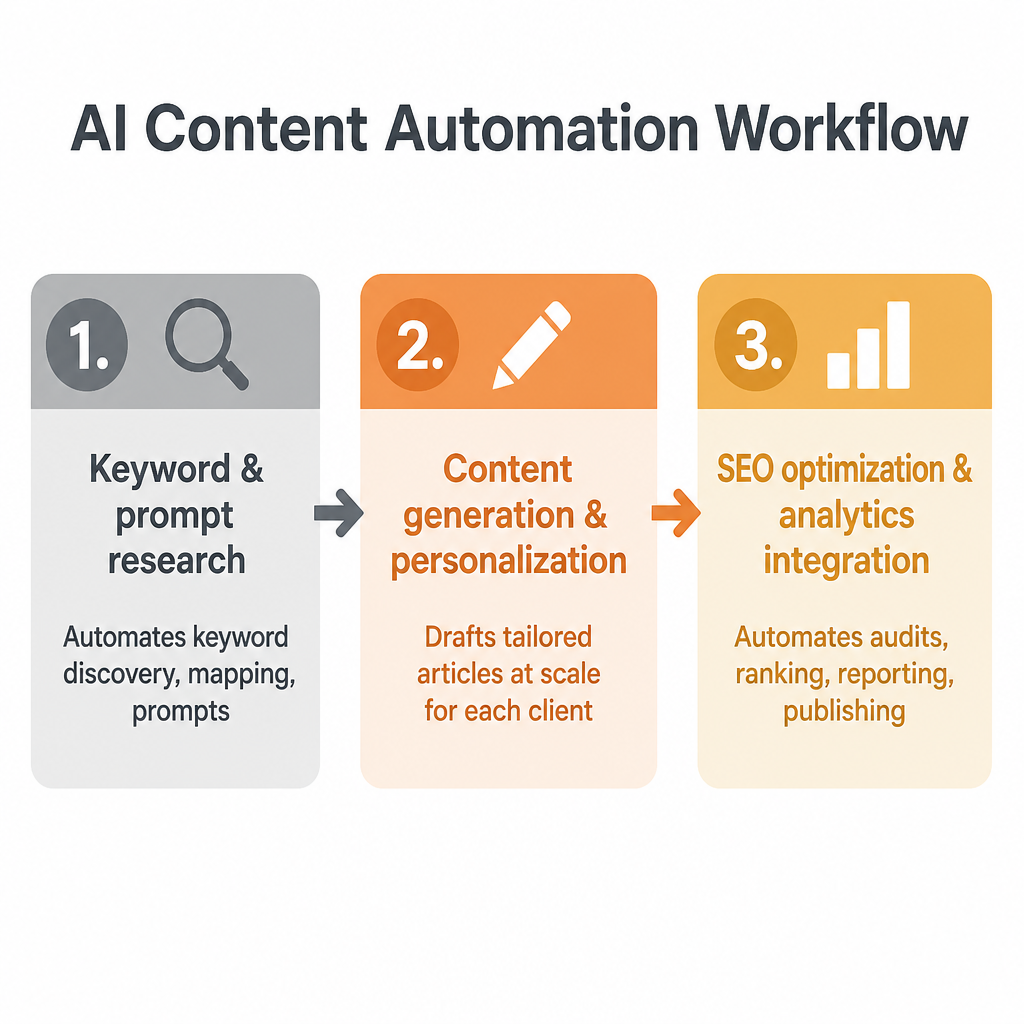
Step 2: Content generation and personalization
AI tools generate and personalize content drafts at scale by combining keyword inputs with brand-specific data. Most platforms, including SEOLadders, offer workflows that automatically draft 20 to 30 articles per month per client, customized for site voice and target audience. Bulk writers like Writesonic and SurferSEO also let agencies modify tones and formats for each client domain.
- Brand knowledge integration lets agencies ensure every article reflects the client's knowledge base instead of generic outputs.
- Built-in image and citation handling means drafts come with supporting visuals and proper references, ready for publishing.
- Language coverage—such as SEOLadders' support for 23 languages—enables agencies to serve global clients without switching tools.
AFF Digital Review notes that the best automation tools maintain content quality even at high volumes, with style controls for each brand.
Step 3: SEO optimization and analytics integration
SEO optimization and analytics integration ensure that content driven by AI platforms ranks as intended and supports long-term strategy. Leading automation suites automatically audit published content for SEO health (site structure, internal links, page freshness) and track rankings across both Google and AI search engines. SEOLadders uniquely adds weekly site health crawls, auto-rewrites slipping articles, and monitors visibility on platforms like ChatGPT and Gemini.
- Integrated dashboards bring together Google rankings, AI search coverage, and backlink status for every client under one login (agencies benefit from this single view).
- Automated alerting and reporting let agencies quickly spot and act on declining pages or new opportunities.
- Direct publishing integrations (WordPress, Ghost, webhook) make content deployment frictionless.
Analytics allow agencies to quantify content ROI and adjust their content calendars based on real audience and search trends.
Expert Insight: Even with full automation, retaining editorial review before publishing—an option in most tools—prevents off-brand or inaccurate content from reaching client sites.
When Should Agencies Look Beyond SurferSEO?
While SurferSEO remains a popular choice for content optimization, certain agency use cases require different workflows or additional automation. Knowing when to consider alternatives helps agencies deliver both scale and results for multiple clients.
Best scenarios for alternatives
Some agencies outgrow SurferSEO’s manual workflow as they take on more clients or want to expand automation. The most common triggers include:
- Needing hands-off content automation – Agencies managing large volumes of client sites may prefer a platform that fully automates topic research, article creation, publishing, and periodic rewrites rather than relying on manual editing and scheduling.
- Bulk content production requirements – If an agency must deliver daily content across many clients or tight content cluster deadlines, tools with auto-publishing and multi-site support can relieve bottlenecks.
- Desire for integrated technical SEO – End-to-end platforms that include real-time audits, automated health checks, and direct action on technical issues can reduce the vendor stack and free up operations time.
- Comprehensive AI search and backlink monitoring – Agencies increasingly want platforms that track AI search mentions and automate backlink discovery in a unified dashboard, expanding beyond SurferSEO’s core focus on on-page optimization.
For more details on platform differences, see how we compare with Surferseo.
Where SurferSEO fits well
SurferSEO is best suited for agencies prioritizing manual control over every stage of content optimization. It excels when:
- Editorial teams want step-by-step keyword guidance – Editors can access dynamic recommendations directly inside a content editor and apply changes manually.
- The workflow benefits from interactive optimization – Some clients demand custom, hands-on tweaks to every article, which SurferSEO’s real-time scoring and competitor analysis support.
- Agencies need a flexible tool – SurferSEO lets users cherry-pick features like content scoring, site audits or rank tracking, keeping teams in the loop at every step.
A manual approach gives agencies control, but the tradeoff is higher labor and slower scaling compared to platforms that auto-generate and schedule content end-to-end.
When AI writing assistants add value to agency workflows
AI writing platforms add value where agencies aim to automate repetitive content tasks and minimize manual intervention. Key benefits include:
- Automated draft and publishing – Some tools fill article calendars automatically, reduce review cycles, or publish directly to the CMS without constant user action.
- Consistent multi-lingual or high-volume output – When agencies manage clients across markets or languages, automated writing tools help maintain pace and consistency.
- Scalable reporting and monitoring – Integrated dashboards consolidate rank, technical health, AI search mentions, and backlinks, streamlining client reporting workflows.
Agencies that embrace these automation features typically operate at a higher scale with more predictable delivery times and easier onboarding for new clients.
Expert Insight: If your agency’s growth is stalling due to manual bottlenecks in research, writing, or publishing, evaluating automation-focused alternatives can unlock new capacity quickly.
AI Content Automation Tools Compared: Which Is Right for Your Agency?
Choosing the right AI content automation platform depends on your clients' needs, scale, and the workflow you want. This section lays out a direct, fact-based comparison of top-rated tools so agencies can make an informed, side-by-side decision.
Master comparison table: features, pricing, limits
A thorough, multi-factor table gives agencies a clear perspective on limits, costs, and client management features in each platform. This chart strictly uses published numbers from official vendor pages and trusted knowledge.
| Tool | Entry Price (monthly) | Seats Included | Article/Prompt Limit | AI Search Tracking | CMS Integrations | Free Trial |
|---|---|---|---|---|---|---|
| SEOLadders | $97/site (1st mo $48), then $97 | 5 per site | 30 articles, 15 links/wk | Yes: 6 AI engines | WordPress, Webhook, Ghost, Webflow (soon), Framer (soon) | 7 days |
| Semrush | $117.33 (SEO) | 1 | 120 reports/day (SEO) | Yes: track AI search | WordPress, HubSpot | Free |
| Moz Pro | $20 (Starter Md) | 1 | 300 queries/mo | Not listed | Not listed | Free |
| SE Ranking | $50 (Wallet) | 1 | 100K credits (trial) | Not listed | WordPress | Free trial |
| Profound | Not listed | Not listed | Credits model (runs) | Yes: Answer Engine Insights | Not listed | Free trial |
| Otterly | $25 (Lite) | 1 | 15-1000+ prompts | Yes: 4 AI engines | Not listed | Not listed |
| Surferseo | $49 (Discovery, yearly) | 1 | 20 pages/mo | Yes: 5+ AI search types | WordPress, HubSpot, Shopify | Not listed |
| Writesonic | $199 (Basic, annual) | 5 | 100+ prompts (Basic) | Yes: 7+ AI engines | WordPress, Shopify, HubSpot | Not listed |
Agencies can use this chart to pinpoint which software fits their budget and allows for needed article or prompt volume. Full details are available on each vendor’s pricing and features page.
Detailed pros and cons by tool
Every agency platform has distinct strengths and tradeoffs, often determined by automation level, visibility monitoring, and integration breadth.
SEOLadders / Semrush
Pros: Comprehensive keyword tracking and backlink analysis; robust content audit features; automation level supports scheduled reports and alerts; strong integration with major CMS and marketing platforms; suitable for agencies managing multiple clients with up to 5 user seats on the Guru plan.
Cons: Higher pricing tiers may be costly for smaller agencies; some advanced features require manual configuration; content creation tools less advanced compared to dedicated AI writing platforms.
Jarvis (Jasper AI)
Pros: Advanced AI content generation optimized for marketing copy and blogs; wide range of templates and tones; strong automation for bulk content production; intuitive interface good for fast agency workflows; team plans support multiple seats.
Cons: Limited SEO keyword research features; output sometimes requires substantial editing for accuracy; pricing can escalate with word count demands.
Writesonic
Pros: AI-driven generation with an emphasis on creativity and long-form content; versatile tool for blogs, ads, and product descriptions; automated plagiarism detection; affordable plans with generous word limits; supports agency collaboration via multi-seat subscription.
Cons: SEO integration is basic; quality can vary depending on input prompts; less developed analytics and reporting features.
Copy.ai
Pros: Quick generation of marketing copy, social posts, and brainstorming ideas; user-friendly with many templates; decent automation for repetitive tasks; suitable for agencies focusing on social media content.
Cons: Content quality sometimes formulaic; limited content length per generation; lacks comprehensive SEO tools and integrations.
Surfer SEO
Pros: Combines AI content generation with deep SEO data analysis and optimization; real-time content scoring to improve search rankings; automation of content audits and keyword strategy; integrates well with content platforms; appropriate for agencies needing detailed SEO insights alongside content creation.
Cons: Less focused on pure content volume generation; pricing may be high for small teams; learning curve for full feature adoption.
Each of these tools fits particular agency needs, balancing automation, content quality, SEO integration, and multi-user collaboration differently.
How each tool supports multi-client marketing automation
Multi-client agencies need software that separates client sites and calendars without clutter or confusion.
- SEOLadders:
- Per-site isolation: Each client is a separate site, with unique clusters, content calendars, and reporting.
- Automation: Daily publishing, AI tracking, and site health checks are fully managed per client, enabling hands-off workflow for agencies.
- Team Access: Offers 5 seats per site, simplifying team management and access control for multiple clients.
- Semrush:
- Multiple sites trackable: Designed for agencies with project setup required for each client to separate data and reporting.
- Automation: Lacks built-in publishing automation, so content scheduling and workflows often require manual steps or integration with other tools.
- Reporting: Provides extensive client-specific analytics but requires careful project management to avoid data overlap.
- Moz Pro, SE Ranking, Profound, Otterly, Surferseo, Writesonic:
- Project structure: Most support multiple projects or campaigns, enabling some level of client data segregation.
- Workflow segregation: Typically limited to creating separate projects; they do not offer advanced workflow automation or segregated content calendars for multi-client agencies.
- Automation and publishing: Only SEOLadders documents fully automated content creation and publishing per client. Others often require manual content editing, approval, export, and publishing processes that complicate multi-client management.
- Reporting: Client-specific reporting is generally basic or requires exporting data for custom presentation, which can slow down agency operations.
For more context on agency workflows, see our agency solution comparison.
Tip: Pay special attention to seat limits and automation claims—most platforms require more manual work per site than their marketing suggests.
Common Mistakes Agencies Make With AI Content Automation
AI content automation brings major efficiencies, but agencies often run into avoidable pitfalls when scaling it across multiple clients. Understanding these problems can help agencies deliver stronger, more consistent results.
Relying solely on automation for all content types
Automating every content format without oversight can reduce quality and effectiveness. AI tools excel at producing informational articles and handling programmatic publishing, especially across high-volume keyword clusters. But when agencies use automation for all asset types—including case studies, in-depth thought leadership, and nuanced opinion pieces—the results often miss client expectations around voice, originality, or depth.
- Generic content risk: Automated workflows often default to safe, surface-level language. Complex topics may not get the expertise or proprietary insight clients expect.
- Strategy gaps: Automated planning sometimes overlooks evolving search intent or seasonality that a human strategist would spot.
- When to intervene: Scenario-based guides, interviews, and unique long-form content benefit from manual review or human touch before publishing.
For more on selecting the best automation tools for each workflow, see All alternatives.
Overlooking brand voice and message consistency
Failing to maintain consistent brand voice is a common automation mistake. While many AI platforms can adapt tone using initial prompts or brand guidelines, small inconsistencies creep in over large content volumes—especially for agencies juggling many clients with distinct style requirements.
- Loss of differentiation: Uniform AI output can blur brand personalities if not tuned for each client.
- Review process required: Adding a final approval or review step helps catch off-brand messaging before articles go live.
- Customization features: Advanced tools like SEOLadders let agencies set custom voice profiles per client, reducing manual editing while keeping messaging sharp. See how articles are written for implementation strategies.
Ignoring data analytics and ongoing optimization
Skipping analytics and regular optimization leads to stagnant results over time. AI-generated content is not “set it and forget it.” Topic gaps, keyword trends, and shifting AI-platform algorithms mean some articles perform well at launch but slip later if not monitored.
- Weekly audits matter: Tools with built-in site audits and performance tracking, like SEOLadders, help agencies catch underperforming pages, dead content, or declining rankings quickly.
- Iterative updates: Setting up workflows that include scheduled rewrites, backlink monitoring, and regular reporting ensures content stays effective.
- Visibility tracking: Monitoring presence in both traditional and AI search keeps agencies alert to where clients are (or aren’t) surfacing. Agencies features details how automation platforms can support this process.
Expert Insight: Agencies balancing automation and human oversight tend to avoid the content quality issues and misalignments that fully automated workflows often introduce.
Frequently Asked Questions
What are good AI content automation tools besides SurferSEO?
Besides SurferSEO, SEOLadders is a strong AI content automation tool that fully automates keyword research, content planning, writing, publishing, and site audits. It supports multiple CMS platforms, tracks AI visibility on major models, and offers backlink outreach—all under one $97/month plan per site, ideal for agencies managing several clients.
How do AI content automation tools help agencies manage multiple clients?
AI content automation tools streamline managing multiple clients by automating SEO tasks like keyword research, content planning, writing, publishing, and site audits across client sites. For example, SEOLadders offers a single dashboard where agencies add each client as a separate site with dedicated keyword clusters and content calendars, producing up to 30 articles monthly per client. This automation improves efficiency, maintains brand voice, and monitors AI visibility and rankings, all within one platform.
Which tools provide the best workflow integration for agencies?
SEOLadders offers top workflow integration for agencies managing multiple clients by supporting separate client sites within one account, each with dedicated topic maps and calendars. It automates content planning, writing, publishing directly to WordPress or via webhook, and site audits, while tracking AI visibility and backlink outreach. This streamlines SEO tasks across clients efficiently under a single dashboard.
Do these AI tools maintain consistent brand voice across content?
Yes, some AI content automation tools, including SEOLadders, maintain a consistent brand voice by using the agency's or client's brand knowledge base during automated content creation. SEOLadders generates up to 30 articles monthly per site, tailored to the specified brand voice across 23 languages, ensuring uniformity across all published content.
Is relying only on automation a mistake for agency content?
Yes, relying solely on automation can be a mistake for agency content because it may lack human editorial control and nuanced quality checks. While SEOLadders automates content planning, writing, publishing, and SEO audits, agencies still maintain editorial review to ensure brand voice and context accuracy before publishing, balancing automation efficiency with human oversight.
Conclusion
Agencies managing multiple clients need more than one content automation tool to handle diverse needs. Each AI platform here targets different priorities—whether hands-off publishing, SERP analysis, local SEO, collaboration, or custom reporting. Success depends on matching tools to your workflows and client demands, not just scaling what worked on smaller sites. Avoid common pitfalls like overestimating automation, skipping manual checks, and missing key reports.
Next steps:
- Assess your agency’s workflow and pain points.
- Shortlist 2-3 tools from this list for side-by-side trials.
- Evaluate speed, content quality, and CMS integration during trials.
- Pilot the best fit with your top client to verify reporting and automation.
Combining the right tools lets you save time and improve client outcomes without relying solely on SurferSEO.
Ready to modernize your multi-client SEO workflow? Explore more about full automation and agency solutions on our AI-powered agency resources page and see which platform best fits your goals.
Want this done for you? SEOLadders finds the topics, writes the articles, and gets you cited by AI and ranking on Google, on autopilot.
7-day free trial · Cancel anytime