

Table of contents
TL;DR
- Checklist: Tools & prep before you begin
- Numbered walkthrough: Effective outreach that earns links
- Fix common outreach mistakes fast
- Validation steps: Know your outreach is working
You’ve created great content, but your organic traffic is not growing. Your competitors get the links that improve their rankings, while your outreach emails get ignored. If you are a founder or marketer without a dedicated SEO team, you know how hard it is to earn strong backlinks. You don’t have time to research prospects, write personal emails, and track what works.
This article explains how to run a successful SEO outreach campaign from start to finish. It covers what you need before reaching out, steps to get backlinks, common mistakes to avoid, and how to measure success. You’ll also learn about tools—like fully automated options such as SEOLadders—that make SEO outreach easier for small teams. The key is to target the right prospects with personalized, relevant messages and use tools that fit your workflow and resources.
What You Need Before You Start
Laying the groundwork is essential for a smooth and effective SEO outreach process. Before you launch any campaigns, make sure you have the right setup, a realistic understanding of the work required, and clear goals.
Accounts and tools required
To run effective SEO outreach, you need access to key accounts and tools that support prospecting, pitching, and tracking links. Most businesses use a combination of their own website accounts (such as WordPress or Ghost), an email platform for sending outreach messages, and an outreach tool like SEOLadders to identify targets, draft emails, and monitor backlink placements.
A typical toolkit might include:
- Website content — while outreach itself doesn't require CMS access, having quality content live on your site gives you valuable resources to share with prospects.
- Professional email account — essential for sending outreach directly from your own inbox.
- Outreach and SEO analytics platform — used for prospect discovery, email drafting, and backlink monitoring; you can see how SEOLadders drafts your outreach to simplify campaign management.
- Free domain and backlink checker tools — essential for vetting prospect quality alongside evaluating the best backlink outreach tools for your team.
Many teams supplement with spreadsheet software to manage lists or keep notes for manual tasks. Making sure that your accounts are active and connected before you start will prevent campaign delays.
Time and skill level expectations
SEO outreach requires a mix of research, communication, and follow-up—so expect to spend dedicated hours each week, especially if you're just starting out. Beginners can typically get going with intuitive outreach platforms but still must learn how to vet prospects, personalize messages, and avoid spammy practices.
Breakdown of typical effort:
- 1–2 hours per week for platform setup and learning curves for new users.
- Ongoing hours for sending, tracking, and following up on outreach emails, which SEOLadders simplifies by drafting messages and providing instructions, leaving your team to send and mark them as done.
- Periodic review and adjustment as you learn what works or when campaign results need a boost.
Outreach tools aim to reduce the hands-on hours required, but even with automation, there's still some manual time needed for authentic engagement.
Setting clear link building goals
Defining specific link building goals keeps your SEO outreach focused and measurable. Clear targets might include the number of pitches sent per week, links from certain types of sites, or growth in referring domains tracked monthly.
Sample goals to consider:
- Number of outreach emails sent and replies received per week
- Minimum domain rating (DR) or authority score for target prospects
- Monthly or quarterly net new backlinks
- Contribution to overall SEO or traffic objectives
Writing these goals down helps the team stay accountable and makes it easier to review performance against plan. For more on setting effective targets, see the full comparison of backlink outreach tools and how goal setting affects tool choice.
Tip: Double-check that your CMS and email accounts are connected and working before campaigns begin—missing access is the top cause of launch delays.
How to Execute a Winning SEO Outreach Campaign
Launching an effective SEO outreach campaign involves strategic prospecting, crafting the right message, and clear follow-up. Here’s how to turn outreach into high-quality backlinks and long-term relationships.
Finding high-quality link prospects
Identifying strong link prospects starts with relevance and authority. The best backlinks come from sites your audience actually trusts and visits, not just any high-domain-authority domain.
- Start from your buyer’s perspective: SEOLadders pinpoints up to 15 relevant websites weekly that match your audience, but never pitch directories or competitors.
- Research with intent: Look for sites active in your topic area, prioritizing those with audiences similar to yours.
- Manual verification: SEOLadders only drafts pitches for sites where editor or author details are public or on LinkedIn; you never risk guessing emails or spamming generic inboxes.
For deeper prospecting, review competitor backlink profiles using tools like the Backlink Checker, then filter out low-quality or paid placement domains. This targeted approach helps ensure every link is relevant and earned ethically.
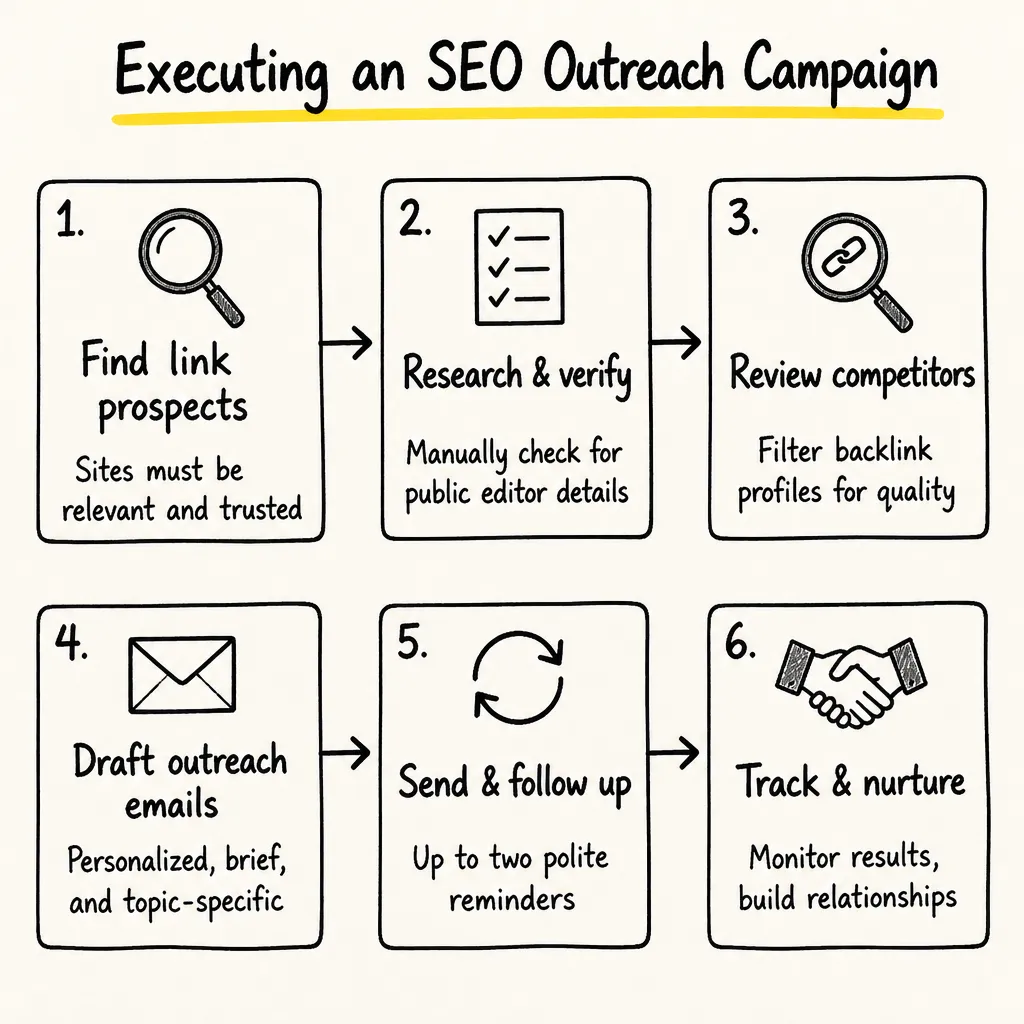
Drafting and sending compelling outreach emails
Effective SEO outreach emails are short, personalized, and polite. Avoid generic templates that get ignored.
- Subject lines: Use clear, relevant subjects that mention the recipient’s topic or site. Avoid salesy or vague phrases.
- Personalization: Mention the editor’s name and reference a specific page or article. Explain exactly how your resource adds value to their content.
- Use your own inbox: Send emails from your personal or company address to build trust and authenticity.
- Keep it concise: Write one or two brief paragraphs. Focus on how your link benefits their content, not on self-promotion.
- Follow up: Send up to two polite follow-up emails if you get no reply. Stop after two to avoid annoying the recipient.
For outreach email examples and tool comparisons, see 7 Best Backlink Outreach Tools for Earning Quality Links [2026].
Tracking responses and building relationships
Tracking replies and maintaining connections turns one-off links into ongoing partnerships. With SEOLadders, all drafted pitches, statuses, and successful placements are shown together in a unified dashboard.
- Status updates: Easily note who responded, who ignored, and which links went live—no need for separate spreadsheets.
- Automated monitoring: SEOLadders checks new links daily until they're live, then routinely verifies placement. Hosts have seven days to restore dropped links.
- Relationship nurturing: Each positive reply is a networking opportunity. Engage with editors beyond the initial pitch—regular, useful contact (not just more asks) can lead to recurring coverage.
Expert Insight: Sending outreach emails from your own inbox (rather than a platform) improves deliverability and response rates—most editors ignore mass-sent emails but pay attention to genuine, personalized pitches.
Common Mistakes and How to Fix Them
Even experienced marketers slip on easily avoided errors that can undermine SEO outreach and link-building efforts. Addressing these common issues up front means better deliverability, higher response rates, and links from sites that actually move the needle.
Outreach emails ignored or flagged as spam
Many outreach emails land in spam folders or get overlooked entirely, shutting down opportunities before they start. This usually stems from:
- Generic subject lines – Vague or overused phrases (like "Quick question") are more likely to trip spam filters or be ignored.
- Lack of sender authentication – Not setting up email authentication (SPF, DKIM, DMARC) increases spam risk.
- Mass blasting – Sending the same pitch to hundreds of sites often results in blacklisting.
To improve deliverability:
- Craft specific, benefit-focused subject lines that reflect the recipient’s interests.
- Authenticate your mail domain before executing campaigns.
- Warm up new sender emails with gradual volume increases.
For more ways to keep outreach out of spam, see the detailed breakdown in 7 Best Backlink Outreach Tools for Earning Quality Links [2026].
Targeting the wrong websites
Reaching out to irrelevant or low-quality sites wastes time and could even harm search rankings. The most common issues include:
- Pitching non-authority or spammy domains – Links from these do little for SEO and could even hurt it.
- Ignoring topical relevance – Backlinks from off-topic sites are less valuable.
- Relying on directories or paid lists – These rarely result in sustainable, quality links.
To target the right sites:
- Pre-qualify prospects based on domain authority, traffic, and niche fit.
- Check for recent, relevant content – If a site hasn’t published in months, outreach is less likely to be fruitful.
- Use tools like SEOLadders or a Backlink Checker to screen for quality and relevance before sending any pitch.
Efficient prospecting keeps your outreach focused on sites that actually move organic rankings.
Failure to personalize or follow up
Emails that lack personalization or follow-up rarely get a response, even when targeting the right sites. The biggest mistakes:
- No mention of the recipient’s content – Generic templates signal mass outreach.
- Forgetting to follow up – Most replies happen after at least one reminder.
- No custom value proposition – Not explaining what’s in it for them.
To improve outcomes:
- Reference a specific article or detail from the recipient’s site to show genuine attention.
- Schedule a polite follow-up if there’s no reply in a few days.
- Highlight benefits such as resource exchange or audience fit clearly in your pitch.
Most successful link outreach campaigns rely on tailored communication and persistence. For more tips, visit 7 Best Backlink Outreach Tools for Earning Quality Links [2026].
Expert Insight: Taking the time to qualify prospects and personalize every outreach email significantly increases both response rates and link quality.
How to Check If Your Outreach Worked
After sending outreach emails, it's crucial to verify which efforts secured backlinks and measure their true impact. This section covers how to confirm link placement and ensure ongoing value from your campaigns.
Verifying acquired backlinks
You can confirm acquired backlinks by checking whether referring domains have actually linked to your site, rather than relying on verbal assurances or sent pitch counts.
- Use backlink checker tools like the SEOLadders Backlink Checker to scan for new inbound links to your target pages. Free tools often have limits on the number of links or domains checked, while paid tools provide more comprehensive data, including link quality, anchor text, and historical changes.
- Validate the context and placement: The link should be in content, not a low-value directory or footer, and must point to the correct page.
- Check indexation: Ensure the linking page itself is indexed in Google, as an unindexed page provides little to no SEO benefit. Use the Google Search Console URL Inspection tool or search “site:domain.com/linking-page-url” on Google to confirm indexation status.
In practice, teams often cross-reference their list of outreach targets with detected new backlinks to spot successful placements. Especially for automated campaigns, you can check whether the link is live with a free backlink checker to guard against "phantom links"—those that never really went live.
Manual and automated link validation checklist:
- Manually visit the linking page to confirm the link’s existence and contextual relevance.
- Verify the link points to the intended target URL.
- Confirm the page is indexed via Google search or Search Console.
- Use free backlink checkers for initial verification of link presence and anchor text.
- Employ paid tools for deeper insights on link authority, historical data, and link removals.
- Regularly update and compare backlink reports to detect lost or changed links.
Measuring campaign outcomes
Campaign effectiveness is measured not just by the number of links placed, but by the quality and resulting SEO signals.
- Track domain authority: Record the authority (using Moz, Ahrefs, or proprietary scores) of domains that linked back.
- Monitor rankings changes: Watch whether target keyword rankings improve post-campaign using rank tracking tools.
- Annotate traffic spikes: Compare analytics data for traffic or conversions on linked pages after backlinks go live.
- Match links to pitches: For each outreach list, log which contacts responded and earned placements, helping refine future prospect lists.
Smart teams build simple spreadsheets or use outreach software that connects each pitch to actual outcomes. For more on choosing the right platform, you can review 7 Best Backlink Outreach Tools for Earning Quality Links [2026].
Ongoing monitoring for sustained results
Sustained SEO value requires ongoing monitoring of each acquired backlink, as links can be removed, nofollowed, or lose their value over time.
- Set recurring link checks: Use Backlink Checker monthly to spot dropped or altered links.
- Monitor for page changes: Audit the referring pages to detect major content updates that could impact relevance.
- Watch anchor text diversity: Keep an eye on anchor variations to avoid over-optimization risk.
- Leverage weekly site audits: Platforms like SEOLadders prioritize backlink health in their regular reports and notify you of problems.
Ongoing tracking ensures links remain beneficial and alerts you quickly if valuable placements disappear or degrade.
Expert Insight: Many teams miss lost or changed backlinks because they only check results once. Scheduling monthly link audits catches issues early and preserves SEO gains.
Tools That Help with SEO Outreach
The right tools make SEO outreach campaigns more efficient, organized, and effective for teams with limited resources. Below, you'll find a guide to choosing, comparing, and automating outreach platforms for link building.
Essential free and paid tools
A mix of free and paid SEO outreach tools covers prospecting, outreach management, and link monitoring in one workflow. Free tools, like email finders and basic outreach schedulers, offer simple contact identification or single-task automation, but scale issues quickly appear for business campaigns. Paid outreach platforms bundle research, template management, and analytics under one login, reducing busywork and context switching.
Key tasks and typical tools involved:
- Prospect discovery: Google Search, LinkedIn, Hunter.io, Apollo.io
- Email drafting and tracking: Gmail, Outlook, Mailtrack, Yesware
- CRM & follow-up: Google Sheets, HubSpot, Pipedrive, Streak CRM
- Backlink monitoring: Backlink Checker, Ahrefs, manual Google Search, SEMrush
For a topical breakdown of top backlink outreach tools, dedicated platforms often surpass generic email solutions when scaling outreach beyond a handful of domains.
Comparing SEO outreach platforms
Most SEO outreach platforms offer overlapping features, but differ in automation, transparency, and publishing integration. SEOLadders automates prospect discovery and email drafting while integrating tightly with CMSes like WordPress and Ghost. In contrast, traditional suites such as Ahrefs or SEMrush focus on backlink indexes and manual reporting, while contact and outreach steps remain largely hands-on.
| Platform | Prospect Discovery | Email Drafts | Sends Emails | CMS Integration | Link Monitoring | Pricing (starting) |
|---|---|---|---|---|---|---|
| SEOLadders | Automated | Automated | Manual | WordPress, Ghost, Webflow, Framer* | Yes | $97/mo (all features) |
| Ahrefs | Manual/export | None | None | None | Yes | $129/mo+ |
| SEMrush | Manual | Moderate | Yes | None | Yes | $129/mo+ |
| BuzzStream | Manual | Yes | Yes | None | Yes | $24/mo+ |
| Hunter.io | Limited | Yes | Yes | None | No | Free / $49/mo+ |
*Webflow, Framer support soon
Platform Differentiators:
-
SEOLadders: Stands out by fully automating prospect discovery and email drafting, combined with native CMS integrations allowing users to publish outreach content or guest posts directly through WordPress, Ghost, Webflow, and soon Framer. This reduces manual steps and centralizes campaign management without per-seat charges, while keeping email sending manual for personalized outreach.
-
Ahrefs: Primarily a backlink index and SEO analysis tool, Ahrefs offers robust link monitoring and manual prospect export but lacks native outreach or email features. It’s ideal for teams focused on backlink data and manual outreach strategies rather than automated campaigns.
-
SEMrush: Blends SEO and marketing tools with moderate email drafting and integrated email sending capabilities. However, it lacks CMS integration and relies on manual prospect finding, making it suited for users seeking an all-in-one SEO and outreach tool but willing to manage some steps manually.
-
BuzzStream: A dedicated outreach platform that supports manual prospecting, email outreach, and link monitoring. It excels in managing large outreach projects with team collaboration features but lacks CMS publishing integrations and automated prospect discovery.
-
Hunter.io: Focused on finding and verifying email addresses with limited prospect discovery. It includes email templates and sending but doesn’t support link monitoring or CMS integration, making it valuable for initial contact discovery rather than full campaign management.
Notice SEOLadders eliminates per-seat charges, includes full CMS publishing, and keeps email sending under your control for better personalization.
When to automate vs handle manually
Automation is most valuable for repetitive, high-volume outreach; manual outreach matters for relationship-building and custom requests. Most teams automate prospecting and draft emails to save time, then personalize the pitch or select contacts for high-value domains. This hybrid approach means:
- Automate when:
- Scaling outreach to many relevant domains
- Following up at fixed intervals
- Monitoring live link status across pages
- Handle manually when:
- Pitching top-tier sites or influencers
- Responding to unique opportunities or niche segments
- Reviewing email drafts for brand voice and compliance
For example, if your campaign goal is rapid link acquisition from a broad set of mid-tier blogs, automation helps you contact hundreds efficiently. Conversely, if your objective is securing a guest post on an authoritative industry site, manual outreach ensures your message is customized and thoughtful. Features like SEOLadders's automated prospecting plus manual send workflow fit businesses that want scale without losing editorial control. For a deeper evaluation of SEO automation options, look at how hands-on review and edit steps fit your team's capacity.
Expert Insight: Automation frees up teams to focus on building relationships and customizing pitches for the most valuable backlinks—don’t skip manual review for your priority prospects.
Frequently Asked Questions
What is SEO outreach and why does it matter?
SEO outreach is the process of finding relevant websites and pitching them to link back to your content, aiming to increase your site's authority and visibility. It matters because high-quality backlinks improve organic search rankings and drive referral traffic. Tools like SEOLadders automate backlink discovery and outreach drafting, making this task easier for businesses without in-house SEO teams.
How do you identify the best sites for outreach?
The best outreach sites are identified by analyzing competitors' referring domains, monitoring pages that earn the most links, and prospecting relevant backlink opportunities matching your topic. SEOLadders automates this by discovering backlinks and drafting outreach pitches weekly, helping target high-value, relevant sites for effective SEO outreach without relying on paid link placements.
What are the biggest mistakes in SEO outreach?
The biggest mistakes in SEO outreach include sending generic, non-personalized pitches, neglecting relevance between your content and the target site, and failing to follow up appropriately. Additionally, ignoring outreach automation and AI tools can waste time and reduce efficiency. SEOLadders helps by automating backlink discovery and drafting personalized outreach pitches to improve success rates.
Can you automate the entire outreach process?
You can automate much of SEO outreach, including backlink discovery and drafting pitches, but the actual sending of outreach emails must be done manually. For example, SEOLadders automates backlink prospecting and outreach drafting but requires users to send emails themselves, ensuring control over communication.
Is buying links a safe SEO strategy?
Buying links is generally not considered a safe SEO strategy as it risks penalties from search engines. Instead, effective SEO outreach focuses on discovering relevant backlinks, drafting genuine outreach pitches, and building quality links naturally. SEOLadders supports safe outreach by automating backlink discovery and drafting pitches, avoiding risky paid link placements.
Conclusion
A successful SEO outreach strategy doesn’t have to feel overwhelming—even if you’re short on time or staff. This guide walked you through all the essentials: prepping your site, building and personalizing a targeted outreach list, avoiding common pitfalls, and measuring your outreach’s real impact with the right checks and tools.
SEOLadders stands out as the most actionable choice for founders and marketing teams who want link outreach handled—offering automated prospect discovery, weekly drafted pitches for you to send, and built-in backlink opportunities tied directly to your content strategy. Other options require more manual time or connect you with paid link partners; SEOLadders is different because it streamlines discovery, drafting, and reporting all in one plan—with a clear focus on helping your site earn links that move the needle.
If you’re ready to see your SEO outreach pay off faster, here’s how to get started today:
- Review your existing content and site health as your foundation
- Build an outreach list of relevant sites, avoiding competitors
- Use draft templates or automated tools to personalize each pitch
- Send pitches consistently, then track responses and earned links
Bringing outreach under one roof means you’ll spend less time managing tasks and more time growing your rankings with real, earned backlinks.
Ready to put your SEO outreach into action? Explore how SEOLadders automates prospect discovery and outreach drafting, so you can focus on building relationships and landing links—see the workflow in detail here.

Samuel Kwesi Afriyie
Founder of SEOLadders
Samuel is a software engineer who builds SEOLadders, an AI SEO agent for Google and AI search. This site, including this blog, runs on it.
Want this done for you? SEOLadders finds the topics, writes the articles, and gets you cited by AI and ranking on Google, on autopilot.
3-day free trial · Cancel anytime