
Table of contents
TL;DR
- Start with intent-based keyword research.
- Optimize site architecture for better crawlability.
- Publish user-focused, on-brand content regularly.
- Earn backlinks from credible, niche-relevant sites.
You’re tired of watching your new blog posts collect digital dust while competitors grab all the clicks. If you’re a website owner or digital marketer, you know that writing more content isn’t enough—your organic search traffic needs a real boost.
This guide on how to increase organic traffic lays out a clear, proven path. You’ll learn what organic traffic actually means, why it matters for serious site growth, and the essential steps—right down to choosing an SEO strategy that fits your goals. Plus, you’ll see how top brands made these strategies work, so you can do the same.
What Is Organic Traffic? A Clear Definition
Organic traffic refers to visitors who land on your site by clicking unpaid search results. Understanding how organic visits differ from other traffic sources is a key starting point for learning how to increase organic traffic sustainably.
How search engine algorithms drive organic visits
Search engine algorithms determine which websites appear in unpaid (organic) search results based on relevance, quality, and site authority. According to SEOIndiaOnline, search engines analyze hundreds of factors, from keyword intent to technical signals, to rank content that most closely matches a user's query.
Organic traffic results from users clicking sites ranked highly in these results, not ads or paid placements. In practice, algorithm shifts—like Google’s frequent updates—can suddenly increase or drop your organic visits overnight. Teams often notice ranking gains last longer when their content targets low-competition keywords with strong intent (see our Topical Authority guide for details).
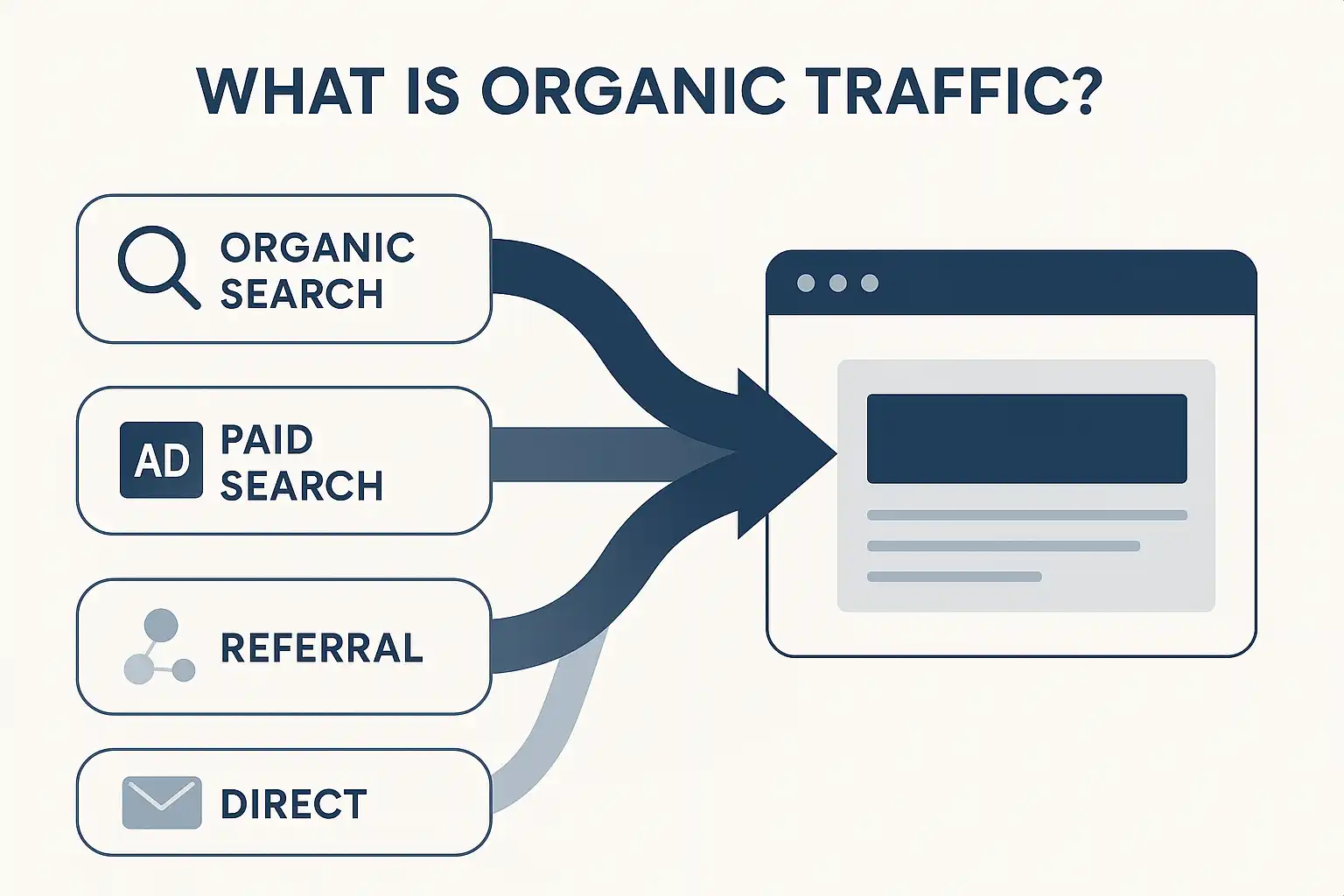
Key terms: organic, paid, referral, direct
Organic traffic is website activity that comes from unpaid search engine results, while paid traffic refers to visits driven by advertisements. Referral traffic occurs when someone navigates to your site from a link on another website, and direct traffic happens when users type your URL directly or use a saved bookmark.
Here’s how to remember each channel:
- Organic: User clicks an unpaid search listing
- Paid: Visitor arrives via a search or social ad
- Referral: External site sends a visitor via a link
- Direct: The visitor enters your site address manually
Most analytics platforms clearly separate these sources, so you can track what’s working and spot seasonal shifts.
Organic traffic versus other channels explained
Organic traffic is distinct from other channels because it’s not purchased and depends on your ranking for relevant queries. Unlike paid traffic, which vanishes when ad spend stops, organic visits keep coming when your content stays visible.
Here’s a quick comparison:
| Channel | Cost Model | Longevity | User Intent |
|---|---|---|---|
| Organic | Free (unpaid) | Long-term gains | Often high, informational |
| Paid | Per click | Stops without spend | Transactional/varies |
| Referral | Free/varied | Ongoing (if links stay up) | Varies |
| Direct | Free | Consistent (brand loyalists) | High/brand aware |
Why it matters:
- Organic is more scalable
- Relies on long-term content
- Typically seen as more trustworthy
Results will vary, especially if search behavior shifts or platforms change their algorithm, so it’s smart to monitor channel sources and adapt.
For automation that helps sustain organic gains, explore Schedule & Publish.
Expert Insight: Organic traffic tends to compound over time, but results fluctuate with each search engine update, so diversify your efforts and watch for early warning signs in your analytics.
Why Increasing Organic Traffic Matters for Site Growth
Relying on organic traffic isn't just a nice-to-have—it's fundamental for sustainable site growth. Whether you're running a blog, SaaS, or eCommerce brand, understanding why organic growth matters sets the stage for smarter, long-term decision-making.
Key Benefits: Cost, Trust, Scalability
The main benefits of boosting organic traffic are lower cost, higher trust, and broader scalability for most sites. According to Pulse Bulletin, organic visitors are more likely to trust a site that ranks well naturally, as opposed to clicking on paid ads.
Why does this matter? Unlike paid campaigns, organic traffic compounds over time—after the initial investment in content and SEO, every additional visitor essentially costs nothing. There’s also the trust factor: regular organic readers engage more, share more, and are likelier to convert. In practice, scaling up happens when you layer on new articles or product pages targeting realistic keyword gaps.
- Reduced dependency on ad spend
- Credibility in crowded markets
- Growth that doesn’t rely on a bigger budget or changing algorithms
Want to automate this at scale? Modern platforms like Schedule & Publish offer hands-off solutions for building up organic reach.
Practical Use Cases: Blogs, SaaS, eCommerce
Organic traffic strategies are uniquely valuable whether you're running a blog, launching a SaaS product, or managing an eCommerce shop. For blogs, organic visitors often come in via articles targeting long-tail keywords or niche questions—traffic keeps compounding as your content library grows.
SaaS companies lean on content to highlight product features, rank for solution keywords, and attract trial signups. In eCommerce, every new landing page can rank for hundreds of transactional search terms. In practice, teams navigating these scenarios often discover that consistent organic growth starts with realistic keyword targeting—see See keyword research for a closer look at this process.
Key outcomes:
- More stable pipeline for conversions
- Lower cost per acquisition over time
- Brand authority with minimal incremental effort
Why Most Guides Give Overrated Advice on Traffic Spikes
Most SEO guides focus on quick wins or sudden traffic spikes, but that advice rarely supports long-term growth. The reality? Chasing viral keywords or short-term tactics can distract from building real, compounding organic visibility. In practice, sustainable growth comes from ranking for clusters of lower-competition keywords and steadily expanding relevant pages, not just betting on a single piece of viral content.
Honestly, we’ve seen site owners burn out by relying too much on hacks or one-off stunts—results fade fast without a system in place. For those evaluating options, skip hype-driven tactics and focus on repeatable processes that support steady gains (refer to the Blog for more objective approaches).
| Strategy Type | Long-Term Value | Cost Rise Over Time |
|---|---|---|
| Spiky traffic tactics | Low | High |
| Organic growth system | High | Low |
Expert Insight: Sustainable organic traffic isn’t about chasing spikes—focus on building a system with realistic, compounding gains.
How to Choose the Right SEO Strategy for Sustainable Growth
Choosing an SEO strategy that actually drives sustainable growth means thinking beyond one-off wins. The right approach addresses your site’s strengths, search intent, and long-term visibility, not just a quick surge.
How we vetted these options: Evaluation criteria
The most effective SEO strategies for organic traffic growth are evaluated using a mix of measurable and experiential criteria. According to Veecotech, best practices focus on factors like keyword difficulty, search intent, and alignment with overall site structure. Our process prioritizes:
- Realistic opportunities based on domain rating
- Searcher intent matching each stage of the funnel
- Technical feasibility for implementation
In practice, teams often find they must balance what’s theoretically optimal with what their resources actually allow. Tools that automate analysis or content, like those listed in our see all integrations, help minimize bottlenecks when scaling efforts.
Why it matters:
- Reduces wasted effort on keywords your site can’t rank for yet
- Ensures content answers real user questions, not just targeting volume
- Promotes consistent, incremental rankings that compound over time
Keyword research: Intent, competition, context
Keyword research is the process of finding and prioritizing search phrases based on intent, competition, and site context. The trick? You need keywords with the right mix of achievable difficulty and proven relevance. For sustainable growth, focus on keywords your site has a realistic shot at ranking for, not just the ones with massive search volume. We’ve seen plenty of teams chase head terms and get nowhere for months.
Research from SEO Ladders’ Topical Authority feature shows that matching keyword targets to your domain authority avoids frustration and sets expectations. Analyze three dimensions every time:
- Search intent (informational, commercial, transactional)
- Competition strength in the current SERP
- Your own site’s domain rating and topical relevance
This approach saves time—and nerves—over old-school guesswork-driven methods.
Site architecture and on-page optimization essentials
Site architecture is the arrangement of content and internal links to help both users and search engines discover material efficiently. Good site structure isn’t just for indexing—it optimizes crawl budget and maximizes equity flow between top pages. Your most important keywords need clear, crawlable category and topic hubs—never just buried blog posts.
On-page optimization covers everything from descriptive title tags and fast-loading visuals to semantic headings and relevant internal links. In practice, inconsistent structures and missing on-page basics lead to wasted opportunities. We’d recommend reviewing your technical health using tools similar to Schedule & Publish, which highlight overlooked fundamentals.
Why it matters:
- Facilitates higher indexation rates
- Improves user journey signals for ranking
- Lays the groundwork for future content growth
Expert Insight: Don't rely exclusively on search volume—targeting attainable, lower-competition keywords almost always pays off faster for newer domains.
What Are the Core Steps to Increase Organic Traffic?
Building organic traffic comes down to a handful of specific, repeatable steps. Let’s break down the strategies that consistently move the needle and how they look when applied practically—drawing from industry standards and on-the-ground experience.
Content marketing strategies that work (with real examples)
Effective content marketing is the backbone of nearly every strategy for how to increase organic traffic. The most reliable approach is to publish informative, keyword-targeted articles that answer real queries—think in-depth how-tos, expert guides, and resource collections.
According to YouFind Digital, high-performing content is mapped to user intent and leverages keyword research that aligns with your site’s authority. For example, many teams use dedicated Topical Authority tools to identify low-competition queries their site can actually rank for, rather than chasing overly broad terms. In practice, sites that update or expand existing posts, add media, and respond to topical news see ongoing lifts—especially when using structured internal linking.
Why it matters:
- Topic alignment with search intent
- Consistent publishing boosts authority over time
- Better keyword targeting brings quicker SEO wins
- Fresh, relevant articles attract more natural links
Backlink building: Earning authority, not chasing quantity
Link building that drives organic growth is about quality, not volume. "Backlink building" is the practice of earning links to your website from trustworthy, niche-relevant sources. According to Link-Assistant, links from reputable domains boost search rankings more than dozens of low-quality mentions.
Real-world approaches include guest posting on respected blogs or earning citations when your content is referenced as a resource. Teams often find that outreach works best when they showcase unique research or original tools, rather than generic requests. A common pitfall is pursuing easy links from irrelevant sites—these rarely provide lasting SEO value and can put your site at risk. In our experience, personalized pitches backed with meaningful value tend to get a much higher response rate.
Why it matters:
- Trusted links build long-term authority
- Niche relevance improves ranking for competitive keywords
- Authentic mentions drive referral as well as organic traffic
User experience improvements that drive engagement
Improving site usability is a key but often-overlooked lever for increasing organic traffic. "User experience improvements" refers to all changes that make it easier for visitors to find, read, and interact with your content. A smooth, mobile-friendly layout, simple navigation, and fast load times all send clear signals to Google about your site’s value.
Research from Wix SEO Hub shows that time on page, bounce rate, and real engagement are becoming clear ranking factors. In practice, teams see results by optimizing page structure, adding clear calls to action, and embedding rich media like videos and FAQs. Small details—like fixing broken links or clarifying headlines—can have outsized impact, especially on older posts.
Why it matters:
- Better engagement metrics strengthen rankings
- Higher user satisfaction increases repeat visits
- Streamlined experience builds trust with visitors and search engines
Expert Insight: Many sites see real organic growth only after shifting from sporadic tactics to a focused system that integrates keyword research, content refreshes, and technical fixes on a rolling schedule.
Real-World Examples: How Leading Brands Grew Their Organic Traffic
Seeing actual strategies in action offers insight into how to increase organic traffic efficiently. The following real-world examples showcase tested approaches that helped brands scale their SEO results in different industries.
Case study: Automated content publishing for SaaS
Automated content publishing is a method where SaaS companies use AI-driven tools to create and publish SEO-optimized blog content without manual intervention. Brands adopting these workflows often see compounding gains because articles target realistic keywords and require minimal upkeep. For instance, integrating solutions like Schedule & Publish allows continuous article output across multiple languages, complete with structured headings and relevant visuals.
In practice, teams found that setting a monthly content calendar—auto-published to their website—resulted in steady keyword gains without needing a full content team. Real feedback from SaaS founders highlights that reducing the bottleneck of manual writing enables attention to higher-level topics and technical improvements. According to Udemy's Complete Digital Marketing Course, automating content tasks allows more time for reviewing analytics and optimizing user experience.
Why it matters:
- Sustained publishing keeps the site fresh
- Internal links boost topical authority
- Drives growth on autopilot—no major staffing increases needed
Case study: Local SEO changes for brick-and-mortar business
Local SEO changes are targeted updates that help physical businesses show up for geo-specific searches. These can include optimizing Google Business Profiles, targeting location-based keywords, and managing customer reviews. When a retail location prioritized these steps—updating their NAP data and encouraging happy customers to leave reviews—they saw increased visits from local queries. Insights on How to access your business’s reviews from Google My Business were especially relevant here.
A common pitfall is neglecting accurate directory listings, which causes ranking gaps. In our experience, automating review requests post-purchase and adding city-specific landing pages led to significant visibility gains, especially for 'near me' searches. The downside? It takes ongoing effort to monitor listings and encourage review activity.
Why it matters:
- Geo-targeted traffic is high-converting
- Improves local rankings for competitive terms
- Strengthens brand reputation via customer input
Case study: Keyword targeting with SEO Ladders
Keyword targeting with SEO Ladders involves building a plan around winnable, intent-matched search terms using AI. Unlike chasing broad or highly competitive phrases, this approach relies on see keyword research tools that calibrate difficulty to your site’s authority—mapping opportunity to reality. Teams often find that using an automated keyword calendar keeps content aligned to what’s actually within reach.
One firsthand observation: when writers focused each article on a specific intent (informational, transactional, or comparison), organic traffic climbed faster than with generic listicles or topic clusters. Reviewing past rankings using Topical Authority made it possible to measure progress and adjust tactics. The benefit? No more wasted effort on impossibly tough keywords.
Why it matters:
- Reduces wasted resources chasing unrankable terms
- Consistent growth through data-backed strategy
- Enhances ROI compared to manual guesswork
Expert Insight: Brands that systematize their SEO—combining automation with careful review—see the most reliable organic gains versus relying solely on ad-hoc campaigns.
Frequently Asked Questions
What is the fastest way to increase organic traffic?
The fastest way to increase organic traffic is to target low-competition, high-intent keywords matched to your site's domain authority and publish SEO-optimized content around them consistently. Tools like SEO Ladders automate keyword research and content creation, enabling quick, data-driven content publishing that ranks faster and drives traffic without manual effort.
How long does it take to see SEO results?
SEO results typically take 3 to 6 months to appear because search engines need time to index content and assess its relevance. Factors like competition, website authority, and content quality affect this timeline. Tools like SEO Ladders can speed up this process by automating keyword research and publishing SEO-optimized articles that match your domain authority, helping you grow organic traffic more efficiently.
Do backlinks still matter for organic rankings?
Yes, backlinks still matter for organic rankings as they signal a website's authority and trustworthiness to search engines. High-quality backlinks from relevant sites improve your SEO and help increase organic traffic. Tools like SEO Ladders can aid in identifying backlink opportunities and creating content that attracts natural links.
Why isn't my organic traffic growing, even after publishing content?
Organic traffic may not grow despite new content if the content isn't optimized for the right keywords, lacks valuable information, or isn't promoted effectively. Also, your site’s authority and backlink profile influence rankings. Tools like SEO Ladders help by automating keyword research and creating SEO-optimized content matched to your domain authority, improving your chances to rank and attract traffic.
Is automating SEO safe for long-term growth?
Automating SEO can be safe for long-term growth if done thoughtfully, focusing on quality content and realistic keyword targeting. Reliable automation tools like SEO Ladders help produce SEO-optimized articles matched to your domain authority, ensuring sustainable traffic gains. Avoid over-automation that ignores human oversight to keep content valuable and aligned with search engine guidelines.
Conclusion
Every website competing for search attention faces the same challenge: sustainable growth demands a real SEO plan, not guesswork.
- Define what organic traffic means for your own site and set realistic benchmarks.
- Audit your current content and keyword approach—don’t just create more, create smarter.
- Craft an SEO strategy that focuses on long-term traffic wins instead of shortcuts.
- Apply each core step from this guide and track your results closely so improvements compound over time.
Even a few small tweaks done right can spark lasting growth—if you take action today. ↑ Back to top
Ready to put your traffic growth on autopilot? Unlock hands-off strategies for keyword research, content publishing, and ongoing SEO improvements with SEO Ladders' content automation platform and start seeing measurable results.
Want this done for you? SEOLadders finds the topics, writes the articles, and gets you cited by AI and ranking on Google, on autopilot.
7-day free trial · Cancel anytime