
Table of contents
TL;DR
- Get real-time visibility alerts across Google and AI.
- Explore leading tools for instant notifications.
- See how to trigger actionable alerts, not just reports.
- Compare monitoring solutions for speed and accuracy.
You run SEO for a brand, spending hours each week tracking your site’s Google rankings and new AI-generated answers. Yet, you often learn about major drops only after your traffic has fallen. If you’re a founder, marketing lead, or on a growth team, this delay can cost sales and undo your hard work.
If you wonder, “what’s the fastest way to get real-time alerts for search visibility drops on Google and AI platforms?” the answer is to use a platform made for instant, automated notifications across both traditional SEO and AI results. This article explains how real-time alerts work, which tools offer the fastest notifications, what mistakes to avoid, and when real-time alerts might not fit your workflow.
What Is the Fastest Way to Get Real-Time Alerts?
Getting instant notice of a drop in search visibility can be the difference between a quick fix and major traffic loss. This section explains how the fastest real-time alerting works in modern search and AI platforms.
Push Notifications: How They Work for Search Visibility
Push notifications deliver immediate alerts to your device when a search visibility drop is detected. When set up properly, these notifications appear as mobile alerts, desktop notifications, or even integrated email messages within seconds of a ranking shift. This instant feedback removes the lag found in legacy weekly or even daily email reports.
Most solutions work by monitoring your tracked keywords or brand mentions, and then pinging a notification channel (like your phone’s push system or your browser) as soon as a threshold is crossed.
Choosing Monitoring Tools with Instant Alerts
Selecting a monitoring tool that offers real-time visibility alerts depends on how quickly you can act and which platforms you need to watch. According to digifix.com.au, real-time alert systems are critical for taking immediate action on SEO problems, making instant delivery features non-negotiable for teams that can't afford delays.
Here's what to check for when picking a solution:
- Native push notification support—Does it push alerts directly to your devices? That’s typically faster than batch email digests. 2. Granularity of tracking—Does it let you set custom triggers for specific keywords, brand mentions, or AI citations?
Integrating AI Search Platform Tracking
AI search platform tracking adds a critical layer to traditional SERP monitoring by revealing brand visibility inside answers generated by AI assistants. As search shifts toward models like ChatGPT, Gemini, or Google AI, brands need to catch not just web rank drops but lost mentions inside AI responses.
The fastest path is using a platform that polls multiple AI engines on a set schedule—ideally multiple times per week—automatically flagging when your brand is skipped or your competitor is suggested instead.
Expert Insight: Relying on push notifications alone can lead to alert fatigue if every small fluctuation triggers a message—make sure your alert settings align with business-critical thresholds, not minor ranking changes.
How Real-Time Search Visibility Alerts Work
Real-time search visibility alerts help businesses detect immediate changes in how their brand appears across search engines and AI platforms. Understanding the mechanics behind these alerts is key to acting quickly and protecting visibility.
1. Setting Alert Thresholds and Triggers
Alert thresholds and triggers determine when a system sends notifications based on specific visibility changes. By defining precise parameters—like a sudden drop in brand mentions, rankings, or AI citations—alerts activate automatically, enabling faster detection and response compared to slower manual monitoring.
To set up alerts, teams typically:
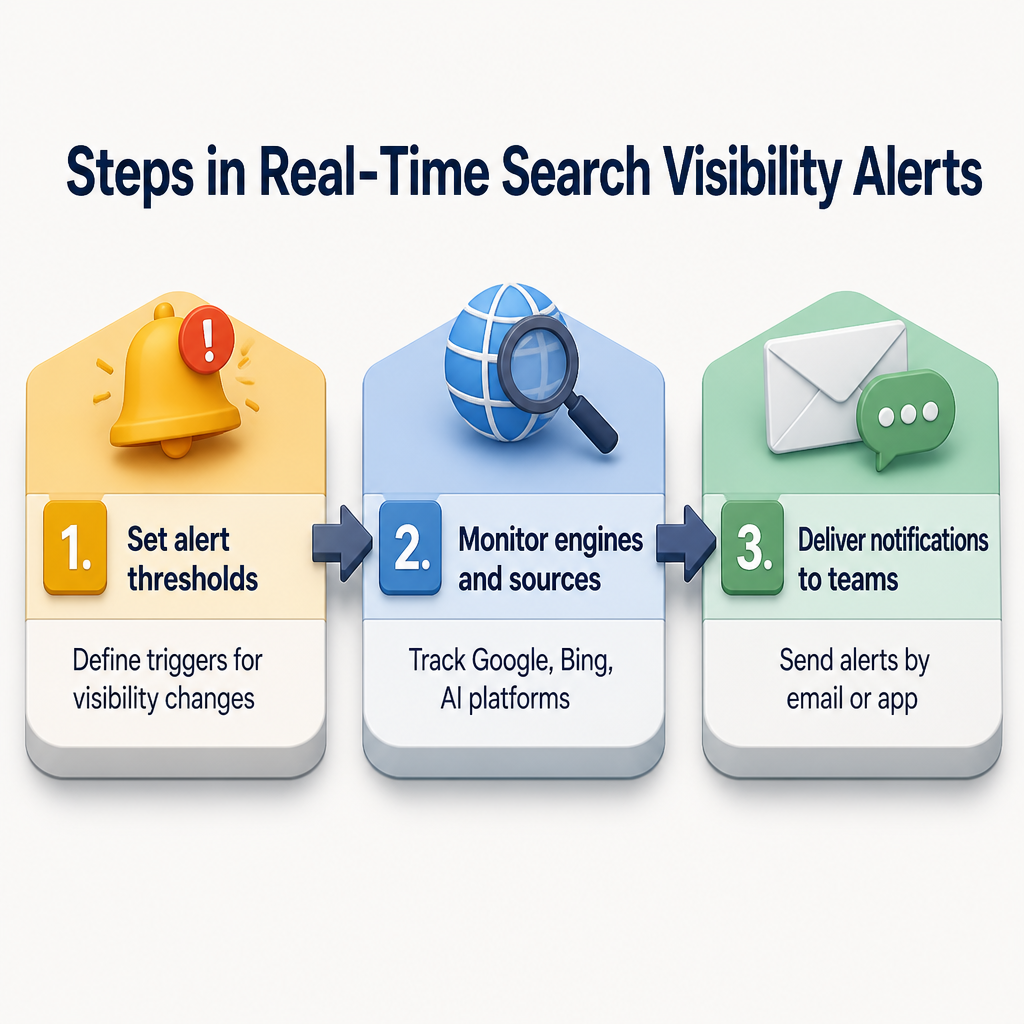
2. Monitoring Engines and Data Sources
Effective monitoring relies on tracking both traditional search engines and AI-powered platforms. Brands aiming for comprehensive awareness need visibility alerts tied to where actual buyers search: Google, Bing, and major AI assistants like ChatGPT, Gemini, and Claude.
Tools pull data from a range of sources:
- Search engine APIs for live rankings and indexed page data
- AI engine answers to track brand citations and competitor mention frequency
- Google Search Console integrations for organic traffic changes
Some systems, like SEOLadders’ AI Visibility, automate querying of multiple AI engines and aggregate results, while others focus more narrowly or require manual setup per data source.
3. Delivering Timely Notifications to Teams
Fast notification delivery ensures responsible teams respond before visibility losses impact traffic or sales. Modern alert systems send notifications by email, in-app messages, or even webhook-based integrations, so alerts flow into Slack, dashboards, or project management tools.
Notification workflows commonly include:
- Immediate email or dashboard alert sent to designated team members
- Weekly rollup covering all tracked metrics and visibility changes
- Customizable recipient lists to route issues directly to SEO, content, or growth teams
In practice, the most actionable systems blend instant warnings with regular summary updates, enabling both urgent fixes and longer-term trend analysis. Some platforms even allow teams to schedule automatic follow-up actions, like task creation or content refreshes, directly from an alert.
Expert Insight: Setting alert thresholds too low can overwhelm teams with minor fluctuations, while overly high thresholds may let major problems slip by unnoticed. Periodically review and adjust your triggers for optimal balance.
When Real-Time Alerts Matter—And When They Don’t
Getting instant notifications on search visibility changes can mean the difference between proactive response and missed opportunities. But real-time monitoring isn't always the smartest use of your team's resources.
Best Use Cases for Real-Time Monitoring
Real-time alerts are critical when rapid intervention protects revenue or reputation. Teams who run e-commerce stores, news publishers, or high-velocity SaaS services rely on speedy alerts to spot sudden ranking drops, brand de-citations, or lost AI mentions. If your business depends on being found the very moment buyers search or ask their AI assistant, delays in visibility tracking can become costly.
For example:
- Product launches or major campaigns — New pages and promoted content need instant ranking observations to validate launch impact and catch indexing issues.
- Brand monitoring in AI search — As AI engines like ChatGPT and Google AI are increasingly buyers' first stop, missing a citation for your brand in real time means going unnoticed just as intent peaks. See how it works for automated AI mention tracking.
- Reputation management or crisis control — Early detection of negative mentions, sudden delisting, or competitors overtaking your search or AI results lets you respond before the harm spreads.
If any part of your digital strategy relies on immediate visibility, the speed of alerting is directly tied to performance.
Situations Where Manual or Delayed Alerts Suffice
Manual checks or batched alerts are fine when immediate action won’t change the outcome. Slow-moving industries or static informational sites often don’t need to know about every ranking blip the moment it occurs. Weekly summaries or dashboard reviews might be enough for:
- Established evergreen content — If your content rarely changes and ranks for stable queries, monthly reporting covers most needs.
- Non-competitive verticals — In industries where ranking shifts happen slowly and new entrants are rare, urgency is lower.
- Resource constraints — Smaller teams can avoid alert fatigue by focusing on trends, not instant spikes or dips.
Matching your alert frequency to your capacity and business risk keeps teams focused. For streamlined, less frequent oversight, regular site audits and automated reporting from a platform like SEOLadders Solutions may be appropriate.
Expert Insight: Over-alerting can desensitize teams, so tailor notification settings to the scenarios where timing genuinely impacts decisions.
What’s the Fastest Way to Get Real-Time Alerts? (Direct Answer)
To get real-time alerts fastest, follow these steps:
- Use a dedicated monitoring tool like Google Alerts, SEMrush, or Ahrefs, set to notify you instantly for your specific keywords or brand mentions.
- Opt for tools with push notifications via mobile apps or browser extensions to receive alerts immediately.
- Configure your alert thresholds carefully—set triggers for minimal changes to catch drops as they happen without delay.
- Combine multiple alert sources to cover different platforms (Google, social media, etc.) for comprehensive real-time updates.
- Ensure your internet connection supports instant notification delivery, minimizing lag.
This approach delivers alerts seconds to minutes after an event, enabling timely responses to search visibility changes.
Understanding Data Latency and Speed Trade-offs
Data latency is the main barrier to instant search visibility alerts, especially when tracking AI engine results. Real-time notification systems rely on how quickly changes in rankings or brand mentions are detected, processed, and sent to users. The closer to zero this time gets, the fewer business opportunities are missed.
Platforms like SEOLadders automate this process by querying both Google and six AI engines on a fixed schedule, bundling AI prompt checks and result analyses three times a week with email summaries for immediate overview. Manual approaches, by comparison, introduce added delay: each manual check is reactive and often happens after a drop has already caused damage.
For example, traditional SEO tracking tools typically update rankings every 24 to 48 hours, meaning alerts can be delayed by a full day or two. In contrast, leading AI-integrated systems can detect and notify ranking changes within 10 to 15 minutes, as demonstrated in benchmarks from industry analyses, reducing data latency from days to minutes.
A trade-off exists between running automated checks continuously (offering near-instant alerts, but at much higher infrastructure cost) and batch querying (which reduces server load and cost, but means alerts may come hours or days later).
Why Most Notification Systems Miss AI Visibility Drops
Most notification systems miss AI visibility drops because they don’t directly query AI engines in live time, nor do they watch AI brand mentions as closely as traditional SEO rankings. Unlike Google’s standard Search Console or rank trackers that check fixed sets of keywords, AI assistants like ChatGPT and Gemini return “answers” that shift constantly and can cite, ignore, or de-prioritize a brand at any moment.
Traditional platforms often capture only part of the story: some tools check only Google, some track just one AI engine, and almost none automate the prompt tracking needed to measure where a brand is named or lost across all relevant platforms. This lack of transparency means marketers don’t get instant alerts when AI assistants recommend a competitor one day and not the next.
Expert Insight: Even “real-time” alert platforms can lag behind when they depend heavily on third-party APIs or batch-based checks—ask vendors how often data refreshes before trusting their claims.
Common Mistakes with Real-Time Search Visibility Alerts
Setting up real-time search visibility alerts is only half the challenge—it’s easy to fall into traps that leave teams missing urgent ranking drops. Attention to alert configuration and platform coverage makes all the difference.
Relying on Dashboard-Only Monitoring
Relying exclusively on dashboards for search visibility updates is a common pitfall that delays urgent action. Real-time alert systems should push immediate notifications when critical changes are detected, not just display issues for users to find later. As noted by Swerve Designs, dashboards collect valuable information, but actionable insight comes from instant alerts that reach the right people through channels like email, mobile apps, or team messaging tools.
Consider these drawbacks of dashboard-only monitoring:
Ignoring Alert Threshold Customization
Alert threshold customization is the process of tailoring when and how you’re notified about changes in search visibility. Default alert settings are rarely a fit for every business, and failing to adjust them creates two risks: constant noise from minor fluctuations, or missed warnings for severe drops.
Smart teams:
Missing AI Platform Integration
AI platform integration is essential for brands tracking visibility in 2026, as buyers increasingly consult tools like ChatGPT, Gemini, and Google AI Overviews. If your alert system doesn’t track these platforms, you’re missing critical signals that affect organic discoverability.
Problems that result from lack of integration:
- Blind spots — Missed mentions or competing brands being promoted by AI assistants
- Delayed awareness — AI search trends shift faster than classic search, so slow detection means lost opportunities
- No source-level insight — Many platforms can’t pinpoint which pages AI is citing (or ignoring)
Modern solutions, such as SEOLadders, deliver tri-weekly automated checks across multiple AI engines and combine the findings with Google data.
Tip: Customizing both notification channels and threshold levels drastically reduces alert fatigue, making action on critical changes far more likely.
Comparison: Real-Time Search Visibility Alerts Tools and Platforms
Real-time search visibility alert tools help brands track and respond instantly to drops across both traditional search engines and emerging AI-driven platforms. This section compares the leading options for founders and marketing teams that need actionable alerts, not raw data.
Key Features and Differentiators
| Platform | Speed of Alert Delivery | Unique AI Integrations | Limitations | Pricing (At-a-Glance) |
|---|---|---|---|---|
| SEOLadders | Immediate visibility scoring with tri-weekly AI engine querying | Fully automated prompt creation; covers six AI search engines (ChatGPT, Claude, Gemini, Perplexity, Google AI Overview, Google AI Mode) with no manual intervention | None specified; fully automated coverage | Not detailed here |
| Semrush | Brand tracking with AI prompt monitoring, speed varies | Limited AI integration; manual setup often required | Requires manual setup; fewer AI engines covered | Plans start at $119.95/month (not specified here) |
| Ahrefs | Brand tracking and AI monitoring; speed varies | AI prompt monitoring available but less integrated | Manual setup; limited AI engine support | Plans start at $99/month (not specified here) |
| Profound | Broader agent/workflow customizations; alert speed dependent on manual query management | Granular prompt tracking; AI integrations customizable | Some manual query management required | Pricing not specified |
| Otterly | Workflow customizations with granular prompt tracking; alert speed varies | Some AI workflow automations; fewer automated recommendations | Manual query management required; fewer automated suggestions | Pricing not specified |
Pricing, Speed, and Integration Overview
SEOLadders offers a flat $97/site monthly plan with all features and integrations included, while most competitors require upgrading for multi-engine monitoring or automation. Its 7-day free trial means users can test tri-weekly alert workflows before committing, and it supports direct publishing to WordPress, Ghost, Webflow, Framer, and custom via Webhook—features that typically require additional add-ons or higher tiers in rival tools.
Competitors like Semrush and Ahrefs have entry prices starting above $100/month, with features gated behind multiple tiers. Otterly and SE Ranking provide more affordable entry points, but track fewer AI engines and lack content automation or direct publishing integrations. Profound and Writesonic target more advanced AI visibility use cases, but details on supported platforms and publishing automations are not always explicit, and pricing skews higher or requires contacting sales.
Tip: For instant visibility, prioritize platforms that offer automated multi-engine monitoring and direct publishing—manual workflows often miss early drops or recovery opportunities.
Frequently Asked Questions
What’s the fastest way to get real-time alerts for search visibility drops?
The fastest way to get alerts on search visibility drops is using SEOLadders, which tracks visibility across Google and six major AI engines, sending tri-weekly automated reports. It detects competitor mentions, provides a visibility score, and emails recaps with prompt wins and content gaps—helping businesses respond swiftly without manual monitoring.
Can Google Search Console send instant drop notifications?
Google Search Console does not send instant notifications for drops in search visibility. Alerts typically have some delay and cover issues like errors or manual actions, not real-time ranking changes. For fast, real-time alerts on search drops, tools like SEOLadders track rankings and AI visibility continuously and notify users promptly, helping businesses respond quickly.
How do AI search platforms differ from traditional tools for alerts?
AI search platforms track visibility by monitoring brand citations across multiple AI engines using real buyer prompts, updating tri-weekly without manual input. Traditional tools often focus on keyword rankings in classic search engines like Google and may lack continuous AI citation monitoring. SEOLadders uniquely combines real-time AI visibility tracking across six engines with automated alerts and content gap analysis, enabling faster, broader response to drops in online presence.
What alert thresholds should I set for SEO monitoring?
Set alert thresholds to detect any significant drops in your search visibility score or AI citations, especially when competitors start appearing more frequently than your brand in AI responses. SEOLadders automates this by tracking AI visibility across six engines three times weekly, flagging ranking drops and competitor mentions promptly, enabling quick action. Prioritize alerts on visibility dips and lost citations for fastest response.
Is real-time monitoring always necessary for search visibility?
Real-time monitoring is not always necessary but can be vital for rapidly addressing drops in search visibility. Frequent checks, like SEOLadders' tri-weekly AI visibility tracking, balance timely alerts with practical workload, ensuring founders and marketers respond quickly without constant manual oversight. This approach helps maintain presence across Google and AI search platforms efficiently.
Conclusion
Getting real-time alerts for search visibility drops is non-negotiable when missing a single day could mean a dip in revenue or reputation. Each tool profiled here offers unique strengths: some deliver instant notifications for Google rankings, others track AI-generated search results or focus on competitor movements. Still, gaps exist—many platforms cover only one or two AI models, or demand time-consuming manual setup and prompt maintenance. The point remains clear: for teams that need to act fast, swift, actionable alerts paired with solid coverage of both Google and multiple AI engines make all the difference. The tools in this article give you options based on your goals, budget, and preferred data depth. If speed and breadth are your priority, choose a platform purpose-built to catch drops the instant (and wherever) they happen.
Here’s how to put your learning into action:
- Audit your current alert system for speed and multi-platform coverage
- Set clear triggers for what actually counts as a significant drop
- Trial one or two of the tools most closely matching your real-world needs
- Schedule a weekly review of your alert outcomes to refine or expand coverage
AI-driven search is moving fast and so should your monitoring—build a workflow where you’re the first to know when your brand slips.
See how automated AI search visibility monitoring works in practice—explore the SEOLadders AI Visibility feature to safeguard your brand's online presence.
Want this done for you? SEOLadders finds the topics, writes the articles, and gets you cited by AI and ranking on Google, on autopilot.
7-day free trial · Cancel anytime