

Table of contents
TL;DR
- Defines what a generative engine optimization tool is
- Step-by-step look at how these tools automate SEO and AI citation
- Covers situations where GEO tools help—and where they don't
- Compares GEO tools to classic SEO platforms
You’ve spent hours writing blog posts and paid for costly SEO tools. But you still can’t tell if AI models are noticing your brand when customers ask buying questions. If you’re a founder or marketer, this is frustrating. It’s also overwhelming. New AI engines are changing SEO rules almost overnight. Your old strategies stop working.
Generative engine optimization tools solve this problem. They automate what’s needed to help your website rank on Google and get cited by AI engines like ChatGPT, Gemini, and Perplexity. In this article, you’ll learn how these tools work. You’ll see how SEOLadders handles generative engine optimization from research to ranking. You’ll also find out when to add this workflow to your growth plan.
What Is a Generative Engine Optimization Tool?
A generative engine optimization tool uses AI to help businesses get discovered and cited by both traditional search engines and AI-powered platforms. Here’s how these solutions reshape the way brands approach search and visibility.
Generative AI and search explained
Generative AI transforms search by creating original content and influencing which brands are cited in AI answers. Major AI models, like ChatGPT and Gemini, now deliver direct answers and recommendations instead of just linking to websites. This shift means your website can appear as the named source in AI responses—or be left out completely.
SEO automation versus manual optimization
SEO automation uses AI tools to manage and execute optimization tasks at scale, reducing manual effort. Manual SEO involves keyword research, writer assignment, editorial review, publishing, backlink outreach, and analytics—all handled individually. Automation platforms like SEOLadders ingest your site, map topics, cluster keywords, draft articles, and even monitor citations by AI engines, publishing new content automatically to platforms like WordPress or Ghost.
Typical differences include:
| Feature | Automated Tool | Manual Process |
|---|---|---|
| Content Planning | AI-driven, ongoing | Research and editorial |
| Writing | AI-articulated | Human writers |
| Publishing | Auto to CMS | Manual upload |
| AI Visibility Tracking | Built-in, recurring | Manual spot checks |
Automation accelerates output and addresses AI-specific search needs that manual workflows rarely cover.
Core terms: AI citation, visibility tracking, RAG
-
AI Citation: Being cited means your brand or page is named as a source in AI-generated answers. This raises customer awareness by showing your content as a trusted reference. For example, if an AI chatbot recommends a product and mentions your website as the source, that counts as an AI citation.
-
Visibility Tracking: This means monitoring where and how often your brand appears in both organic and AI-powered search results. For example, tracking how often your brand name shows up in AI-generated summaries or search engine snippets helps you measure your online presence.
-
RAG (Retrieval-Augmented Generation): RAG is when AI first pulls relevant information from a database or documents. Then, it uses this information to create answers. This makes responses accurate and relevant. For example, a customer support chatbot might read your product manuals before answering questions.
Tip: AI-generated search answers can omit your brand if you don’t have content optimized for those specific questions. Proactive optimization increases your chances of being named by AI engines.
How Does a Generative Engine Optimization Tool Work?
Generative engine optimization tools automate the entire process of improving your site's visibility for both search engines and AI platforms. Each step builds on the previous, moving from initial assessment to content creation and ongoing optimization.
Step 1: Site audit and AI readiness check
A generative engine optimization tool starts with a technical site audit and AI readiness check. The first pass looks for issues that block Google from indexing key pages, such as robots.txt blocks, error codes, broken links, or missing metadata. The audit assigns your site a health score (for example, 78 out of 100) and provides fixes for problems found, such as missing page titles, duplicate content, or slow-loading pages.
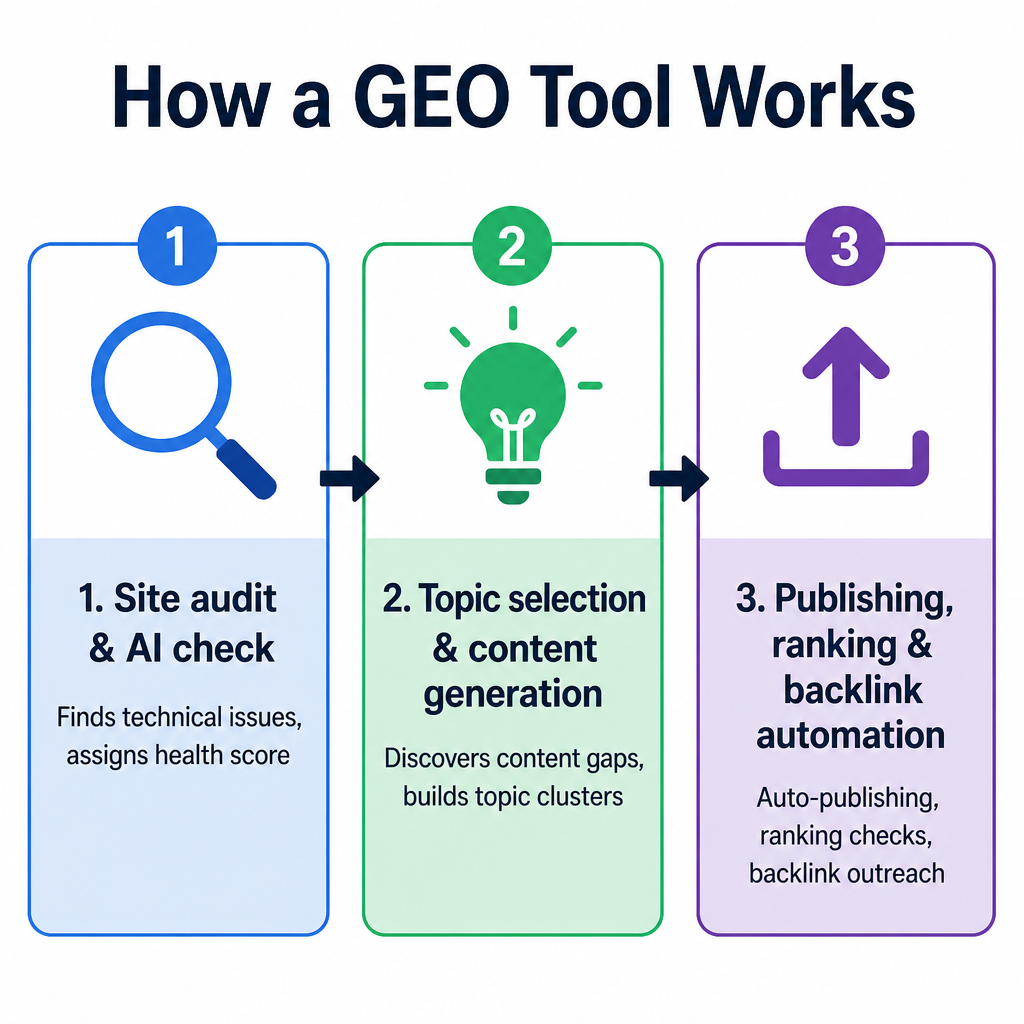
Step 2: Topic selection and content generation
The next phase is automated topic selection and targeted content generation. The tool analyzes what buyers search for and where your brand’s content is missing or underrepresented, often focusing on both Google and AI search queries. It builds topic clusters and discovers “content gaps” where AI platforms cite competitors but not your brand.
For example, the tool may identify:
- Content gaps such as missing detailed guides on a specific product feature or unanswered customer questions.
- Topic clusters like a series of related articles around sustainable product materials or industry trends.
By filling these gaps and expanding clusters, your content becomes more relevant and comprehensive, increasing the chances that AI platforms will cite your brand directly.
Step 3: Publishing, ranking, and backlink automation
The final stage includes auto-publishing, ranking checks, and backlink outreach. Content is either published directly to your CMS or reviewed before scheduling, with support for platforms like WordPress, Ghost, or webhook connections. The tool monitors rankings in both Google search and AI-generated answers, rechecking your mention status multiple times a week to spot changes. For backlink growth, it identifies authoritative sites read by your audience, drafts outreach emails, and facilitates safe link exchanges between vetted members.
Expert Insight: Most GEO tools require you to approve changes before anything goes live, letting you keep control while still automating the research and drafting stages.
When Should You Use a Generative Engine Optimization Tool?
Determining whether a generative engine optimization tool fits your workflow depends on how you handle content production and search visibility tasks. The following scenarios outline where these tools add value—and where they don’t.
Good fit: multi-channel, recurring content needs
A generative engine optimization tool is a strong fit when your business relies on producing high volumes of recurring content across multiple channels. Teams managing regular blog or website updates, multiple landing pages, and integrated SEO efforts benefit most from automation here. Automated topic mapping, daily article creation, and direct publishing—such as the workflow described in how it works—free up staff for higher-level strategy.
Bad fit: no automation required, static websites
Static sites with little or no new content rarely benefit from a generative engine optimization tool. For businesses with a handful of landing pages or those only updating their site every few years, these tools are often overkill.
Typical situations include:
- Single-page websites or brochure sites
- No need for regular news, articles, or blog updates
- Manual SEO is sufficient, without need for scale or automation
Common use cases: agencies, SaaS, local and small business
Agencies, SaaS companies, local, and small businesses frequently use generative engine optimization tools to manage ongoing SEO and stay visible in AI-driven search. Agencies, in particular, need scalable tools to handle multiple client sites, content calendars, and competitor tracking under one roof.
Here's how common user types align:
| Use Case | Typical Requirements | Why Useful |
|---|---|---|
| Agency | Many clients, content at scale | Centralized management |
| SaaS | Frequent feature updates, heavy docs | Knowledge tracking |
| Local Biz | Targeted, location-based keywords | Town-specific queries |
| Small Biz | Limited staff, steady new content | Hands-off automation |
See use cases for AI SEO tools for more examples.
Tip: Before adopting a generative engine optimization tool, audit how often you update your content and whether manual processes measurably slow your growth.
Generative Engine Optimization Tool vs Classic SEO Tools
Generative engine optimization tools and classic SEO suites take very different approaches to improving online visibility. Understanding their feature sets, automation depth, and cost structures helps teams pick the right option at the right stage.
Comparing automation, tracking, and publishing
Generative engine optimization tools automate content creation, tracking, and publishing across both search and AI platforms, while classic SEO tools focus on analysis and manual implementation. Classic tools like Ahrefs or SEMrush offer keyword research, technical audits, and rank tracking, but require users to plan and write articles themselves, then push content live on their own.
Which is right: use cases and cost differences
Classic SEO tools suit power users managing hands-on research and campaigns, while generative engine optimization platforms are best for teams needing done-for-you content and full-cycle automation. SEO suites are often chosen by agencies or specialists who want direct control over keyword choices, content direction, and technical adjustments. Generative tools allow leaner teams or those without in-house SEO expertise to maintain visibility and brand authority by automating routine tasks and delivering ready-to-publish articles.
Emerging features: AI engine coverage and citation measurement
Generative engine optimization tools distinguish themselves with features that track AI search engines and direct brand citation, which most classic platforms lack. As conversational search expands, SEOLadders and similar platforms now monitor brand presence in major AI systems (ChatGPT, Claude, Gemini, Perplexity, Google AI Overviews, and AI Mode). They measure how answers reference your business versus competitors, flagging when and where you are cited.
Expert Insight: While most SEO tools report on Google's native search rankings, only a handful now track how brands are cited in AI engine results—and this distinction is growing more important as generative answers appear throughout the buyer journey.
Common Mistakes When Using Generative Engine Optimization Tools
Even the most advanced generative engine optimization tool can backfire if misused or misunderstood. Here are critical mistakes teams often make and the consequences for visibility in AI search engines.
Ignoring manual tasks highlighted by the platform
Failing to complete manual action items flagged by a generative engine optimization tool leaves visibility gaps that automation can't solve. Platforms like SEOLadders distinguish between fully automated tasks and those only a human can perform—such as correcting AI hallucinations about your brand or submitting forms to directories that name your competitors. If you skip these flagged actions, you risk letting misinformation persist or missing out on new citation opportunities.
Typical manual tasks include:

Expecting citations without targeted topic coverage
AI engines typically cite brands only when content covers specific topics—not from generic content or by default. If your generative engine optimization tool skips strategic topic mapping, your brand can be entirely absent from AI-generated answers. For example, if an article about health products misses discussing "immune support," AI engines won’t cite it for that query. The consequence is clear: no citations mean lost visibility and fewer opportunities to influence potential customers. Language models pull answers from authority sources closely aligned with user intent or common queries.
Common missteps include:
Assuming classic SEO alone reaches AI engines
Classic SEO methods don’t guarantee citation or ranking in AI-driven search results, which evaluate sources differently than traditional engines. Many businesses focus on keyword optimization and backlinks without considering how AI models assemble answers. This often leads to a disconnect between high organic rankings and absent brand references in AI conversations.
Critical differences:
Tip: Always prioritize manual action items in your generative engine optimization workflow—AI models reference only accurate, visible, and properly attributed brand information.
Frequently Asked Questions
What is the main difference between a generative engine optimization tool and a regular SEO tool?
A generative engine optimization tool automates SEO content creation and optimizes for both traditional search engines and AI-driven platforms like ChatGPT and Gemini. Unlike regular SEO tools, it tracks AI visibility and citations, ensuring your brand is referenced by AI models. SEOLadders exemplifies this by integrating keyword research, automated writing, publishing, AI citation monitoring, and backlink outreach in one platform.
Do generative engine optimization tools guarantee AI engine citations?
Generative engine optimization tools do not guarantee AI engine citations, as AI models choose citations independently. However, tools like SEOLadders increase the chances by automating SEO content, citations, and tracking AI visibility across six major AI engines, helping brands monitor and improve their citation presence over time.
How often should I review my content if I'm using automation?
You should review your automated content regularly, ideally at least once a week, to catch AI-flagged incorrect facts and gaps in answers. SEOLadders performs checks several times weekly and provides audits and prioritized action boards to help you maintain content accuracy and SEO health.
Can a generative engine optimization tool help with backlink outreach?
Yes, a generative engine optimization tool like SEOLadders assists with backlink outreach by automatically drafting up to 15 pitches weekly based on AI citations, competitor links, and best-of lists. It also finds contacts for outreach and supports a link exchange network among users, helping automate and streamline backlink building efforts.
Is a generative engine optimization tool necessary for static, rarely-updated websites?
A generative engine optimization tool is generally less critical for static, rarely-updated websites because it focuses on ongoing content planning, creation, and AI citation management best suited for dynamic sites. SEOLadders automates continuous content updates and AI visibility tracking, which may offer limited benefit if your site content changes infrequently.
Conclusion
A generative engine optimization tool automates key steps—topic research, content creation, AI visibility tracking, and backlink outreach—to help your site get cited by both search engines and the latest AI models. SEOLadders stands out as the solution that combines full-cycle content workflows, automated AI citation monitoring, and site health checks in one plan—without upsells or hidden costs. You approve every article, see which AI engines mention your site, and take prioritized SEO actions each week, all for a predictable monthly fee.
If you’re ready to put your site in front of both Google and the AI engines that matter to your buyers, here’s what to do next:
- Audit your current AI visibility using SEOLadders’ tools
- Set up your site for automated topic research and daily content
- Review the AI engine mentions and citation gaps flagged for your brand
- Prioritize technical fixes and backlink opportunities from the weekly actions board
SEOLadders does the heavy lifting so you can focus on growing your brand, not wrestling with a stack of disconnected tools.
Ready to see real AI search visibility in action? Explore the SEOLadders AI Visibility feature and discover how automated workflows can keep your brand cited by leading AI engines—check the feature walkthrough.

Samuel Kwesi Afriyie
Founder of SEOLadders
Samuel is a software engineer who builds SEOLadders, an AI SEO agent for Google and AI search. This site, including this blog, runs on it.
Want this done for you? SEOLadders finds the topics, writes the articles, and gets you cited by AI and ranking on Google, on autopilot.
3-day free trial · Cancel anytime