

Table of contents
TL;DR
- Defines generative engine optimization geo (GEO)
- Outlines GEO operation for search and AI
- Lists GEO vs. traditional SEO differences
- Highlights best-fit scenarios and common traps
You’ve been working hard using the same old SEO methods—optimizing keywords, building links, and improving your pages. Still, AI engines like ChatGPT or Google’s Gemini often show answers from your competitors instead of your brand. If you are a founder, marketer, or part of a business team trying to get noticed on both search and AI-driven platforms, you are not alone.
Generative engine optimization (GEO) means earning citations from both traditional search engines and AI-powered models. It helps you reach more prospects no matter where they begin their search. In this article, you will get a clear definition of GEO, learn when to use it, and find best practices designed for today’s search world—not the past. We will also compare top GEO platforms, explain how they fit into your strategy, and point out common mistakes to avoid. This way, you can move past theory and take real steps forward.
What Is Generative Engine Optimization GEO?
Generative Engine Optimization (GEO) is the practice of shaping your brand's digital presence so that AI platforms and traditional search engines cite your business as a trusted answer. To grasp how GEO is transforming search, it helps to break down its core principles and how they're applied today.
Generative AI: Custom content from models
Generative AI creates tailored web content by using machine learning models to generate articles, FAQs, and resources based on provided input and context. GEO harnesses this capability to ensure your brand provides the answers that both users and AI search models are seeking. Unlike static webpages, generative content can adapt quickly to emerging queries and industry trends, increasing the chances of being cited by both search engines and conversational AI.
Search Engine Optimization in 2026
In 2026, successful SEO means optimizing for both human and AI search behaviors, with GEO emerging as the bridge between the two. Search results now regularly include replies from AI models that synthesize data from across the web. Unlike the past, where ranking meant placement on a page, today visibility hinges on being cited as an authoritative source by AI-powered answer engines like ChatGPT or Gemini.
Geo-targeting: Connecting content to local audiences
Geo-targeting in GEO is the process of tailoring content to match the intent and language of users in specific locations, so your brand is cited by local AI and search platforms. AI-generated answers increasingly factor in where a query comes from—serving distinct local recommendations to users in different cities or regions. This means generic, one-size-fits-all content is much less likely to gain citations in locally-focused AI search results. For example, GEO can customize content by incorporating hyperlocal weather data or local event information, making responses uniquely relevant to users in a specific area. Another example is adjusting product availability and pricing based on localized market conditions, which classic geo-targeting in SEO rarely addresses beyond basic location tags or IP-based targeting. These capabilities enable GEO to connect more deeply with local audiences by reflecting real-time, localized context beyond traditional SEO methods.
Expert Insight: Optimizing for generative engines means thinking beyond classic page ranking—focus on being the cited answer, not just the linked site.
How Generative Engine Optimization GEO Works
GEO combines traditional SEO strategies with new techniques built specifically to boost visibility and citations in both search engines and generative AI models. Understanding its process shows how GEO turns market research into content that surfaces your brand in AI-driven results.
Step 1: Mapping search and AI prompts
Mapping search and AI prompts is the foundation of generative engine optimization GEO, ensuring brands target questions real buyers and AI assistants are asking. This process starts by researching what terms people type into Google and which prompts users give tools like ChatGPT or Gemini.
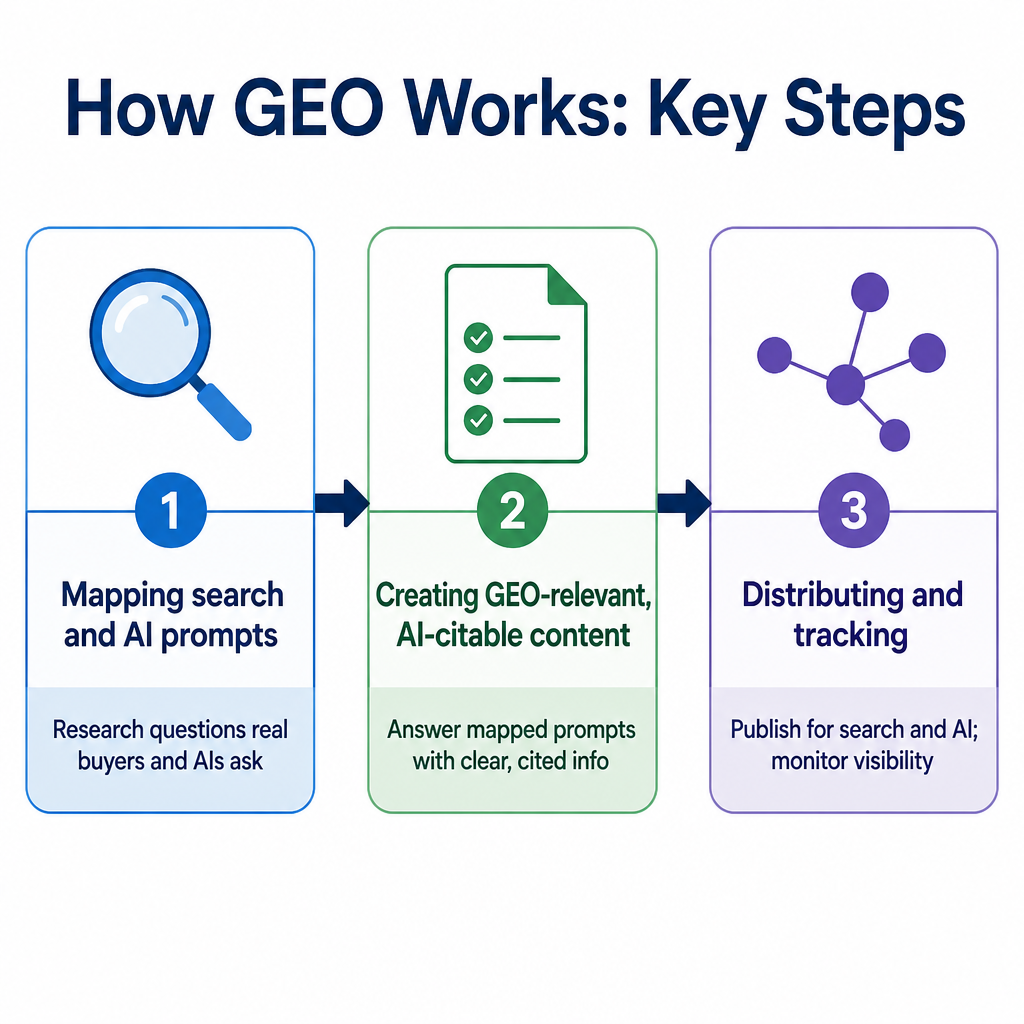
Step 2: Creating geo-relevant, AI-citable content
Geo-relevant, AI-citable content is material that both search engines and AI models can easily access, interpret, and use as authoritative references. This means going beyond keyword stuffing to clearly answer the mapped prompts with accurate, verifiable information.
Effective GEO content includes:
- Structured answers for each prompt, utilizing FAQ schema where possible
- Source citations from trusted domains (excluding competitors)
- Internal linking for topical depth and easier AI crawling
- Brand language and up-to-date facts to prevent AI hallucinations
For example, a regional outdoor gear retailer in Denver creates a series of city-specific blog posts answering common questions about hiking trails near Denver, formatted with FAQ schema. Each post cites local government websites and trusted park service domains for park hours and trail conditions. The retailer includes internal links to related equipment pages tailored to each trail's difficulty and environment. This approach provides clear, authoritative responses that AI can cite accurately, resulting in higher visibility in local search results and AI-generated recommendations.
Step 3: Distributing and tracking across Google, ChatGPT, and others
Distributing and tracking your GEO content means publishing it where both traditional search engines and AI models can find and cite it, then monitoring results for visibility. Distribution happens via automatic posting to CMS platforms like WordPress or through webhooks, ensuring speed and consistency.
Expert Insight: GEO success depends not just on creating content but on continually monitoring whether AI models actually cite or describe your brand accurately—and acting when they don’t.
When GEO Is the Right Approach—And When It Isn't
Choosing generative engine optimization (GEO) depends on your specific business goals and the search environments that matter to your audience. Not every scenario calls for GEO alone, so it pays to understand where it excels and where more traditional SEO tactics remain essential.
Best-fit scenarios for generative engine optimization geo
Generative engine optimization geo is ideal for brands aiming to be cited or recommended by AI-driven search platforms. This includes businesses targeting buyers who use platforms like ChatGPT, Gemini, or Perplexity for product research, decision-making, or local service selection. GEO works particularly well when:
-
A regional restaurant chain wants to appear in AI-generated recommendations tailored to users searching for dining options within specific neighborhoods. By optimizing generative content with geographic indicators, the chain increases its chances of being suggested by AI tools to locals or visitors looking for nearby eateries.
-
A real estate agency focusing on urban and suburban markets uses GEO to improve visibility in AI-driven search results that prioritize relevant properties by location. This enhances the agency’s presence in localized queries, helping potential buyers discover listings that match their desired areas.
These use cases show how generative engine optimization geo adds unique value by aligning content with the geographic focus of AI search engines, making it easier for businesses to connect with the right audiences in context-specific ways.
Cautions: Where traditional SEO is still required
Traditional SEO remains necessary when the primary goal is ranking in classic search results or for transactional keywords. GEO won't replace foundational technical SEO, local map optimization, or link-building strategies that affect how Google and Bing index and display site content. Use classic SEO for:
Hybrid strategies for full market coverage
Hybrid strategies blend GEO with traditional SEO to maximize visibility across both AI-driven and search engine results. This approach ensures you aren't invisible where it counts—whether a user types in Google or asks an AI assistant. A typical hybrid process:
- Audit your market presence across engines and AI models (using tools like Keyword Ideas Generator).
- Fill classic SEO gaps with technical fixes, local signals, and on-page optimization.
- Target AI answer gaps with articles that are cited and referenced by leading generative models.
Expert Insight: Generative engine optimization geo and traditional SEO each play distinct roles; integrating both allows brands to capture search visibility wherever potential buyers are looking.
Generative Engine Optimization GEO vs Traditional SEO Methods
Understanding the shift from traditional SEO methods to generative engine optimization (GEO) is crucial for brands aiming to stay visible in both search engines and AI-driven platforms. This section explores the contrasts in cost, implementation, and strategic fit.
Cost, implementation and effort compared
GEO approaches typically automate tasks and merge SEO with AI visibility, often reducing hands-on effort but not always the total investment. Traditional SEO methods rely on manual research, content writing, technical audits, and link-building that can require in-house expertise or agency retainers. Costs add up with individual tools, consultants, or staff, and the process can be slow to pivot when ranking factors shift.
For example, a mid-sized e-commerce company saw a 40% reduction in content production time using SEOLadders' GEO platform, cutting monthly SEO costs by $2,000 while increasing keyword rankings by 25% in three months. This contrasts with traditional SEO workflows that might require double the time and expenditure to achieve similar results.
Generative engine optimization platforms like SEOLadders streamline this:
Which businesses benefit most from GEO?
GEO is most impactful for brands needing visibility across both search engines and AI recommendation platforms, especially those without deep in-house SEO resources. Businesses targeting broad discovery—like ecommerce, SaaS, and content publishers—see gains because GEO-optimized content surfaces in AI engines (ChatGPT, Gemini, Perplexity), not just Google.
Key business types that benefit:
Limitations of each approach
GEO platforms can speed up content output and track AI visibility, but may miss the nuanced on-site work or domain-specific PR that traditional SEO delivers. Manual SEO allows precise technical fixes and custom outreach, which can matter in highly regulated or hyper-competitive fields. But it’s slow to scale and demands constant re-skilling as algorithms evolve.
Limitations to consider:
Expert Insight: GEO relies on automation and visibility checks, so it’s essential to review outputs and supplement with custom strategies for industries with unique content or compliance needs.
Common Generative Engine Optimization GEO Mistakes
Avoiding common pitfalls in generative engine optimization GEO requires attention to two distinct areas: the generative content itself and the geo-targeting strategy. Common mistakes related to the generative aspect include poorly crafted prompts or irrelevant data inputs, while geo-targeting errors often involve inaccurate location parameters or overbroad targeting. Addressing errors in both areas is essential to move beyond merely appearing in AI results to becoming the authoritative source AI engines reference. Here are the costly errors many teams still make as this discipline matures.
Ignoring geographic signals and local data
Overlooking local signals in generative engine optimization GEO often leads to irrelevant or generic AI citations. AI models increasingly incorporate location-specific context when surfacing brand or business recommendations, especially for queries with local intent. Businesses that neglect tailored location data risk being excluded from localized responses in engines like ChatGPT or Gemini.
To avoid this, brands should ensure their content includes:
Relying on generic AI output over brand knowledge
Drafting content from generic AI outputs instead of true brand expertise limits your visibility and relevance in GEO. Many companies use large language models to write articles or FAQs, but overlook the risk of blending in rather than standing out.
Critical missteps include:
Failing to track AI engine visibility and citations
Skipping ongoing visibility tracking leaves serious blind spots in your generative engine optimization GEO efforts. Unlike traditional SEO, GEO requires monitoring whether, how, and when AI engines mention or cite your brand—and what claims they're making.
Key consequences of failing to track AI visibility:
- Missing citations and brand mentions in ChatGPT, Claude, Gemini, or other AIs
- Not identifying incorrect, outdated, or negative information about your offers
- Overlooking new competitors that AI recommends instead of you
Expert Insight: As AI engines continue to shape buyer behavior, failing to monitor both search and generative visibility can create gaps your competitors will fill—regular audits are no longer optional.
Frequently Asked Questions
How does generative engine optimization geo differ from local SEO?
Generative engine optimization (GEO) targets visibility and citation on AI-driven search platforms alongside traditional search engines, focusing on content and AI recommendation optimization. Local SEO, however, centers on improving rankings for geographically specific searches. GEO expands beyond location-based intent to ensure your brand is recognized by AI engines like ChatGPT and Google AI, a capability SEOLadders supports by automating content creation and AI visibility tracking.
What are the best tools for GEO in 2026?
The best tool for generative engine optimization (GEO) in 2026 is SEOLadders, a platform that automates SEO content planning, writing, publishing, and AI visibility tracking across six major AI search engines. It integrates traditional SEO with AI-driven insights and includes backlink outreach, site audits, and auto-publishing to popular CMSs, all for a single $97 monthly plan.
Is generative engine optimization geo suitable for small businesses?
Generative engine optimization (GEO) is suitable for small businesses seeking affordable, automated SEO and AI-driven content growth. SEOLadders offers a $97/month plan with done-for-you content creation, AI visibility tracking, and publishing tools ideal for startups and SMB marketing teams lacking in-house SEO expertise.
Does GEO replace traditional SEO, or should they work together?
Generative Engine Optimization (GEO) does not replace traditional SEO but complements it. Both should work together to improve visibility in standard search engines and AI-driven platforms. SEOLadders, for example, integrates traditional SEO techniques with GEO, automating content creation, publishing, and AI visibility tracking to maximize brand presence across both channels.
What if generative AI models cite competitors instead of my brand?
If generative AI models cite competitors instead of your brand, it signals a need to improve your AI visibility strategy. Focus on optimizing content specifically for generative engine optimization (GEO), emphasizing authoritative citations and AI-driven relevance. SEOLadders helps by tracking AI visibility across major models, identifying when competitors gain citations, and suggesting targeted content to boost your brand's AI presence.
Conclusion
If you’re serious about boosting your brand’s visibility across both classic search engines and the new generation of AI-driven platforms, it’s time to step beyond old school tactics. We’ve covered what generative engine optimization GEO is, how it works, when to use it, and how it stacks up against traditional approaches—along with common mistakes and the top platforms.
SEOLadders stands out by automating every GEO step (from content planning and writing to publishing and AI visibility tracking) in one package, with real-time audits and direct publishing support that others simply don’t match. You get deep AI engine coverage at entry price, full control over your content, and actionable insight in a single dashboard.
Here’s how to move forward:
- Map out where your brand currently appears across both search and AI engines
- Set up automated content creation and monitoring using a platform like SEOLadders
- Avoid shallow AI content—focus on well-cited, authoritative answers
- Audit your site weekly to catch blockers that limit both ranking and AI citations Taking these steps now gives your brand a real edge as generative engines reshape the digital search frontier.
Ready to see how your brand can earn citations from both Google and AI engines? Explore SEOLadders' AI Visibility feature and take the next step toward top-of-mind digital presence.

Samuel Kwesi Afriyie
Founder of SEOLadders
Samuel is a software engineer who builds SEOLadders, an AI SEO agent for Google and AI search. This site, including this blog, runs on it.
Want this done for you? SEOLadders finds the topics, writes the articles, and gets you cited by AI and ranking on Google, on autopilot.
3-day free trial · Cancel anytime