

Table of contents
TL;DR
- Backlink management means building, monitoring, and maintaining your site's link profile.
- High-quality links drive authority—quantity alone won’t win rankings.
- Tool-based audits and outreach save time for small teams.
- Learn common mistakes and efficient, safe ways to scale.
You’ve probably noticed some brands jump in search rankings fast, while your content takes longer to get noticed. If you’re a founder, marketer, or on a business team without an SEO expert, managing your website’s backlinks can feel hard—especially with limited time and resources.
This article explains what backlink management is, how it works, and when your business should focus on it. You’ll learn the difference between managing your current links, removing harmful ones, and why buying links won’t help your SEO in the long run. By the end, you’ll understand key tips and mistakes to avoid with backlinks, and why SEOLadders is our top pick for easy backlink management and growth.
What Is Backlink Management?
Backlink management is the regular process of checking and improving the links that point to your website. These links, called inbound links, help your site rank better in search engines. Instead of just building many links, backlink management focuses on getting links that are high-quality, relevant, and trustworthy for long-term success.
Backlink profile: What it shows
A backlink profile is the full list of external pages linking to your website, along with key metrics for each source. According to GettoNews, analyzing this profile means evaluating both the assets that help and the links that could harm your site’s authority.
Most backlink checkers display:
- Total backlinks and referring domains (unique linking websites vs. total links)
- Domain authority or similar trust scores
- Dofollow vs. nofollow link ratio
- Spam score for each inbound domain
- Context: anchor text used, target URLs, and sometimes estimated traffic
A solid backlink profile is diversified, showing links from relevant, authoritative websites. SEOLadders' Backlink Checker highlights these elements so you can prioritize valuable links and address harmful patterns. For more outreach advice, see 7 Best Backlink Outreach Tools for Earning Quality Links [2026].
Domain authority: The trust metric
Domain authority is a numerical estimate of a website’s trustworthiness and influence, based on the quality and quantity of its inbound links. Higher domain authority signals to search engines that a site is credible, making links from these domains more influential for your rankings.
Tools often use slightly different formulas, but most scores range from 0 to 100.
- High domain authority suggests strong, trustworthy backlinks
- Low domain authority or a high spam score indicates risk or low value
- Multiple links from the same domain only count as one "vote" in most ranking models
Monitoring this metric helps you spot opportunities for targeted outreach and understand which links truly impact your site's SEO.
Anchor text: Its role in SEO
Anchor text is the clickable text within a hyperlink, giving context to both users and search engines about the linked page’s topic.
How you use anchor text affects:
- Relevance: Search engines infer your content’s subject from the words used
- Ranking potential: Natural, mixed anchor text profiles are favored
- Risk: Overuse of exact-match keywords or unnatural phrases can signal manipulation
A healthy backlink profile includes branded anchors, descriptive phrases, and occasional generic terms. It's important to review these patterns to avoid penalties and support steady SEO growth.
Tip: Regularly reviewing your backlink profile can uncover both new opportunities for outreach and early warning signs of negative SEO or risky link schemes.
How Does Backlink Management Work?
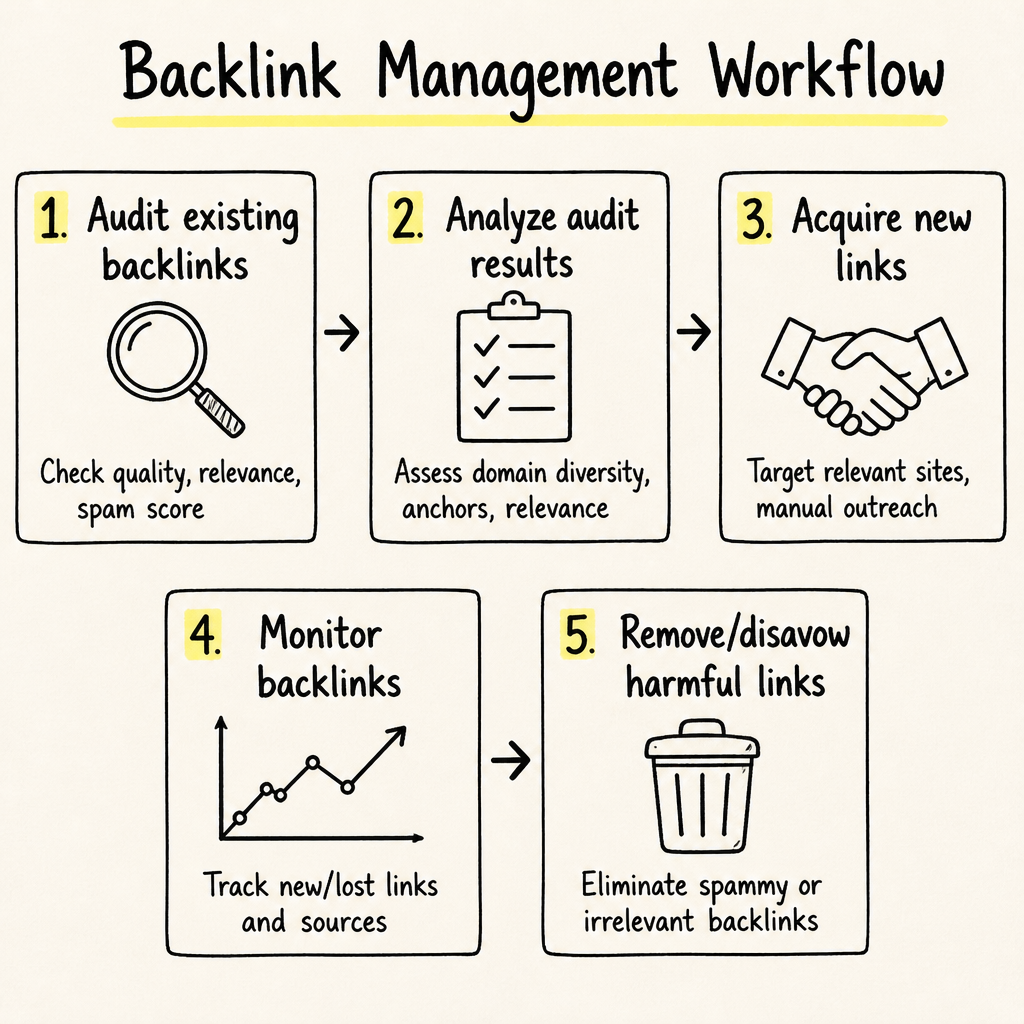
Backlink management is an ongoing process of evaluating, acquiring, and maintaining quality links to help your site earn visibility and authority. A practical step-by-step workflow might look like this: First, identify existing backlinks using tools like Google Search Console or third-party platforms. Analyze these links for quality, relevance, and potential risks such as spammy sources. Next, prioritize link acquisition by targeting websites within your niche, creating valuable content to attract links, and reaching out to webmasters for guest posts or collaborations. After acquiring new backlinks, continuously monitor their status to ensure they remain active and relevant. Remove or disavow links that become harmful or irrelevant to maintain your site's credibility. For example, a marketing agency managing backlinks for a client might begin by auditing the client's backlink profile to remove low-quality links, then plan a campaign focusing on industry blogs and news sites for new links while checking backlink status monthly and adjusting the strategy based on results. This ongoing cycle ensures the backlink profile evolves with the site's goals and search engine standards.
Auditing your existing link profile
Auditing your existing link profile means assessing the strength, relevance, and risks of your current backlinks before making changes. Successful audits focus on these key elements:
- Referring domains vs. total links: A higher number of unique websites linking to you signals broader authority, while repeated links from the same domain count less for search engines.
- Dofollow vs. nofollow split: Only dofollow links transfer ranking value. Nofollow links can drive referral traffic but add little authority.
- Spam score checks: High spam scores often suggest manipulative or low-quality links, which can harm your site.
- Anchor text diversity: Too many exact-match anchors or unnatural language can flag your site for penalties.
- Link source relevance: Links should come from sites and pages related to your industry or audience.
The free Backlink Checker tool from SEOLadders provides instant visibility into these metrics, letting teams benchmark against competitors and spot issues fast.
Link building and safe outreach
Link building through safe outreach centers on earning links from trusted sources with methods that align to search engine guidelines. Effective link building means:
- Prioritizing relevance and authority — Reach out to sites your audience actually reads, and that cover topics related to yours.
- Manual outreach, not automation — Personal emails or contact with editors is safer. SEOLadders drafts outreach pitches for real site contacts and never sends emails automatically.
- Natural placement — Contextually relevant links earn more value and avoid penalties. In the SEOLadders link exchange, links are placed where they naturally fit in the sentence.
- Avoiding paid placements — Buying links or engaging in link schemes puts rankings at risk, as explained in this guide to quality links.
Safe outreach is about building relationships, not chasing quantity.
Ongoing monitoring and maintenance
Ongoing monitoring and maintenance ensures your site maintains a healthy backlink profile and quickly addresses risks. This means:
- Automated link checks: Tools like SEOLadders track new and lost links, flagging drops or spikes in your dashboard.
- Analyzing link sources regularly: Frequent checks for links from unrelated or spammy domains prevent problems before they escalate.
- Responding to changes: If a quality link disappears, create a task to attempt restoration.
- Documentation and reporting: Maintaining a history of outreach activity and earned links simplifies audits and reporting over time.
For advanced strategies and automation, see SEOLadders’ link building feature breakdown or explore this overview of outreach tools.
Warning: Auditing for spammy or irrelevant links is more important than sheer volume. A few toxic links can outweigh dozens of neutral ones if left unchecked.
When Is Backlink Management Needed—And When Not?
Backlink management is essential for building sustainable SEO, but not every scenario demands the same level of attention. Understanding when to take action—and when to hold off—can save valuable resources while safeguarding your site's authority.
When to prioritize link audits
Proactive link audits become critical when you spot risk signals or after major site changes. If you're experiencing a sudden drop in rankings, it's wise to review your backlink profile for toxic or spammy domains. Frequent penalties, manual actions from Google, or a barrage of links from irrelevant or low-quality sites all justify immediate scrutiny.
A few clear indicators that a link audit should be done now:
- Ranking volatility paired with an influx of unknown backlinks
- Manual actions reported in Google Search Console
- Recent SEO work such as content pruning, migrations, or rebrands
- Expanding outreach or link-building campaigns
Tools like SEOLadders' Backlink Checker provide instant insight into referring domains, spam scores, and link quality, supporting fast audits. For more advanced strategies, reviewing top backlink outreach tools can inform scalable audit processes.
Situations where link cleanup CAN wait
Not every suspicious link or small pattern requires emergency cleanup. If your site's organic performance is stable, minor fluctuations in backlink numbers or the presence of a handful of questionable domains often don't warrant urgent action.
You can usually defer deep link cleanups when:
- No ranking loss or traffic declines are evident
- Spam scores remain low across your main referring domains
- Backlink influx aligns with new marketing or outreach activity
- No Google Search Console warnings are present
In these cases, periodic monitoring may be enough—overreacting can waste effort and even remove links that still drive value.
Why not all links need fixing
Most links, even low-value ones, don't damage your SEO unless they're overtly manipulative or trigger search engine penalties. Search engines increasingly discount, rather than penalize, irrelevant or weak links—so chasing every minor issue can undermine your efforts.
Links that generally DON'T need removal include:
- Nofollow links from forums, comments, or news
- Low-authority but relevant sites in your industry
- Natural citations that simply lack strong metrics
Rely on guidance from tools and support content like 7 Proven Ways to Increase Backlink Quality and Authority to focus your efforts on what truly moves the needle.
Tip: Cleaning up every weak or unrelated link can waste resources and risks losing diversity in your backlink profile. Focus on clearly harmful or manipulative links rather than trying to achieve a 'perfect' list.
Backlink Management vs Disavow and Link Buying
Not all backlinks help your rankings, and how you handle bad links matters as much as acquiring good ones. Backlink management means regularly monitoring your backlink profile to identify and remove harmful links, such as spammy or irrelevant ones that could lower your site's authority. For example, if you notice a surge in low-quality backlinks from unrelated sites, you would contact webmasters to remove them or use tools to clean up your profile. Disavowing is a more extreme step used when you cannot remove bad links manually; it tells search engines to ignore certain backlinks. For instance, if you receive toxic links from malicious sources and removal requests fail, disavowing these links helps protect your rankings. Buying links, on the other hand, involves paying for backlinks to boost your site’s authority. This is risky because search engines often view purchased links as manipulative, which can lead to penalties or drops in ranking. For example, buying links from low-quality networks may temporarily increase your traffic but can result in severe ranking consequences once detected. Proper backlink management avoids these pitfalls by proactively maintaining a healthy and natural link profile.
Disavow tools: Actual use cases
Disavow tools are designed for situations where you need to signal to Google that certain links should not count toward your site. Most SEO platforms recommend using disavow features only when there’s a documented manual action or a history of mass link manipulation such as large-scale paid link schemes. In day-to-day backlink management, routine disavows are unnecessary and can create new issues if done carelessly.
Teams often rely on a backlink checker to spot links with high spam scores, but flagging a domain doesn’t always mean it’s hurting your rankings. Google’s algorithms are generally good at ignoring most irrelevant or low-quality links on their own. Actual use cases include:
Why buying links often fails
Buying links is widely discouraged because it can harm rankings and lead to penalties. Google’s guidelines explicitly prohibit paying for links to manipulate search positions, treating them as violations regardless of quality or placement. The short-term temptation to “boost” authority this way almost always backfires: algorithms detect paid networks by footprint, anchor patterns, and sudden spikes in link growth.
The most common failure points when buying links include:
- Algorithmic Devaluation: Bought links are ignored or flagged, erasing any SEO benefit.
- Manual Penalties: Detected purchases can trigger manual actions requiring link removal or disavows.
- Reputation Risk: Affiliations with obvious paid links can reduce brand credibility in both user and industry eyes.
Ethical acquisition and exchange
Ethical backlink acquisition means earning links through genuine value and transparent relationships. This approach avoids the risks of link buying and focuses on sustainable authority-building. Common ethical strategies include editorial outreach, creating link-worthy content, and participating in moderated link exchanges.
Modern backlink management platforms support these practices by:
- Identifying relevant, reputable prospects for outreach that match your audience or topic.
- Drafting personalized outreach emails for real editors, not generic addresses or spam lists.
- Running monitored link exchanges, as seen in the SEOLadders network, where links are placed only in context, never direct swaps with the same site or competitors, and limited monthly to avoid footprint risks.
Expert Insight: Disavowing links should be a rare, deliberate act—using the tool incorrectly can hurt your search performance more than it helps.
Common Backlink Management Mistakes
Even well-intentioned backlink campaigns can slip into patterns that undermine search performance and authority if left unchecked. Here are the most frequent pitfalls teams encounter when managing their link profiles.
Over-focusing on quantity over quality
Prioritizing link quantity over quality can still backfire in less obvious ways. For example, aggressively pursuing low-quality guest posts or buying bulk backlinks may temporarily boost numbers but often results in a link profile that appears unnatural to search engines, triggering penalties. Unlike merely having many links, this behavior signals an attempt to manipulate rankings.
Another common mistake is ignoring link placement and context. Links buried in footers or sidebars from unrelated content provide minimal SEO benefit compared to contextual links embedded within relevant text. This subtle difference often goes unnoticed but significantly impacts link effectiveness.
SEOLadders' Backlink Checker not only flags low-authority domains but also exposes link patterns indicative of manipulation, helping identify these nuanced risks.
- Unique referring domains matter more than total links
- Relevance and authority drive real ranking improvements
- Flagged spam scores can indicate link manipulation risks
Ignoring anchor text patterns
Anchor text over-optimization is a subtle but critical backlink management mistake that can signal manipulative behavior to search engines. Using the same exact-match phrases repeatedly or leaning too heavily into commercial anchor text increases the risk of algorithmic penalties. Variety is key—natural anchor profiles mix branded, generic, and partial-match terms so the link footprint mimics authentic editorial citations.
A quick scan with a tool like SEOLadders' Backlink Checker will surface anchor text distribution and highlight red flags such as too many identical or commercialized anchors. A healthy anchor profile includes:
- Mix of branded and non-branded terms
- Long-tail phrases and natural wording
- Minimal repetition of exact-match keywords
For additional strategies to improve anchor practices, see 7 Proven Ways to Increase Backlink Quality and Authority.
Delaying audits after link losses
Failing to conduct prompt backlink audits when links disappear can lead to long-term ranking drops and missed insights. Links naturally vanish as sites update or remove pages, but letting this go unchecked means you may miss warning signs of negative SEO, content cannibalization, or algorithmic demotions.
Best practice is to review lost backlinks as soon as significant drops appear in your monitoring dashboards. Tools like SEOLadders flag dropped links on a regular cadence, making it easier to identify which valuable sources need recovery attempts or content improvement.
- Monitor for sudden link drops weekly
- Investigate sources of lost links
- Actively pursue reinstatement or replacement when it matters
Expert Insight: Quality always outweighs volume in backlink strategies. Tools that focus on revealing domain relevance, not just link counts, protect against common pitfalls.
Frequently Asked Questions
What is the difference between good and bad backlinks?
Good backlinks come from reputable, relevant sites and help improve your website's authority and search rankings. Bad backlinks are from low-quality or unrelated sites and can harm your SEO or cause penalties. Effective backlink management, like SEOLadders' automated outreach and link exchange, ensures acquiring quality links that boost organic visibility.
How often should I audit my backlink profile?
You should audit your backlink profile at least weekly to monitor link health, identify lost links, and detect potential issues promptly. SEOLadders performs weekly site audits and monitors backlinks continuously, checking outreach links daily until live, then every few weeks, and exchange links every two days initially, ensuring you maintain a strong backlink profile without manual hassle.
Should I always disavow spammy links?
You should not always disavow spammy links unless there's a manual Google action or a large number of bought links harming your SEO. Careful backlink management involves monitoring link quality and addressing issues with targeted disavows only when necessary. SEOLadders helps by monitoring backlinks and alerting you if problematic links disappear or impact your site.
Is it better to have 100 links from one site or one link from 100 sites?
Having one link from 100 different sites is better for backlink management, as search engines value diverse, authoritative referring domains more than multiple links from a single site. SEOLadders supports this by facilitating outreach to diverse sites and managing link exchanges across multiple domains to build varied backlinks effectively.
Can automated tools replace manual backlink outreach?
Automated tools can draft outreach pitches and identify relevant backlink opportunities, but they do not send emails or fully replace manual effort. Platforms like SEOLadders automate prospecting and pitch creation for up to 15 weekly outreach attempts, yet the user controls sending and managing responses, ensuring personalized and effective backlink management.
Conclusion
Sustainable SEO starts with smart backlink management—not just chasing big numbers, but building relevant, quality links that keep growing your site’s authority for the long haul. Throughout this article, you learned what backlink management means, how buying or disavowing links compares, and the common missteps to avoid. SEOLadders stands out by drafting your outreach, monitoring links, and giving you access to a quality-controlled link exchange, all from one dashboard—so you can spend less time on spreadsheets and cold emails and more time growing your business.
Before you make your next move, here are a few action steps you can tackle today:
- Audit your current backlink profile for both relevance and authority
- Spot-check for toxic or spammy links that could pose a risk
- Review your internal process for pitching and tracking new backlinks
- Try SEOLadders’ dashboard to see how streamlined backlink management can be
Making backlinks work for you doesn’t need to be complicated—just focused, consistent, and done with the right tools.
Ready to see the difference? Try our free Backlink Checker today to audit your links and discover smarter, safer ways to build authority with SEOLadders.

Samuel Kwesi Afriyie
Founder of SEOLadders
Samuel is a software engineer who builds SEOLadders, an AI SEO agent for Google and AI search. This site, including this blog, runs on it.
Want this done for you? SEOLadders finds the topics, writes the articles, and gets you cited by AI and ranking on Google, on autopilot.
3-day free trial · Cancel anytime