

Table of contents
TL;DR
- AI visibility trackers measure brand mentions in AI engines.
- Track presence on ChatGPT, Gemini, Perplexity, and others.
- Compare your share of voice against competitors.
- Spot gaps and optimize for AI-driven search results.
You and your team have probably noticed how often prospective customers now turn to AI platforms—like ChatGPT or Gemini—to ask about the best tools, brands, or services in your space. If your brand isn’t mentioned or cited there, you’re missing out on an entire channel of search visibility that legacy SEO tools can't track.
This article explains exactly what an AI visibility tracker is and how it differs from standard search rank tools, with a deep dive into how SEOLadders tracks your brand’s presence across six major AI engines. You’ll walk away knowing whether, when, and how to use AI visibility tracking, the common pitfalls to avoid, and why SEOLadders is built for teams that want to monitor and improve their presence in both search engines and AI-generated results.
What Is an AI Visibility Tracker?
An AI visibility tracker allows brands to monitor where and how they appear in answers generated by AI search engines. It highlights the difference between being referenced, cited as a source, or recommended when buyers use platforms like ChatGPT or Gemini.
Brand mentions in artificial intelligence engines
Brand mentions in AI engines show whether your company is named when people ask questions in tools like ChatGPT, Gemini, or Google AI. Tracking brand mentions reveals how often and in what context an AI assistant recognizes your business, product, or competitors. According to Visibility 360, mention frequency doesn't always equal expertise or authority. Some brands might be named in answers but not supported with factual data from their own sites. Monitoring mentions helps spot missed opportunities to reinforce your brand and close the gap between recognition and actual recommendation.
- Direct mentions can show brand awareness in AI.
- Absence from answers warns about visibility gaps in certain topics.
- Competitors named instead may signal a need for targeted content.
Source citations and share of voice
Source citations track when an AI assistant references your site or content as evidence for an answer. Citations are a separate metric from simple brand mentions. For example, your company may be named, but the answer could reference a third-party review or competitor’s research. Visibility 360 found citation patterns in AI responses rarely match mention patterns—sometimes a site is cited frequently but rarely named, or vice versa.
- Citation counts indicate trust in your content.
- Share of voice compares how often competitors get cited or mentioned.
- Cited domains reveal which sources shape AI answers in your category.
AI performance metrics and prompt tracking
AI visibility trackers generate performance metrics and track prompts to measure brand presence over time. Essential metrics include total AI mentions, citations, and the number of buyer questions tracked. Tools like SEOLadders’ AI visibility feature scan platforms such as ChatGPT and Gemini for brand appearances in actual answers, scoring visibility by platform and topic. Regular prompt tracking uncovers which questions surface your brand, where competitors dominate, and how your share of voice shifts. These dashboards help teams prioritize new content or address negative claims.
- Tracked prompts reveal where you are (and aren’t) appearing.
- Visibility scores benchmark your brand against the market.
- Trend data shows improvement after content updates.
Expert Insight: Brand mentions, source citations, and recommendations are distinct metrics—tracking all three provides a more complete view of a company’s AI visibility.
How Does an AI Visibility Tracker Work?
An AI visibility tracker uncovers where and how your brand appears in answers from chatbots and generative search engines. Here’s how these tools structure and analyze the data to give you actionable insights.
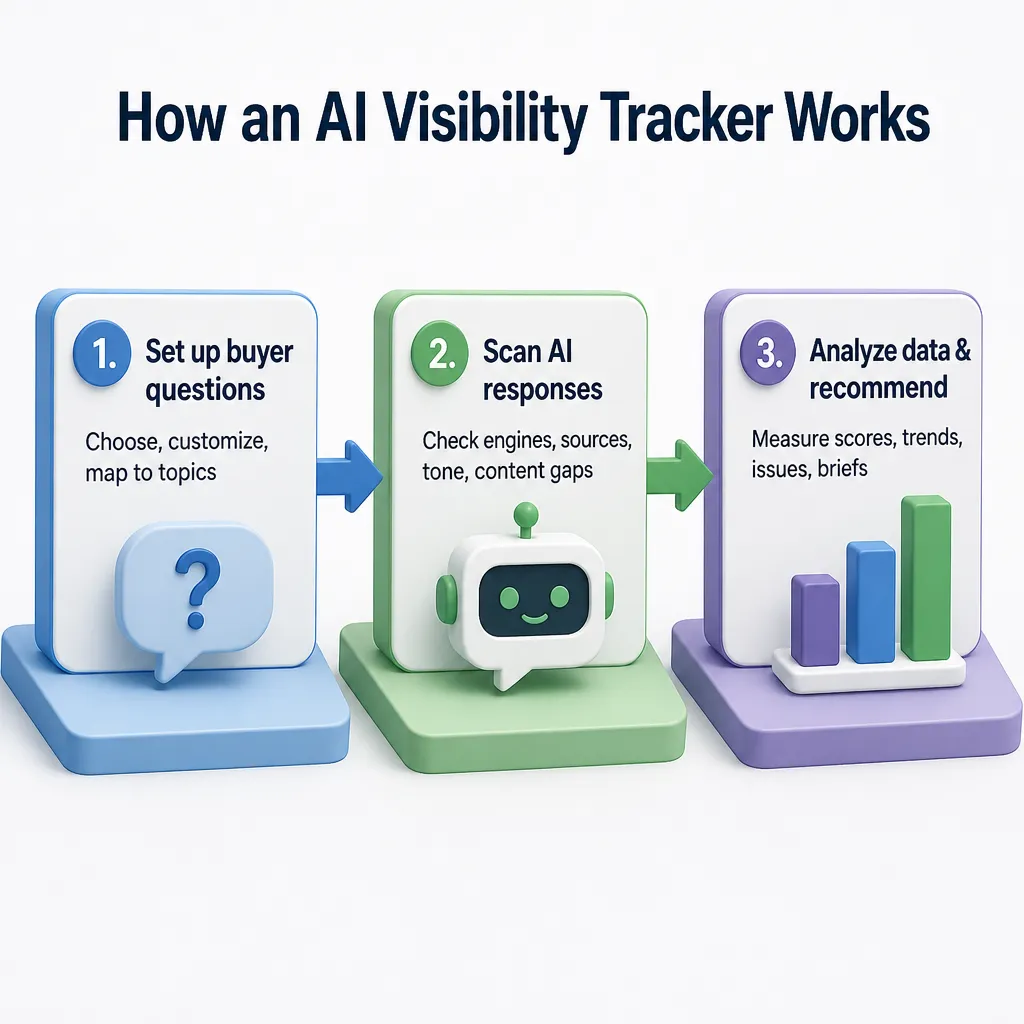
Setting up tracked buyer questions
An AI visibility tracker starts by letting you define buyer questions to monitor across AI platforms. SEOLadders, for example, allows tracking up to 30 questions, spread over five topics with six prompts each. The process involves:
- Choose business-critical questions: Prioritize queries your ideal buyers would ask, such as pricing or comparisons.
- Customize or edit tracked prompts: You can refine or replace questions as your business focus shifts.
- Map questions to pillar topics: Each tracked question lines up with your core content areas for relevance.
This step ensures all tracked data reflects real buying intent, improving coverage for both branded and competitive queries.
Scanning responses across machine learning models
AI visibility trackers systematically scan answers from multiple conversational AI engines to see if your brand is mentioned. SEOLadders tracks responses from ChatGPT, Claude, Gemini, Perplexity, Google AI Overview, and Google AI Mode. The system records:
- Which engines name your brand vs. competitors
- What sources are cited for each AI answer
- How AI frames your brand: positive, negative, or factual tone
- Content gaps: Where competitors appear, but you don’t
This scan provides a transparent view into which AI engines recognize your presence and where improvement is possible.
Analyzing real-time data and recommendations
AI visibility platforms analyze brand mentions, frequency, and sentiment across tracked engines to generate real-time recommendations. SEOLadders visualizes:
- AI Visibility Score and share of voice per engine
- Trends in mentions of your brand and competitors
- Flags for incorrect facts or negative sentiment repeated by multiple engines
- Monthly content briefs to fill gaps or correct misinformation
A combined dashboard presents prioritized actions so you can address weaknesses and track ongoing progress. For a closer look at the workflow, see how AI visibility tracking works.
Expert Insight: Setting up the right buyer questions directly impacts the quality and relevance of your AI visibility measurement—review these regularly as your business evolves.
When Should Businesses Use AI Visibility Tracking—And When Not?
Choosing when to invest in an AI visibility tracker depends on your goals, your competition, and whether traditional SEO covers your needs. This section unpacks the scenarios where AI visibility tools add unique value—and where they're unnecessary.
Best use cases for AI visibility tools
AI visibility trackers are essential for brands aiming to measure or increase their presence in AI-generated search results and citations. Businesses should consider these tools if:
- Your audience relies on conversational AI: If customers increasingly use platforms like ChatGPT, Gemini, or Google AI Overview to answer their questions, tracking AI citations is critical.
- You want to know which competitors AI prefers: Visibility tracking shows which brands AI surfaces most, letting you spot citation gaps.
- You need content strategies for AI search: AI trackers flag gaps where your brand isn't mentioned, so you can create new content or update existing pages.
- Brand accuracy and risk matter: These tools often reveal when AI answers cite incorrect or outdated facts about your business, allowing you to respond.
For teams building topical authority, AI visibility tracking features can be the missing link between ranking in classic search and being cited by cutting-edge AI models.
Situations where traditional SEO is enough
Traditional SEO alone is sufficient when your visibility depends only on classic search rankings and direct website traffic, rather than AI-generated answers. If your core channels are organic Google results, news sites, or direct navigation, focusing on:
- On-page optimization: Meta tags, headings, keyword placement, and consistent updates.
- Backlink building: Earning authoritative links in your industry.
- Performance and indexability: Site speed, mobile-friendliness, and accessibility.
These tactics will still drive traditional traffic and rankings. For brands not mentioned in AI answers and in industries where buyers don’t consult chatbots or generative platforms, conventional SEO methods remain a practical, cost-effective focus. There's no need to adopt AI tracking until your audience or sector shifts.
Warning: Adopting AI visibility tracking too early can divert resources from SEO fundamentals that still account for the bulk of web traffic in many industries.
AI Visibility Tracker vs Traditional Search Rank Tracking
Tracking your brand’s online presence now means looking beyond just search engine rankings. AI visibility trackers use a new set of measurements to show where and how your business appears across AI-generated answers.
Differences in data analytics and interpretability
AI visibility trackers provide broader, more contextual data than traditional rank trackers. Instead of listing a page’s search position for certain keywords, AI visibility systems analyze how often and in what context AI models mention your brand in their answers. For example, SEOLadders highlights which AI engines cite your business, the surrounding sentiment, and which competitors appear instead. This means analytics focus on narrative presence and trust signals, not just scoring a number. Typical workflows involve:
- AI-generated answer analysis: Tracks mentions and framing, not just ranking
- Sentiment and competitor mapping: Shows how brands compare and what narratives prevail
- Manual interpretability: Results often require teams to rethink outreach and content, since mention frequency doesn’t always equal traffic or conversion.
Types of metrics: brand mentions vs rank positions
Traditional rank trackers report keyword positions, while AI visibility trackers measure brand mentions across engines. In a standard SEO tool, users see where a web page ranks for a target keyword in Google or Bing. By contrast, a platform such as SEOLadders reports:
- Number of times a brand is mentioned in AI-generated answers
- Distinct AI engines making the mention (e.g., ChatGPT, Gemini)
- Source citations and co-mentioned brands
This shift reflects how buyers now consult AI for decisions, so mentions can drive influence even when page rank stays flat. Explore our AI Visibility Checker for a demo.
Tracking multiple engines vs Google only
AI visibility tracking solutions monitor several AI engines, while classic rank trackers usually focus on Google. SEOLadders checks brand citations and sentiment across ChatGPT, Gemini, Claude, Perplexity, Google AI Overview, and Google AI Mode. This multi-engine approach shows where a brand is recognized— or overlooked — as AI-powered platforms shape more buying journeys.
| Approach | Engines Tracked | Core Data |
|---|---|---|
| Traditional Rank Tool | Google (and maybe Bing) | Position for terms |
| AI Visibility Tracker | ChatGPT, Gemini, Claude, Perplexity, Google AI | Brand mentions, sentiment, citations |
For modern brands, this broader coverage can highlight opportunities or gaps missed by single-engine analytics.
Tip: Brand mention volume in AI is not a direct substitute for keyword ranking, so tie insights back to real conversions and leads when possible.
Common AI Visibility Tracking Mistakes
AI visibility tracking isn’t foolproof—brands frequently stumble over the same avoidable pitfalls. Being aware of these mistakes can help teams interpret data correctly and adapt their strategy as platforms change.
Focusing only on Google or a single model
Tracking only Google misses how buyers find information across multiple AI channels. If your ai visibility tracker monitors just Google or one AI assistant, you’ll overlook mentions and missed opportunities everywhere else. For example:
- Many users rely on multiple AI models—such as ChatGPT, Gemini, or Perplexity—for research.
- Visibility varies by engine: An answer that highlights your brand in Google might omit it in ChatGPT.
- Platform bias creeps in: Over-focusing on Google can distort content priorities and reporting.
For a more rounded view, leading trackers analyze performance across search engines and AI assistants. See how multichannel AI trackers work.
Misreading citation data or neglecting source checks
Misinterpreting which sources AI models cite can lead brands to overestimate their impact. Just because an AI answer mentions your brand doesn’t mean it draws information from your website or preferred content. Important considerations include:
- Real citations vs. mentions: Some tools count every mention, but only links to your site or authoritative pages move the needle.
- Source mismatches: AI may cite indirect sources, such as a news article or aggregator.
- Manual source checks: Teams should routinely review raw AI answers for accuracy. For a quick reference, try the AI Visibility Checker tool.
Skipping updates as algorithms evolve
Failing to adjust tracking as AI algorithms change can quickly make past visibility reports obsolete. AI models and search engines regularly alter how they aggregate sources, interpret prompts, or display answers. Key issues:
- Metrics shift over time: Tracking the same prompts each month doesn’t guarantee consistent reporting.
- Monitor algorithm updates: New answer formats can change how brands are surfaced—missing these means missing mentions.
- Refresh tracking strategies: Periodic review of both prompts and tracked models keeps analysis current. For ongoing best practices, see site health & optimization insights.
Expert Insight: Many brands misalign their tracking by focusing on easy-to-measure metrics, such as volume of AI mentions, rather than the quality and accuracy of citations. Prioritize nuanced visibility metrics over simple counts.
Frequently Asked Questions
Does AI visibility tracking replace classic SEO rank tracking?
AI visibility tracking does not replace classic SEO rank tracking; it complements it by monitoring brand presence across AI-driven platforms. SEOLadders integrates both approaches, tracking traditional rankings and AI citations to give a fuller picture of online visibility.
Which AI engines should businesses monitor for brand presence?
Businesses should monitor brand presence across six key AI engines: ChatGPT, Claude, Gemini, Perplexity, Google AI Overviews, and Google AI Mode. SEOLadders tracks these platforms to reveal brand mentions, competitor references, and content gaps in AI-generated answers.
How often should AI visibility scans be run?
AI visibility scans should be run continuously throughout the week to effectively track your brand's mentions across AI platforms. SEOLadders performs weekly rechecks on up to 30 buyer questions, enabling timely insights into AI visibility and content gaps.
Is AI tracker data reliable for small brands?
AI tracker data can be reliable for small brands when it monitors relevant AI platforms and buyer questions consistently, providing insight into brand mentions and gaps. SEOLadders tracks AI visibility across six AI engines, helping small brands see how AI cites their content and competitors, which supports informed SEO decisions.
Conclusion
SEOLadders stands out as the only all-in-one platform fully monitoring brand presence across six leading AI engines, plus offering daily AI answer tracking and actionable content prompts you won’t find elsewhere. If you want to know exactly where your business appears in AI-generated answers—and how to close the gaps—don’t rely on traditional rank trackers.
- Try the free AI Visibility Checker to see how often AI mentions your brand
- Add your most important buyer questions and compare yourself to competitors
- Start tracking your visibility and get new content suggestions based on actual AI gaps
Ready to measure your real footprint in AI search? Start my 3-day free trial and see SEOLadders in action today.

Samuel Kwesi Afriyie
Founder of SEOLadders
Samuel is a software engineer who builds SEOLadders, an AI SEO agent for Google and AI search. This site, including this blog, runs on it.
Want this done for you? SEOLadders finds the topics, writes the articles, and gets you cited by AI and ranking on Google, on autopilot.
3-day free trial · Cancel anytime