

Table of contents
TL;DR
- Defines ai generated content and fundamental terms
- Explains how AI-powered content creation works step by step
- Lists when automation works best—and when it doesn't
- Compares manual and AI-written content with a practical table
You’re staring at a blank doc, knowing your site needs more articles. But you barely have time to write one blog post a month. If you’re a founder or marketer working on a tight schedule, AI generated content might seem both promising and overwhelming.
AI generated content means articles, social posts, and other writing created by machine learning algorithms instead of humans. In this article, you will learn how AI generated content works. You will see when it can speed up your workflow and when it does not. You will also learn the biggest mistakes to avoid so your brand stays safe.
What Is ai generated content?
AI generated content includes a wide range of outputs created automatically by software across various media types. Examples include blog posts crafted to boost SEO, infographics designed to simplify complex data, and social media captions that engage audiences quickly. These real-world applications highlight how AI tools can produce diverse content that supports marketing and communication goals.
Natural language processing: foundation of AI writing
Natural language processing (NLP) is the technology that enables computers to interpret and produce human language. NLP combines computational linguistics with machine learning to recognize language patterns, context, and meaning. Modern AI content tools use NLP models to analyze input data—such as keywords or topics—and generate sentences that match natural human speech.
Key applications of NLP in AI content include:

Machine learning in text generation explained
Machine learning powers the pattern recognition and adaptability behind AI generated content. Unlike rule-based systems, machine learning models learn language structures from large datasets. They predict word sequences based on probabilities, enabling the output of original articles, product descriptions, or ad copy. This process allows the generation to mimic a range of voices and tones.
The typical machine learning workflow for text generation follows these steps:
Synthetic media and content automation basics
Synthetic media refers to any media—text, images, or audio—created by algorithms, and it's central to content automation. In practice, this means large volumes of articles, graphics, or even infographics can be produced with much less human input than traditional workflows. Content automation tools often use synthetic media for:
- Scalable article production for SEO or blogs
- Dynamic copywriting for ads and product pages
- Visuals and infographics generated by AI for illustrative content
Expert Insight: Automated content quality depends on the underlying NLP and training data. Not all AI outputs are ready to publish without significant editing.
How does ai generated content work?
AI generated content involves selecting relevant data, processing it through a trained model, and refining the output with human review to ensure quality and accuracy. A typical workflow starts with defining the content goals and gathering input materials—such as keywords, prompts, or source documents—that guide the model’s generation. Next, the model processes these inputs using advanced algorithms, producing draft text based on patterns learned from extensive datasets.
The output often requires iterative tuning, where parameters like temperature, max tokens, or repetition penalties are adjusted to control creativity, length, and coherence. For example, setting a lower temperature produces more focused and predictable text, while a higher one increases randomness. Once the model generates content, human editors review it for factual correctness, tone, and style alignment with the intended audience.
This combination of automated generation and manual refinement helps balance efficiency with quality. It’s essential to monitor for common issues such as hallucinations, bias, or irrelevant information, which can arise when the model interprets ambiguous input or overgeneralizes from training data. Overall, the process integrates technical control over model behavior with critical human oversight to produce polished, reliable content.
Step 1: Data input and keyword selection
Data input and keyword selection are the foundation of AI generated content. To begin, users provide prompts, topics, target keywords, or even entire knowledge bases that guide what the system produces. Modern SEO tools, like those listed in 10 Best AI Content Generator Tools for SEO Automation [2026], use keyword clustering and topic mapping so that content addresses demand while fitting a site’s authority themes.
Typical inputs include:
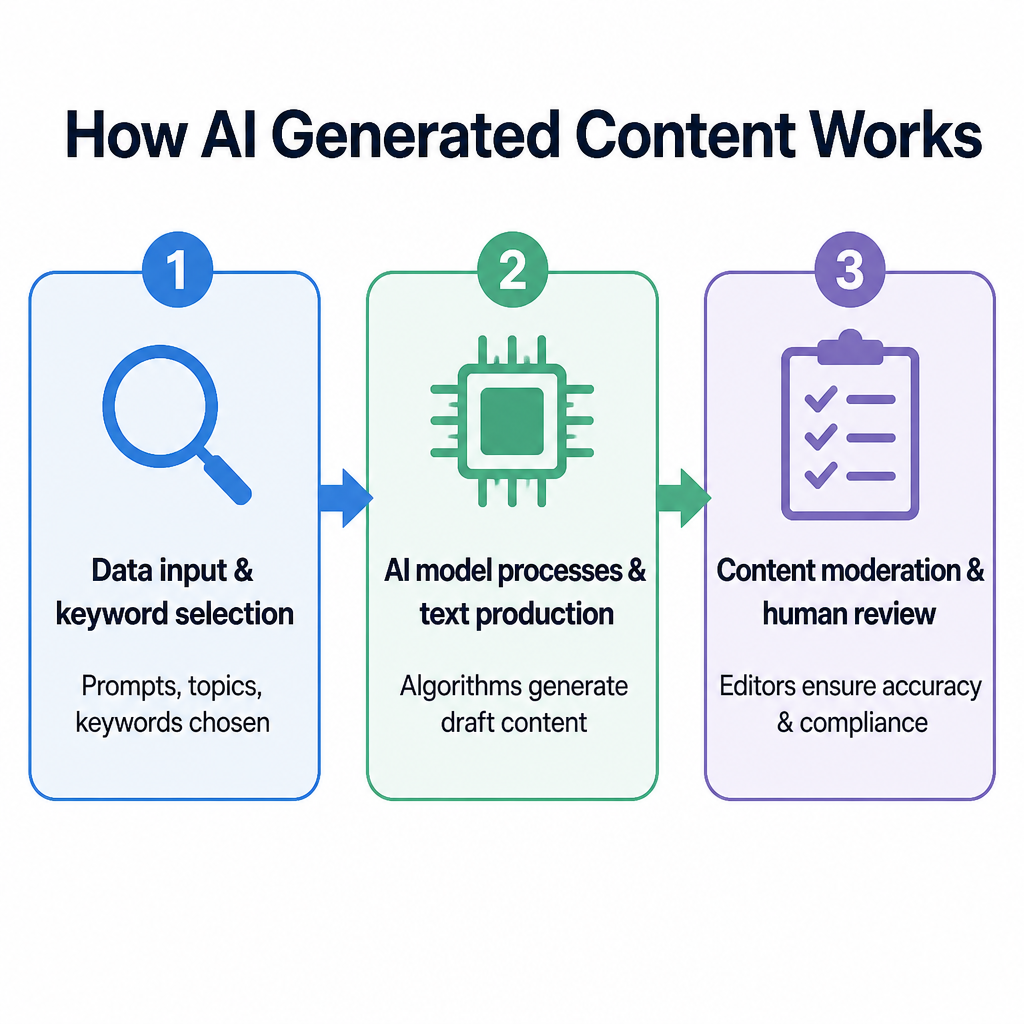
Step 2: AI model processes and text production
AI model processing transforms input data into readable text using advanced language algorithms. Once the goal and keywords are set, large language models (LLMs) generate drafts by analyzing patterns from massive training datasets, which may include online articles, product documentation, and summary facts. The models predict word sequences to match the input intent and tone.
The process frequently includes:
Step 3: Content moderation and human review
Content moderation and human review are essential to ensure accuracy, brand alignment, and compliance for AI generated content. Even the best models can introduce errors, off-brand language, or unintentional bias. Before publishing, drafts pass through review steps that may include in-house editors, automated checkers, or subject experts.
Key tasks in this step typically include:
Tip: Always use clear, specific prompts and verify outputs before publishing—this greatly limits errors and keeps AI driven content on target.
When to use ai generated content—and when not to
Knowing where AI-generated content excels—and where it falls short—helps teams balance efficiency with originality. Automation is a powerful tool, but it isn't a one-size-fits-all solution.
AI-generated content is increasingly detectable through a range of tools that analyze linguistic patterns, syntax, and statistical anomalies. Common flags include unnatural phrasing, repetitive structures, and inconsistencies in tone. While some tools effectively identify AI authorship, others struggle with more sophisticated or fine-tuned models, making detection uneven across different content types.
Legal and compliance considerations are especially important in regulated niches, such as YMYL (Your Money Your Life) topics. Content that impacts financial advice, healthcare, or legal decisions must adhere to strict accuracy, transparency, and ethical standards. Many regulations require human oversight or disclaimers when AI assists in creating content to prevent misinformation or harmful outcomes. Understanding these limitations is vital to ensure compliance and maintain trust with users.
Best use cases: SEO at scale, routine copy
AI generated content is most effective for scaling SEO content production and handling repeatable copywriting tasks. Businesses use AI to generate high-volume blog posts, product descriptions, and FAQs that cover a wide array of keywords and buyer questions. Many platforms—including those listed on 10 Best AI Content Generator Tools for SEO Automation [2026]—focus on automating routine tasks:
- Bulk content production for long-tail search intent
- Consistent formatting across articles
- Automated internal linking and schema markup
Where human creativity outshines automation
Human writers outperform AI when nuance, originality, or emotional resonance are critical. Tasks demanding narrative depth, brand storytelling, or humor still rely on skilled people, because AI models often produce average or formulaic outputs when unprompted. Consider these scenarios:
- Launching campaigns with a unique angle or voice
- Crafting thought leadership pieces that require novel insights
- Managing complex interviews or human-sourced storytelling
AI and deep learning for brand voice: limitations
AI generated content can mimic brand voice, but rarely captures nuance or adapts well to changing tone. Deep learning models match style and vocabulary to a provided sample, sometimes performing well for straightforward messaging. But persistent gaps appear in:
- Adapting tone for multiple audiences or channels
- Maintaining coherent voice across complex campaigns
- Infusing subtle humor or cultural context
Expert Insight: Small teams can use AI for first drafts or idea generation, then refine with in-house expertise for the most strategic content.
ai generated content vs manual writing: Which to choose?
Choosing between AI generated content and manual writing means weighing quality, cost, speed, and the needs of your business. Each method comes with different strengths and tradeoffs, which matter depending on your goals and resources.
Comparing quality, cost, and effort
Manual writing delivers tailored, high-context content but costs more and requires substantial time investment. AI generated content can produce large volumes of passable drafts quickly, often at a fraction of the cost per word, but may need careful review for nuance, accuracy, or brand voice. Editorial teams budgeting for high-quality thought leadership often prioritize expert writers, while marketers scaling content for SEO tend to favor AI solutions to save on labor and speed up delivery.
Top factors for comparison:
Speed and SEO performance differences
AI generated content is built for speed and consistent SEO structure, while manual writing is slower and can vary in search-readiness. Automated systems like SEOLadders produce daily articles mapped to SEO clusters, automate internal links, and fill content gaps in response to real search queries.
Who benefits most from each approach
High-volume marketing teams and solo founders benefit most from AI generated content, while brands aiming for unique insights still rely on manual writing. AI is a fit for:
- Startups with limited staff needing daily SEO articles
- Agencies scaling outreach for multiple clients
- Websites targeting a broad set of keywords quickly
Manual writing remains essential for:
- Niche industries with complex or regulated topics
- Brands requiring expert-level thought leadership
- Campaigns prioritizing original research and human storytelling
Expert Insight: Blending AI-generated content and manual writing often delivers the best results—AI covers routine topics at scale, while human writers focus on high-value pieces that require deeper insight or creativity.
Common ai generated content mistakes
Even the most advanced AI-generated content strategies are prone to avoidable pitfalls that can undermine SEO and brand integrity if not carefully managed. Beyond common errors like factual inaccuracies or awkward phrasing, more sophisticated challenges are emerging. Google increasingly detects AI-generated content, impacting rankings as search algorithms prioritize originality and human value. This leads to greater volatility in Search Engine Results Pages (SERPs), with AI-written articles sometimes ranking well initially but losing visibility over time.
Maintaining quality also requires updating old AI-generated content regularly to keep it relevant and authoritative. Static AI content can quickly become outdated, reducing traffic and engagement. Therefore, integrating ongoing review and revision processes is essential to sustain SEO benefits and brand trust as AI-generated content continues to evolve.
Over-reliance on automation: Bland or off-brand output
Too much dependence on AI-generated content often results in generic, repetitive, or off-brand writing that fails to connect with target audiences. AI models learn from huge data sets, but they can't always capture the subtle details of your brand’s voice or adapt messaging to changing business needs.
Teams that publish every draft as delivered, without meaningful editing, risk losing brand identity. Signs include:
Neglecting content moderation: Risk of errors or bias
Publishing AI content without human oversight exposes brands to factual errors, data hallucinations, or unintentional bias. Even leading AI models can deliver plausible-sounding but inaccurate information.
Common issues include:
- Incorrect product details or pricing (often scraped from outdated sources)
- Out-of-context statistics attributed without proper sourcing
- Subtle bias reflected in phrasing or examples the model selects
Best practice is to fact-check every AI-generated piece before it goes live.
Ignoring ethical guidelines in synthetic media
Neglecting ethical standards in synthetic content increases the risk of spreading misinformation, violating copyrights, or using imagery without consent. As generative models create more text, images, and even video, transparency and responsibility matter more than ever.
Key care points:
- Label AI-generated content to avoid misleading users
- Respect content rights (no copying text or images you can't share)
- Disclose citations and sources for any referenced claims
Warning: Relying entirely on AI output without editing or ethical checks can damage your brand’s credibility and search rankings.
Frequently Asked Questions
What is ai generated content and how is it created?
AI generated content is text, images, or media produced by artificial intelligence tools using data and algorithms. It is created by AI analyzing relevant topics and audience needs, then automatically generating optimized articles with images, links, and citations. SEOLadders automates this process for SEO by researching keywords, writing brand-voice content, and managing publishing, all designed to improve search and AI visibility.
Does ai generated content replace human editors?
AI-generated content does not replace human editors; instead, it assists by producing drafts and automating routine SEO tasks. Human editors remain essential to review, validate facts, ensure brand voice accuracy, and approve final content before publishing. Tools like SEOLadders automate writing and SEO but keep editorial control with users to maintain quality and factual correctness.
Where does ai generated content fail to deliver?
AI-generated content often fails to deliver in nuanced understanding, emotional depth, and original insights that require human experience. It may also produce inaccuracies that need editorial review. Solutions like SEOLadders address these gaps by combining AI efficiency with human editorial control, ensuring content is accurate, brand-aligned, and SEO-optimized.
How does SEOLadders support ai content creation for SEO?
SEOLadders automates the entire AI content creation process for SEO by researching keywords, planning topics, writing 30 optimized articles monthly in your brand voice, and publishing them directly to platforms like WordPress or Ghost. Each article includes images, internal links, citations, and FAQ schema, ensuring content is tailored for search engines and AI visibility.
Are there risks in publishing only automated content?
Yes, publishing only automated content can pose risks such as lack of unique brand voice, potential factual errors, and reduced editorial oversight which may affect credibility and SEO performance. SEOLadders addresses this by ensuring content is written in your brand voice, includes cited authoritative sources, and you retain full editorial control before publishing, mitigating these risks.
Conclusion
AI generated content can save time while supporting growth when applied with clear judgment. Start by identifying topics suited for AI and those requiring human expertise. Regularly audit your content for gaps or repetition, and set review steps to ensure accuracy and consistency with your brand voice. The next wave of content growth is here—use it strategically to advance your business, not just to fill space.
Ready to see how AI can write real articles for your brand? See how articles are written and discover what a fully automated workflow looks like in action.

Samuel Kwesi Afriyie
Founder of SEOLadders
Samuel is a software engineer who builds SEOLadders, an AI SEO agent for Google and AI search. This site, including this blog, runs on it.
Want this done for you? SEOLadders finds the topics, writes the articles, and gets you cited by AI and ranking on Google, on autopilot.
3-day free trial · Cancel anytime