
Table of contents
TL;DR
- Start with keyword research focused on intent.
- Use SEO tools to filter by difficulty and search volume.
- Prioritize keywords your competitors ignore.
- Check long tail keyword relevance for your site.
You spend hours brainstorming blog ideas, but your content barely moves the needle. If you’re a website owner or digital marketer, it’s incredibly frustrating to watch your traffic stall while big competitors grab all the search real estate.
This guide breaks down exactly how to find low competition long tail keywords—those hidden gems that actually drive results. You’ll learn what these keywords are, why they outperform broad terms, which tools work best for discovery, and how to filter and build a list you can rank for with confidence.
What Are Low Competition Long Tail Keywords?
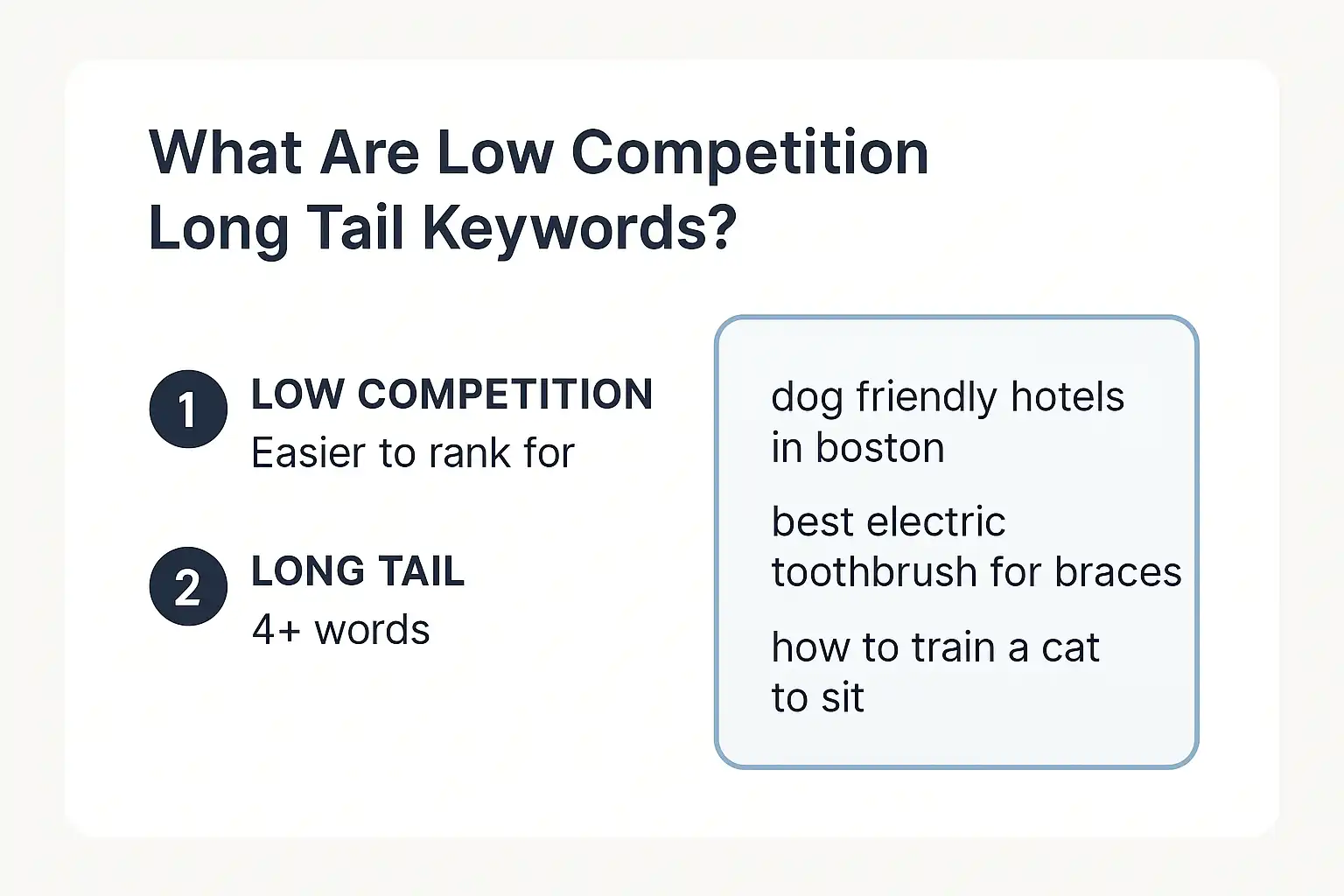
Low competition long tail keywords help sites rank in search results with less effort. These keywords target precise user intent, making them both easier to rank for and more likely to convert—especially if you're starting out or have a newer site.
Definition and Key Criteria
"Low competition long tail keywords" are keyword phrases, usually three or more words, that have lower search volume but face less competition in the search results. According to CloudySky, long tail keywords often target specific queries rather than broad topics, making them more accessible for smaller sites or new content. From experience, teams often hit a wall when pushing for broad terms, but find traction and traffic quickly by focusing on highly defined long tail variations. The essentials? Fewer competing pages, high specificity, and direct alignment with what a user is likely to type into Google. Why does this matter? Because these keywords tend to attract visitors who know exactly what they want—often leading to higher engagement or conversions. If you're interested in how automation can speed up this process, see keyword research for approaches built around low-competition terms.
Why it matters:
- Easier to rank for with limited backlinks
- Drives targeted, ready-to-act traffic
- Less resource-intensive for new or smaller sites
Related Terminology: Search Volume and Difficulty
"Search volume" is the estimated monthly number of searches for a keyword, while "keyword difficulty" measures how hard it is to rank for that keyword. Most tools give you these as numeric values. When looking for low competition long tail keywords, the sweet spot involves phrases with modest volume and the lowest attainable difficulty score. In practice, choosing a target that's too broad (high volume, high difficulty) means you'll likely be outranked by larger domains—something many teams learn the hard way. On the flip side, a keyword with very low difficulty but no volume might not send any traffic. The art lies in balancing both metrics for your site's current level. To experiment with real search volume and difficulty filters, try a resource like the Keyword Ideas tool.
Why Intent Matters
Search intent is the purpose behind a user’s query, and for long tail keywords, matching this intent makes all the difference. Honestly, this one surprised us in client work: Two keywords might look nearly identical, but only one drives qualified leads because it matches what users actually want. According to OptinMonster, understanding intent increases your chances of creating content that ranks and converts. Focus on queries with clear commercial or transactional intent when you want to drive signups or sales—those specific, low competition variants are often hidden gems. For more on intent-driven keyword targeting, see keyword research methods that prioritize what your visitors are truly searching for.
Expert Insight: Long tail keywords often require more initial brainstorming and refinement, but even one small win can propel your site’s organic growth much faster than chasing generic terms.
Why Long Tail Keywords Beat High Search Volume Terms
Long tail keywords consistently outperform high-volume keywords for most non-authority sites looking to rank in search. Understanding why these highly specific phrases win is critical if you want practical wins instead of endless competition for impossible targets.
Key Benefits for Ranking
Long tail keywords are easier to rank for because they attract less competition and match user intent more closely. According to Winsby Inc., targeting low-volume phrases allows new sites to establish visibility where they can realistically rank, rather than getting buried by sites with higher domain authority. A smaller search volume can mean higher conversion rates, since searchers are usually further along in their buying journey.
In practice, focusing on long tail terms means your content is more likely to appear near the top of search results, especially for queries where big brands haven't bothered to optimize. We’ve seen teams achieve consistent growth with this strategy—even when starting with nearly zero domain strength. For tactical expansion, using a smart keyword research approach helps identify these opportunities fast.
When to Use Long Tail Keywords
Long tail keywords are the best choice when you're building authority and don't have the resources to compete for broader terms. The sweet spot: use them when your domain authority is lower than most competitors in your niche, or if you want to generate results quickly while building topical depth.
Teams often find long tail strategies work well for:
- Launching a new blog or product
- Entering a market with established competitors
- Ranking for voice or question-based queries
If you're not sure exactly when to switch from broad keywords, tools that sort by difficulty (like the Keyword Ideas tool) can help you pinpoint realistic targets.
Common Misconceptions (And What Actually Works)
A common misconception is that only high search volume terms drive meaningful traffic. In reality, "high intent" long tail keywords can deliver steady visitors if chosen wisely. Some believe using hundreds of low-competition keywords won’t scale—but distributed rankings across many long tails often outperform a few competitive wins.
Another pitfall: expecting immediate results from just adding long phrases randomly. What works is methodical research and mapping to true user intent. Don’t overlook the impact of matching each page to a narrowly defined search—this matters more than most guides suggest. For deeper learning, explore content automation strategies that prioritize topic clusters rather than headline volume alone.
Expert Insight: Long tail keywords rarely stay low competition forever—early movers lock in rankings before larger sites notice the opportunity.
What Tools Help You Find Low Competition Keywords?
Finding low competition long tail keywords is easier with the right mix of free and paid SEO tools. But not every tool gives you the same data or filtering power—choosing wisely helps you save time and spot real ranking opportunities.
Overview: Free vs Paid SEO Tools
The main distinction between free and paid SEO tools is the depth and reliability of their keyword data. Free keyword tools like Google Keyword Planner or the Keyword Ideas generator can surface valuable long tail queries, but typically offer limited difficulty scores and daily usage caps. Paid platforms provide more advanced filtering, competitor data, and actionable metrics specific to your domain rating. According to RoseHosting, targeting lower-competition keywords can be much easier when your tool lets you sort by difficulty. In practice, free tools may work for early research, but scaling your process or running competitor analysis often requires moving to a premium platform. The gap between basic keyword discovery and actionable search analysis is significant—especially if you want to outrank established domains.
How to Use SEO Ladders for Smart Filtering
"SEO Ladders is an automated keyword research platform that filters long tail keywords by competition and domain match." The key feature is its ability to set a realistic difficulty cap based on your current authority—so you focus on terms you're likely to rank for, not just high volume dreams. Smart filtering means:
- Filtering out branded or irrelevant queries
- Matching keyword difficulty to your site's domain rating
- Auto-grouping by search intent and buyer journey
Teams often find that most manual tools flood you with data but little context. With SEO Ladders’ AI-driven keyword research, you cut straight to winnable topics and can even automate content creation. For high-volume sites, this approach beats hours of spreadsheet wrangling every time.
Comparing Popular Tools: What We've Seen
Popular paid SEO tools—like those from Ahrefs, Semrush, or SEO Ladders—tend to agree on baseline metrics, but practical differences show up in filtering, automation, and ease of use. Each has its quirks:
| Platform | Bulk Difficulty Filter | Competitor Insights | Smart Grouping |
|---|---|---|---|
| Ahrefs | ✅ | ✅ | ❌ |
| Semrush | ✅ | ✅ | ❌ |
| SEO Ladders | ✅ | ✅ | ✅ |
Honestly, the difference is real: some tools require hours checking each keyword by hand. Others, like SEO Ladders, combine filtering, grouping, and auto-publishing into one process—see content automation for a closer look. Your mileage may vary, but workflow speed and result quality matter more than most guides suggest.
Expert Insight: If you’re on a tight budget, start with free tools to practice filtering and watch for actual ranking movement—then upgrade only when limits begin holding you back.
How to Filter and Validate Keyword Opportunities
Not every keyword is worth your time. To get real results, filter for opportunities where your site can actually compete. Here’s how to quickly identify strong candidates and make sure you’re targeting the right long tail keywords.
Check Search Volume and Difficulty Scores
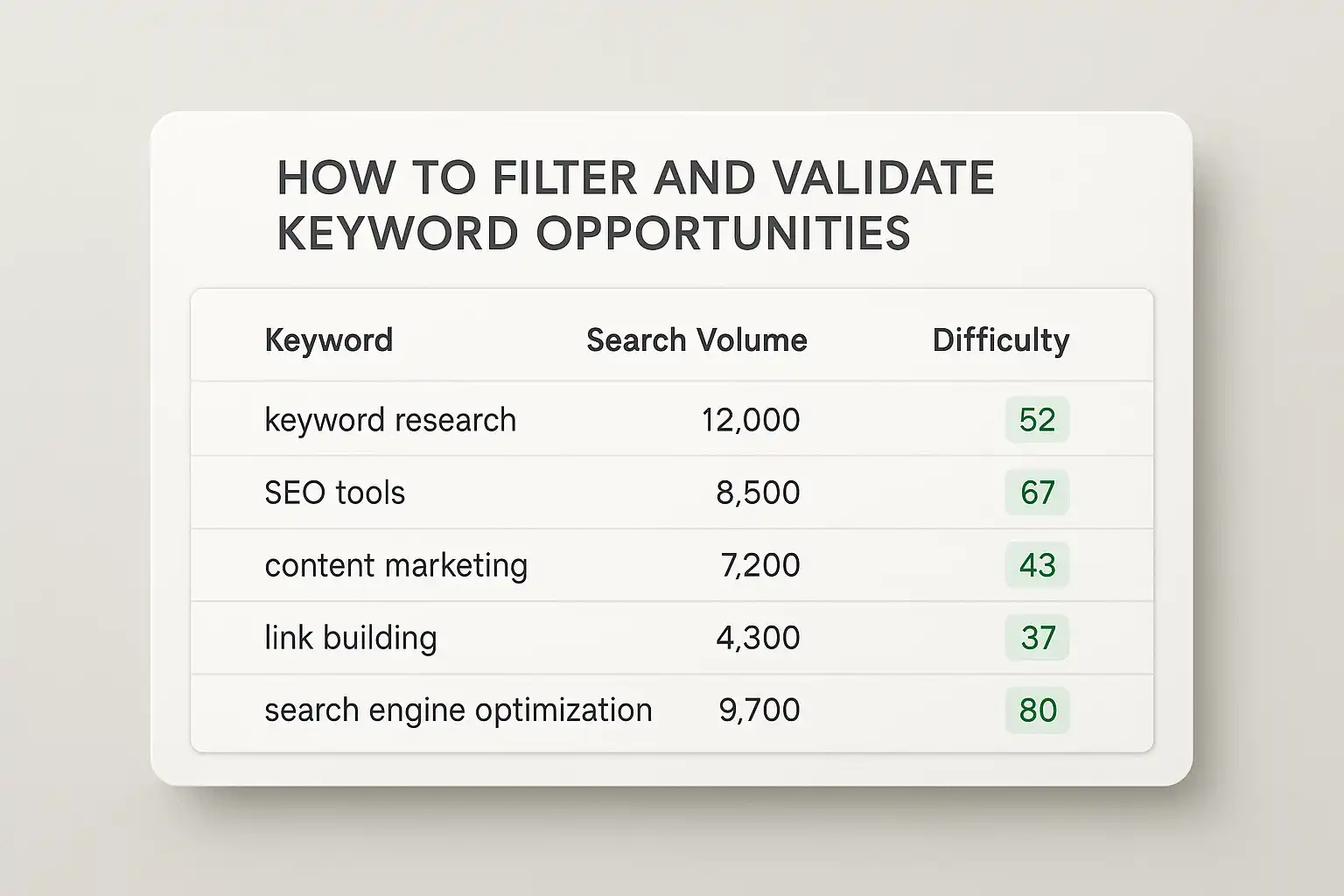
Keyword research always starts with assessing basic metrics: search volume and keyword difficulty both indicate if a term deserves a spot on your SEO list. Tools like the Keyword Ideas generator provide these numbers for each suggestion.
- Search volume shows how many users look for the term each month.
- Difficulty score estimates competition based on current top-ranking sites, backlink strength, and SERP diversity.
According to Class Central, prioritizing keywords with lower difficulty scores dramatically raises your odds of ranking, especially if your site isn’t among the biggest players yet. In practice, teams often find that keywords with even modest search volume can drive serious results—if their difficulty is manageable for your current authority.
Assess Competitor Keyword Overlap
Checking what keywords your competitors rank for reveals where windows of opportunity exist. Competitor keyword overlap is the degree to which other sites already target or rank for the same phrase. The goal: find gaps where strong keyword volume exists, but your direct competition hasn’t fully capitalized.
You can use tools that show competitor positions and compare their keyword footprint to your target list. Sometimes the big players ignore ultra-specific queries, giving smaller or newer sites a real chance. For more on actionable workflows, the Ranked Keywords tool makes gap analysis straightforward and even highlights keywords where your competitors succeed but you haven’t appeared yet.
Evaluate SERP Intent and Relevance
Evaluating search intent and relevance ensures a keyword actually matches what your potential audience wants. SERP intent is how Google interprets a searcher’s goal (informational, commercial, transactional, or navigational).
Scan the live results for your target keyword. Are top results answering questions, selling products, or showing guides? If your content format doesn’t fit what’s ranking, your chances drop—no matter how low the competition. Sometimes, what looks winnable by the numbers turns out irrelevant on closer inspection. Ensuring you match content type and intent makes every keyword you choose more likely to bring qualified traffic.
Tip: Filtering out keywords that don’t genuinely fit your audience’s intent is just as important as checking volume and difficulty—don’t skip this step, even if it’s time-consuming.
What’s the Step-by-Step Process to Build a Winning Keyword List?
Building a strategic keyword list isn’t about volume alone—it’s about relevance, achievability, and alignment with your site’s goals. Here’s how experienced SEOs systematically find low competition long tail keywords that deliver results.
1. Choose a Seed Topic and Expand
Choosing a seed topic creates the foundation for all keyword research efforts. Start with a main subject closely related to your offering or expertise—think of core services, product categories, or customer pain points.
To expand your list, use keyword tools (like the free Keyword Ideas generator) to brainstorm related questions, synonyms, and subtopics. Brainstorming as a team sometimes surfaces surprising themes that competitors overlook. In practice, teams often get stuck either too broad or too niche. Iterating on the seed’s relevance helps avoid lists filled with either untargeted or unrankable terms.
- Example flow:
- Pick a seed (e.g., "organic pet food")
- Use keyword tools for automatic expansions
- Check ‘People Also Ask’ or related searches
Why it matters:
- Every keyword list is only as strong as the seed topics you choose; irrelevant seeds usually lead to wasted effort.
2. Screen for Competition and Intent
Screening for competition and intent ensures you only pursue keywords with a genuine shot at ranking and converting. "Low competition keywords" are queries with fewer strong sites in the top results and have attainable difficulty for newer or less authoritative sites.
Check keyword metrics—difficulty scores, current ranking sites, and visible intent (informational, transactional, etc.). For example, tools like See keyword research automate filtering by domain authority and intent, saving manual sifting time. The best lists skip high-difficulty and vague-intent terms that clog many spreadsheets.
In practice, it’s easy to obsess over low difficulty only to miss intent. If a keyword’s search results pull up product pages but your content type is educational, that’s a mismatch.
3. Finalize, Prioritize, and Track Progress
Finalizing a keyword list means selecting terms that are relevant, achievable, and align with business priorities. Prioritization is based on intent, competition, and your ability to provide value—not just search volume.
Once chosen, tracking keyword progress is required to adjust strategy fast. Tools like the Topical Authority feature let you see which terms move up the SERPs, where you’re stuck, and which low-competition gaps remain.
A common pitfall: not pruning underperforming terms or set-and-forget lists. Continuous review and updating mean your content stays aligned with evolving search trends and new ranking opportunities.
Expert Insight: Always test seed keywords with a quick SERP check—sometimes, a phrase looks promising in tools but is dominated by big brands or doesn’t fit your intent.
Frequently Asked Questions
What exactly counts as a 'low competition' keyword?
A 'low competition' keyword typically has a low difficulty score (often under 10-20), indicating fewer websites compete to rank for it. These keywords are easier to rank for, especially if your site authority aligns with the keyword's challenge. Identifying such keywords, especially long-tail ones, helps target niche audiences with higher chances of ranking. Tools like SEO Ladders automatically find these realistic keyword opportunities matched to your domain authority.
Should I ignore keywords with low search volume?
You shouldn't ignore low search volume keywords because they often have low competition and high intent, making them easier to rank for. These long-tail keywords can attract more targeted traffic and lead to better conversions. Tools like SEO Ladders help identify such keywords matched to your site's authority, maximizing your content's ranking potential without chasing unrealistic volumes.
How do I know if a long tail keyword is truly relevant?
A long tail keyword is truly relevant if it closely matches your content topic and audience intent, has sufficient search volume, and low competition. Check if it's specific to your niche and aligns well with what your target users are searching for. Tools like SEO Ladders can help identify such keywords by analyzing your domain authority and filtering for achievable, relevant keywords.
Are free SEO tools good enough for keyword research?
Free SEO tools can be useful for initial keyword research, especially when searching for low competition long-tail keywords, but they may lack advanced features and accuracy. They often provide basic data like search volume and difficulty but might miss deeper competitor insights. For best results, tools like SEO Ladders offer AI-driven keyword research tailored to your domain authority, helping find realistic ranking opportunities more efficiently.
Is targeting only long tail keywords enough for traffic growth?
Targeting only long tail keywords can drive steady, low-competition traffic but may limit overall growth potential due to their typically lower search volumes. Combining long tail keywords with some higher-volume, relevant terms creates a balanced strategy for sustainable traffic growth. Tools like SEO Ladders help identify the right mix by matching keywords to your domain authority and automating content creation, maximizing growth opportunities.
Conclusion
Smart keyword research unlocks real growth when you tap into low competition long tail keywords tailored to your strengths. Here’s how you can put this into practice today:
- Pick a topic cluster and generate a list of seed keyword ideas specific to your audience.
- Run your list through keyword research tools and pull any promising long tail variants.
- Filter results by realistic difficulty scores and check the SERPs for weak or non-authoritative competition.
- Validate your short-list and map each keyword to dedicated, search-intent-matched content.
The sooner you focus on winnable keywords, the sooner you’ll see traffic and leads rolling in. ↑ Back to top
Ready to turn research into rankings? Start for free and let SEO Ladders uncover high-converting, low competition keywords for your site—fast.
Want this done for you? SEOLadders finds the topics, writes the articles, and gets you cited by AI and ranking on Google, on autopilot.
7-day free trial · Cancel anytime